
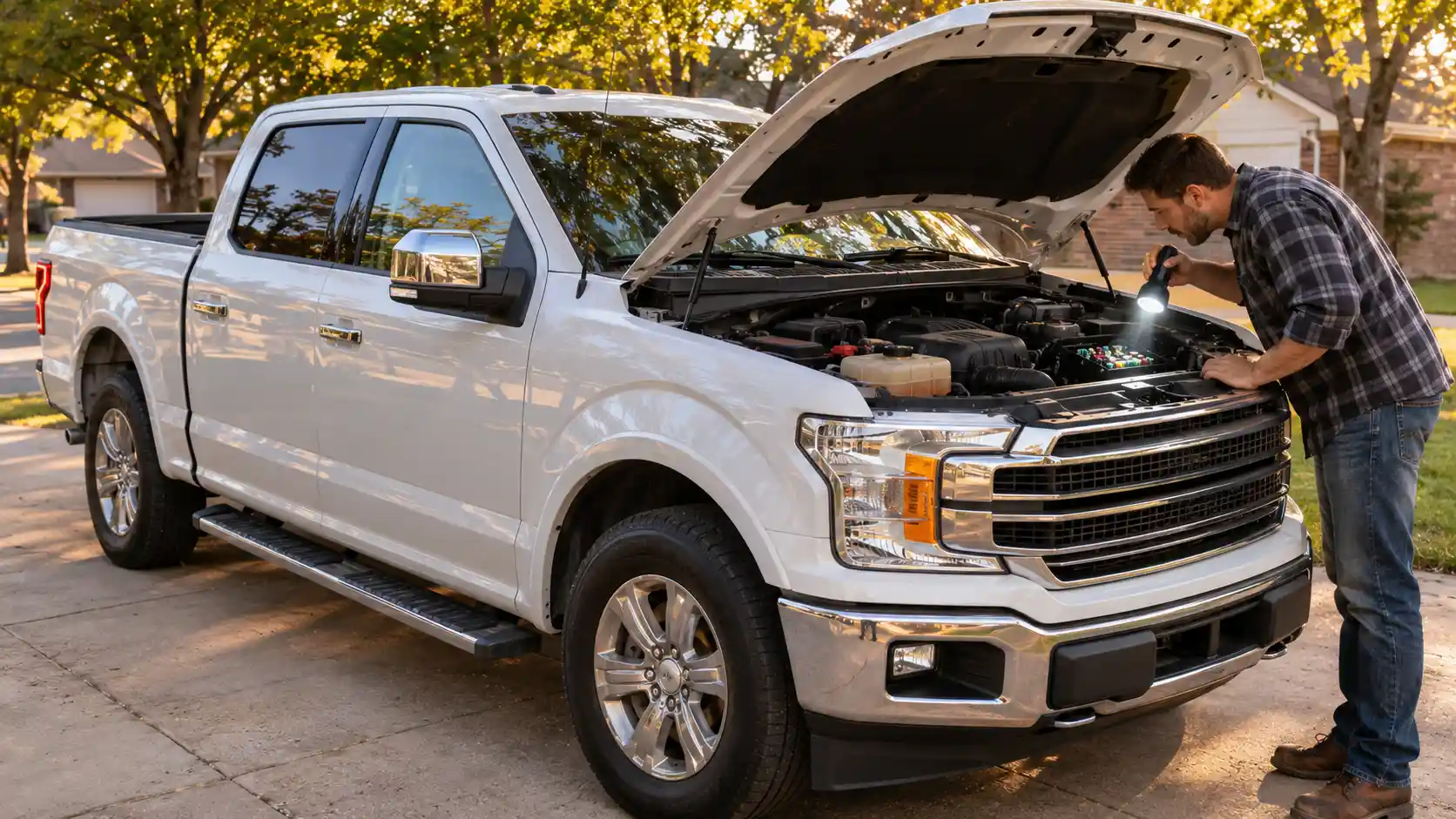
A 2015–2020 Ford F-150 has two fuse boxes: the passenger compartment fuse panel on the right-hand side of the passenger footwell, behind a trim panel, and the power distribution box under the hood. The cabin panel kept the same layout for all six years, but Ford completely renumbered the under-hood box for 2018, so a 2015–2017 under-hood chart won’t match a 2018–2020 truck.
That renumbering is the reason so many owners end up pulling the wrong fuse. On a 2017 the horn is under-hood fuse 43; on a 2018 it’s fuse 1. The power points, fuel pump, starter and trailer fuses all moved too.
If you have a different year, use our F-150 fuse box diagram for every year, or go back one generation to the 2009–2014 F-150 fuse box diagram.
This generation covers the 2.7L and 3.5L EcoBoost, the 3.5L and 3.3L V6, the 5.0L V8, the 3.0L Power Stroke diesel (2018–2020) and the Raptor. A few under-hood fuses change rating by engine, and the tables mark each one.
Find your year
| Jump to | Covers |
|---|---|
| Cabin fuse panel 2015–2020 | Passenger footwell panel, same layout all six years |
| Under-hood box 2015–2016 | Original numbering: fuses and relays |
| 2017 under-hood changes | Same layout as 2015–2016, plus new fuses (Raptor, extra fuel pump fuse) |
| Under-hood box 2018–2020 | Renumbered, including diesel rows |
| Quick reference | The most-searched fuses for all six years in one table |
F-150 fuse box location (2015–2020)
The 2018 F150 fuse box location is the same as the 2015 and 2016 F150 fuse box location: one panel in the passenger footwell and one box under the hood. Only the numbering inside the under-hood box changed.
Passenger compartment fuse panel (passenger footwell)
This panel holds the lower-current fuses for the radio, tailgate release, door locks, door control modules, trailer brake control input and the run/start relay. It works alongside the body control module, which the under-hood box feeds.
- Turn the ignition off.
- Open the passenger door and find the trim panel on the right-hand side of the footwell.
- Remove the trim panel: pull it toward you, then swing it away from the side.
- Remove the fuse cover: press in the tabs on both sides and pull it off.
- To refit the cover, place the top part on first, push the bottom until it latches, then tug gently to check it’s secure.
Power distribution box (under the hood)
The under-hood box holds the power points, fuel pump, starter, blower motor, wipers, horn and trailer tow fuses, plus most relays.
- Open the hood and find the power distribution box in the engine compartment.
- Release the lid and lift it off.
- Use the table for your year below: 2015–2016, 2017 or 2018–2020.
Quick reference: most-searched F-150 fuses by year
“PDB” = power distribution box under the hood. “Cabin” = passenger compartment panel.
| Circuit | 2015–2016 | 2017 | 2018–2020 |
|---|---|---|---|
| Cigar lighter / power point 1 | PDB 89 (20A) | PDB 89 (20A) | PDB 6 (20A) |
| Power point 2 | PDB 90 (20A) | PDB 90 (20A) | PDB 8 (20A) |
| Power point 3 | PDB 91 (20A) | PDB 91 (20A) | PDB 51 (20A) |
| Power point 4 | PDB 92 (20A) | PDB 92 (20A) | — |
| USB smart charger | — | — | PDB 58 (5A) |
| Radio | Cabin 33 (20A) | Cabin 33 (20A) | Cabin 33 (20A) |
| Amplifier | PDB 14 (20A) | PDB 14 (20A) | PDB 22 (20A) |
| Horn | PDB 43 (25A) | PDB 43 (25A) | PDB 1 (25A) |
| Fuel pump | PDB 56 (20A) | PDB 9 (30A) and 56 (20A) | PDB 50 (30A) |
| Starter | PDB 59 (30A) | PDB 59 (30A) | PDB 5 (30A) |
| Blower motor | PDB 60 (40A) | PDB 60 (40A) | PDB 20 (40A) |
| Windshield wipers | PDB 22 (30A) | PDB 22 (30A) | PDB 3 (30A) |
| Heated rear window | PDB 5 (40A) | PDB 5 (40A) | PDB 99 (40A) |
| Tailgate release | Cabin 16 (15A) | Cabin 16 (15A) | Cabin 16 (15A) |
| Trailer brake controller | PDB 49 (30A) + cabin 4 (5A) | PDB 49 (30A) + cabin 4 (5A) | PDB 24 (30A) + cabin 4 (5A) |
| Trailer tow park lamps | PDB 34 (25A) | PDB 34 (25A) | PDB 53 (25A) |
| Trailer tow stop/turn | PDB 35 (20A) | PDB 35 (20A) | PDB 103 (20A) |
| Trailer tow back-up lamps | PDB 87 (10A) | PDB 87 (10A) | PDB 74 (10A) |
| Trailer tow battery charge | not listed in chart | not listed in chart | PDB 30 (25A) |
| 4×4 | PDB 15 and 72 (25A) | PDB 15 and 72 (25A) | PDB 71 and 63 (25A), 29 (10A solenoid) |
The cabin fuses (radio 33, tailgate 16, trailer brake 4) never moved. Every under-hood fuse in this table moved in 2018.
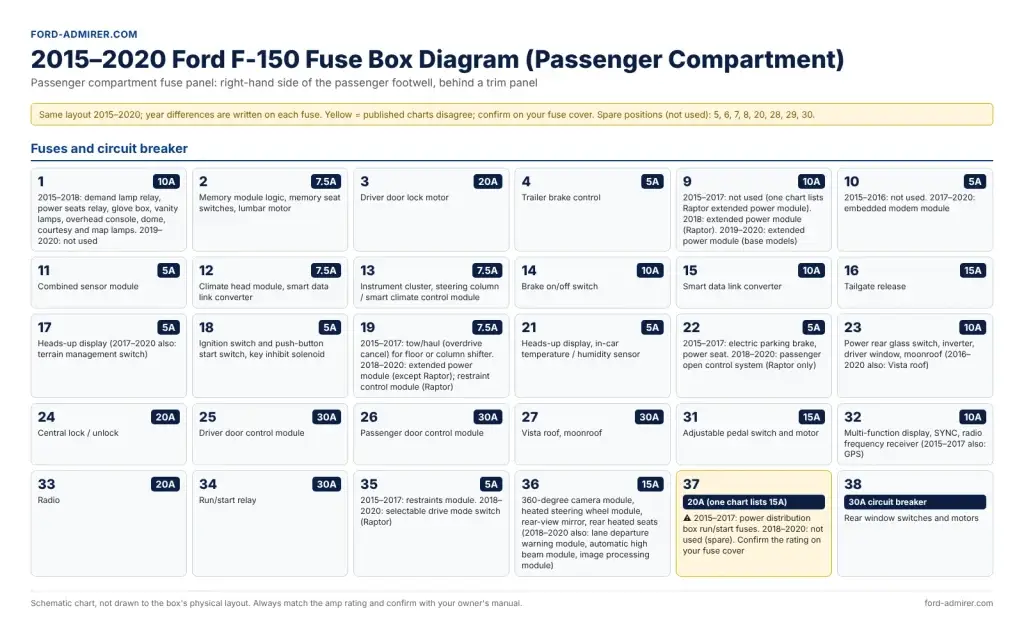
2015–2020 F-150 fuse box diagram: passenger compartment panel
This 2018 F150 fuse panel diagram for the cabin also fits 2015, 2016, 2017, 2019 and 2020 trucks. The layout never changed; where a fuse’s job changed by year, the row says so. Examples: fuse 10 feeds the embedded modem from 2017, fuse 19 switches from tow/haul to the extended power module for 2018, and fuse 1 is unused on 2019–2020.
One row is marked ⚠️ because published charts disagree on its rating.
| Fuse | Amps | Circuits protected |
|---|---|---|
| 1 | 10A | 2015–2018: demand lamp relay, power seats relay, glove box, vanity lamps, overhead console, dome, courtesy and map lamps. 2019–2020: not used |
| 2 | 7.5A | Memory module logic, memory seat switches, lumbar motor |
| 3 | 20A | Driver door lock motor |
| 4 | 5A | Trailer brake control |
| 9 | 10A | 2015–2017: not used (one chart lists Raptor extended power module). 2018: extended power module (Raptor). 2019–2020: extended power module (base models) |
| 10 | 5A | 2015–2016: not used. 2017–2020: embedded modem module |
| 11 | 5A | Combined sensor module |
| 12 | 7.5A | Climate head module, smart data link converter |
| 13 | 7.5A | Instrument cluster, steering column / smart climate control module |
| 14 | 10A | Brake on/off switch |
| 15 | 10A | Smart data link converter |
| 16 | 15A | Tailgate release |
| 17 | 5A | Heads-up display (2017–2020 also: terrain management switch) |
| 18 | 5A | Ignition switch and push-button start switch, key inhibit solenoid |
| 19 | 7.5A | 2015–2017: tow/haul (overdrive cancel) for floor or column shifter. 2018–2020: extended power module (except Raptor); restraint control module (Raptor) |
| 21 | 5A | Heads-up display, in-car temperature / humidity sensor |
| 22 | 5A | 2015–2017: electric parking brake, power seat. 2018–2020: passenger open control system (Raptor only) |
| 23 | 10A | Power rear glass switch, inverter, driver window, moonroof (2016–2020 also: Vista roof) |
| 24 | 20A | Central lock / unlock |
| 25 | 30A | Driver door control module |
| 26 | 30A | Passenger door control module |
| 27 | 30A | Vista roof, moonroof |
| 31 | 15A | Adjustable pedal switch and motor |
| 32 | 10A | Multi-function display, SYNC, radio frequency receiver (2015–2017 also: GPS) |
| 33 | 20A | Radio |
| 34 | 30A | Run/start relay |
| 35 | 5A | 2015–2017: restraints module. 2018–2020: selectable drive mode switch (Raptor) |
| 36 | 15A | 360-degree camera module, heated steering wheel module, rear-view mirror, rear heated seats (2018–2020 also: lane departure warning module, automatic high beam module, image processing module) |
| 37 ⚠️ | 20A (one chart lists 15A) | 2015–2017: power distribution box run/start fuses. 2018–2020: not used (spare). Confirm the rating on your fuse cover |
| 38 | 30A circuit breaker | Rear window switches and motors |
Spare positions (not used): 5, 6, 7, 8, 20, 28, 29, 30.
2015–2016 Ford F-150 fuse box diagram: under the hood
This is the original 13th-gen under-hood layout, used on the 2015 and 2016 F-150 and (with additions) the 2017. The four power points are fuses 89–92, the fuel pump is fuse 56 and the horn is fuse 43.
Two fuses change rating by engine. Vehicle power 1 (fuse 93) is 25A on EcoBoost trucks and 10A on non-EcoBoost trucks; vehicle power 4 (fuse 99) is 15A on EcoBoost and 20A on non-EcoBoost. If you’re tracing a fault on a 2.7L or 3.5L EcoBoost, start with those two, and see our guide to 2.7 EcoBoost problems for the engine’s known issues.
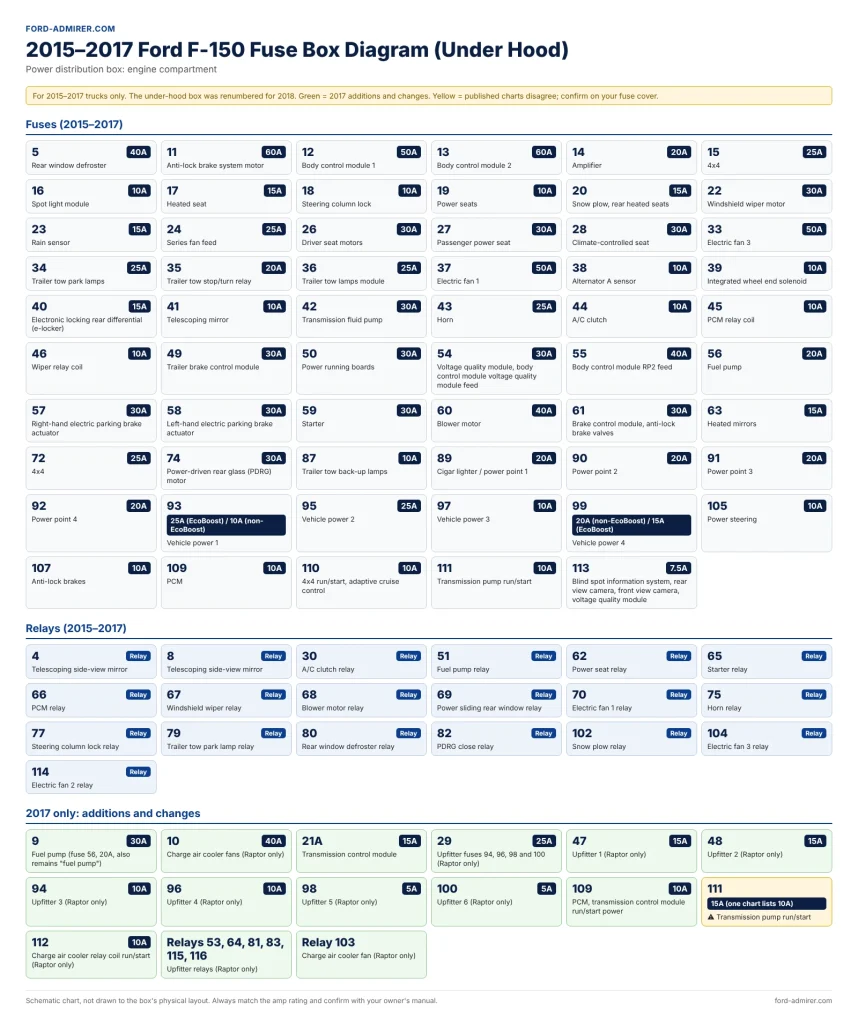
2015–2016 fuses
| Fuse | Amps | Circuits protected |
|---|---|---|
| 5 | 40A | Rear window defroster |
| 11 | 60A | Anti-lock brake system motor |
| 12 | 50A | Body control module 1 |
| 13 | 60A | Body control module 2 |
| 14 | 20A | Amplifier |
| 15 | 25A | 4×4 |
| 16 | 10A | Spot light module |
| 17 | 15A | Heated seat |
| 18 | 10A | Steering column lock |
| 19 | 10A | Power seats |
| 20 | 15A | Snow plow, rear heated seats |
| 22 | 30A | Windshield wiper motor |
| 23 | 15A | Rain sensor |
| 24 | 25A | Series fan feed |
| 26 | 30A | Driver seat motors |
| 27 | 30A | Passenger power seat |
| 28 | 30A | Climate-controlled seat |
| 33 | 50A | Electric fan 3 |
| 34 | 25A | Trailer tow park lamps |
| 35 | 20A | Trailer tow stop/turn relay |
| 36 | 25A | Trailer tow lamps module |
| 37 | 50A | Electric fan 1 |
| 38 | 10A | Alternator A sensor |
| 39 | 10A | Integrated wheel end solenoid |
| 40 | 15A | Electronic locking rear differential (e-locker) |
| 41 | 10A | Telescoping mirror |
| 42 | 30A | Transmission fluid pump |
| 43 | 25A | Horn |
| 44 | 10A | A/C clutch |
| 45 | 10A | PCM relay coil |
| 46 | 10A | Wiper relay coil |
| 49 | 30A | Trailer brake control module |
| 50 | 30A | Power running boards |
| 54 | 30A | Voltage quality module, body control module voltage quality module feed |
| 55 | 40A | Body control module RP2 feed |
| 56 | 20A | Fuel pump |
| 57 | 30A | Right-hand electric parking brake actuator |
| 58 | 30A | Left-hand electric parking brake actuator |
| 59 | 30A | Starter |
| 60 | 40A | Blower motor |
| 61 | 30A | Brake control module, anti-lock brake valves |
| 63 | 15A | Heated mirrors |
| 72 | 25A | 4×4 |
| 74 | 30A | Power-driven rear glass (PDRG) motor |
| 87 | 10A | Trailer tow back-up lamps |
| 89 | 20A | Cigar lighter / power point 1 |
| 90 | 20A | Power point 2 |
| 91 | 20A | Power point 3 |
| 92 | 20A | Power point 4 |
| 93 | 25A (EcoBoost) / 10A (non-EcoBoost) | Vehicle power 1 |
| 95 | 25A | Vehicle power 2 |
| 97 | 10A | Vehicle power 3 |
| 99 | 20A (non-EcoBoost) / 15A (EcoBoost) | Vehicle power 4 |
| 105 | 10A | Power steering |
| 107 | 10A | Anti-lock brakes |
| 109 | 10A | PCM |
| 110 | 10A | 4×4 run/start, adaptive cruise control |
| 111 | 10A | Transmission pump run/start |
| 113 | 7.5A | Blind spot information system, rear view camera, front view camera, voltage quality module |
2015–2016 relays
| Position | Relay |
|---|---|
| 4 | Telescoping side-view mirror |
| 8 | Telescoping side-view mirror |
| 30 | A/C clutch relay |
| 51 | Fuel pump relay |
| 62 | Power seat relay |
| 65 | Starter relay |
| 66 | PCM relay |
| 67 | Windshield wiper relay |
| 68 | Blower motor relay |
| 69 | Power sliding rear window relay |
| 70 | Electric fan 1 relay |
| 75 | Horn relay |
| 77 | Steering column lock relay |
| 79 | Trailer tow park lamp relay |
| 80 | Rear window defroster relay |
| 82 | PDRG close relay |
| 102 | Snow plow relay |
| 104 | Electric fan 3 relay |
| 114 | Electric fan 2 relay |
2017 Ford F-150 fuse box diagram: under-hood changes
The 2017 F-150 uses the same under-hood layout as 2015–2016, so start with the table above. Then apply the additions and changes below. The biggest one for owners: a second fuel pump fuse, 9 (30A), joins fuse 56 (20A). Most other additions are Raptor-only upfitter and charge air cooler circuits.
One row is marked ⚠️ because published charts disagree on its rating.
| Fuse / relay | Amps | Change for 2017 |
|---|---|---|
| 9 | 30A | Fuel pump (fuse 56, 20A, also remains “fuel pump”) |
| 10 | 40A | Charge air cooler fans (Raptor only) |
| 21A | 15A | Transmission control module |
| 29 | 25A | Upfitter fuses 94, 96, 98 and 100 (Raptor only) |
| 47 | 15A | Upfitter 1 (Raptor only) |
| 48 | 15A | Upfitter 2 (Raptor only) |
| 94 | 10A | Upfitter 3 (Raptor only) |
| 96 | 10A | Upfitter 4 (Raptor only) |
| 98 | 5A | Upfitter 5 (Raptor only) |
| 100 | 5A | Upfitter 6 (Raptor only) |
| 109 | 10A | PCM, transmission control module run/start power |
| 111 ⚠️ | 15A (one chart lists 10A) | Transmission pump run/start |
| 112 | 10A | Charge air cooler relay coil run/start (Raptor only) |
| Relays 53, 64, 81, 83, 115, 116 | — | Upfitter relays (Raptor only) |
| Relay 103 | — | Charge air cooler fan (Raptor only) |
For fuse 111, check the rating printed on your fuse cover or in your 2017 owner’s manual before replacing it.
2018–2020 Ford F-150 fuse box diagram: under the hood
This is the 2018, 2019 and 2020 Ford F150 fuse box diagram under the hood, and it’s numbered completely differently from 2015–2017. Power points are now fuses 6, 8 and 51, the USB smart charger is fuse 58, the fuel pump is fuse 50 and the horn is fuse 1.
The 3.0L Power Stroke diesel arrived for 2018 and has its own rows: powertrain control heaters (47, 52 and 97), the fuel filter heater (48), the DEF heater relay (100) and vehicle power 5 (34). Several vehicle power fuses have different ratings on gas and diesel trucks, and the table lists both. One row is marked ⚠️ because published charts disagree on its position.
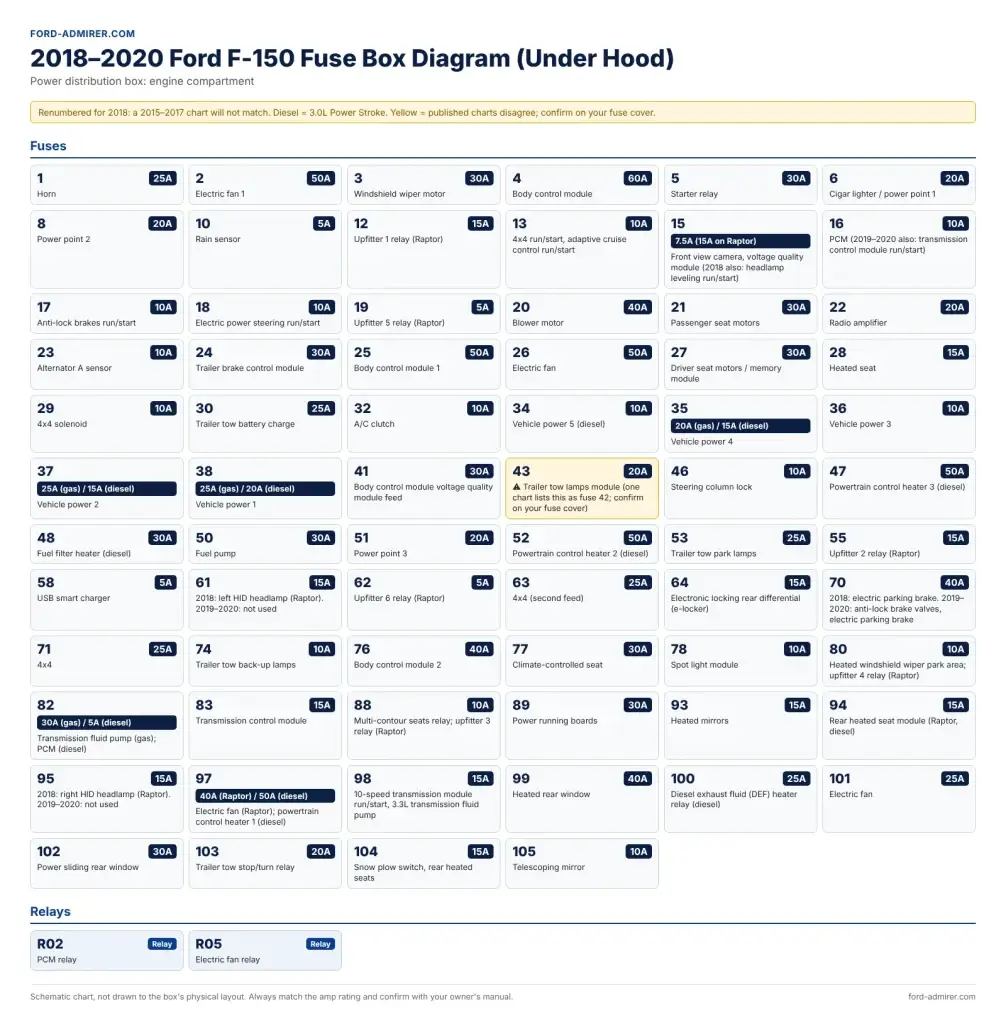
2018–2020 fuses
| Fuse | Amps | Circuits protected |
|---|---|---|
| 1 | 25A | Horn |
| 2 | 50A | Electric fan 1 |
| 3 | 30A | Windshield wiper motor |
| 4 | 60A | Body control module |
| 5 | 30A | Starter relay |
| 6 | 20A | Cigar lighter / power point 1 |
| 8 | 20A | Power point 2 |
| 10 | 5A | Rain sensor |
| 12 | 15A | Upfitter 1 relay (Raptor) |
| 13 | 10A | 4×4 run/start, adaptive cruise control run/start |
| 15 | 7.5A (15A on Raptor) | Front view camera, voltage quality module (2018 also: headlamp leveling run/start) |
| 16 | 10A | PCM (2019–2020 also: transmission control module run/start) |
| 17 | 10A | Anti-lock brakes run/start |
| 18 | 10A | Electric power steering run/start |
| 19 | 5A | Upfitter 5 relay (Raptor) |
| 20 | 40A | Blower motor |
| 21 | 30A | Passenger seat motors |
| 22 | 20A | Radio amplifier |
| 23 | 10A | Alternator A sensor |
| 24 | 30A | Trailer brake control module |
| 25 | 50A | Body control module 1 |
| 26 | 50A | Electric fan |
| 27 | 30A | Driver seat motors / memory module |
| 28 | 15A | Heated seat |
| 29 | 10A | 4×4 solenoid |
| 30 | 25A | Trailer tow battery charge |
| 32 | 10A | A/C clutch |
| 34 | 10A | Vehicle power 5 (diesel) |
| 35 | 20A (gas) / 15A (diesel) | Vehicle power 4 |
| 36 | 10A | Vehicle power 3 |
| 37 | 25A (gas) / 15A (diesel) | Vehicle power 2 |
| 38 | 25A (gas) / 20A (diesel) | Vehicle power 1 |
| 41 | 30A | Body control module voltage quality module feed |
| 43 ⚠️ | 20A | Trailer tow lamps module (one chart lists this as fuse 42; confirm on your fuse cover) |
| 46 | 10A | Steering column lock |
| 47 | 50A | Powertrain control heater 3 (diesel) |
| 48 | 30A | Fuel filter heater (diesel) |
| 50 | 30A | Fuel pump |
| 51 | 20A | Power point 3 |
| 52 | 50A | Powertrain control heater 2 (diesel) |
| 53 | 25A | Trailer tow park lamps |
| 55 | 15A | Upfitter 2 relay (Raptor) |
| 58 | 5A | USB smart charger |
| 61 | 15A | 2018: left HID headlamp (Raptor). 2019–2020: not used |
| 62 | 5A | Upfitter 6 relay (Raptor) |
| 63 | 25A | 4×4 (second feed) |
| 64 | 15A | Electronic locking rear differential (e-locker) |
| 70 | 40A | 2018: electric parking brake. 2019–2020: anti-lock brake valves, electric parking brake |
| 71 | 25A | 4×4 |
| 74 | 10A | Trailer tow back-up lamps |
| 76 | 40A | Body control module 2 |
| 77 | 30A | Climate-controlled seat |
| 78 | 10A | Spot light module |
| 80 | 10A | Heated windshield wiper park area; upfitter 4 relay (Raptor) |
| 82 | 30A (gas) / 5A (diesel) | Transmission fluid pump (gas); PCM (diesel) |
| 83 | 15A | Transmission control module |
| 88 | 10A | Multi-contour seats relay; upfitter 3 relay (Raptor) |
| 89 | 30A | Power running boards |
| 93 | 15A | Heated mirrors |
| 94 | 15A | Rear heated seat module (Raptor, diesel) |
| 95 | 15A | 2018: right HID headlamp (Raptor). 2019–2020: not used |
| 97 | 40A (Raptor) / 50A (diesel) | Electric fan (Raptor); powertrain control heater 1 (diesel) |
| 98 | 15A | 10-speed transmission module run/start, 3.3L transmission fluid pump |
| 99 | 40A | Heated rear window |
| 100 | 25A | Diesel exhaust fluid (DEF) heater relay (diesel) |
| 101 | 25A | Electric fan |
| 102 | 30A | Power sliding rear window |
| 103 | 20A | Trailer tow stop/turn relay |
| 104 | 15A | Snow plow switch, rear heated seats |
| 105 | 10A | Telescoping mirror |
2018–2020 relays
| Position | Relay |
|---|---|
| R02 | PCM relay |
| R05 | Electric fan relay |
The source charts list only these two relay positions for 2018–2020. If you need another relay, check the diagram on your fuse box cover or your owner’s manual.
Why your 2017 chart doesn’t match your 2018 truck
Ford kept the same cabin fuse panel for 2018, but the under-hood power distribution box was completely renumbered. Pull a fuse from a 2018–2020 truck using a 2015–2017 chart and you’ll almost always pull the wrong one.
| Circuit | 2015–2017 fuse | 2018–2020 fuse |
|---|---|---|
| Horn | PDB 43 (25A) | PDB 1 (25A) |
| Cigar lighter / power point 1 | PDB 89 (20A) | PDB 6 (20A) |
| Starter | PDB 59 (30A) | PDB 5 (30A) |
| Blower motor | PDB 60 (40A) | PDB 20 (40A) |
Worse, some old numbers now feed something else. Fuse 5 was the 40A rear window defroster on a 2017; on a 2018 it’s the 30A starter relay. Fuse 22 was the 30A wiper motor; on a 2018 it’s the 20A radio amplifier.
The fix is simple: confirm your model year from the 10th character of your VIN (F = 2015, G = 2016, H = 2017, J = 2018, K = 2019, L = 2020), then use only the chart for that year. The cabin panel is the exception, so the radio (33), tailgate release (16) and trailer brake input (4) stay the same on every 2015–2020 truck.
How to check and replace a blown fuse
A blown fuse takes about five minutes to find and swap, as long as you replace it with the exact same amp rating.
What you need: a fuse puller or needle-nose pliers, a 12V test light or multimeter, a flashlight, and spare mini and cartridge fuses in the ratings from your year’s table.
- Find the right fuse. Check the quick reference first, then your year’s full table. Note which box it’s in (cabin or under-hood), the number and the amp rating. Make sure you’re using the right under-hood chart: 2015–2017 or 2018–2020.
- Test it in place (fastest). With the ignition on, clip a test light to bare metal and touch the two small test points on top of the fuse. Light on both sides = good. Light on one side only = blown. A multimeter set to DC volts does the same: about 12 volts on both sides means the fuse is fine.
- Switch off and pull it. Turn the ignition off, then pull the fuse straight out with the puller.
- Look at it. A blown mini fuse has a broken metal strip inside the plastic. On a cartridge fuse, look through the clear window on top. A multimeter on continuity confirms it if you can’t tell.
- Fit an identical fuse. Same type, same amp rating, pushed fully into the slot. Where a table lists two ratings (EcoBoost / non-EcoBoost, gas / diesel, Raptor), use the one for your truck.
- Refit the cover and test. On the cabin panel, place the top of the cover first, push the bottom until it latches, then tug gently to check. Turn the ignition on and check the circuit works.
Never fit a higher-rated fuse. The fuse is sized for the wire behind it. A bigger fuse lets the wire overheat instead of the fuse blowing, which is how harness damage and fires start.
If the new fuse blows straight away, stop swapping fuses. Something on that circuit is shorted, often a pinched wire, a failed motor or a faulty accessory in a power point. Tracing a short properly needs the full wiring diagrams, which are in the 2015–2020 Ford F-150 workshop manual, not the owner’s manual.
Common 13th-gen F-150 fuse problems (and the exact fuse)
These are the fuse problems 2015–2020 owners search for most. “PDB” means the under-hood box; “cabin” means the passenger footwell panel. Check which under-hood chart applies to your year before pulling anything.
Power outlet or USB dead
| Outlet | 2015–2017 | 2018–2020 |
|---|---|---|
| Cigar lighter / power point 1 | PDB 89 (20A) | PDB 6 (20A) |
| Power point 2 | PDB 90 (20A) | PDB 8 (20A) |
| Power point 3 | PDB 91 (20A) | PDB 51 (20A) |
| Power point 4 | PDB 92 (20A) | — |
| USB smart charger | — | PDB 58 (5A) |
A power point fuse that keeps blowing usually means a coin or a faulty charger in the socket.
Radio out
The radio fuse is cabin 33 (20A) on every 2015–2020 truck. If it’s good, check cabin 32 (10A) for SYNC and the multi-function display. No sound with a working screen can mean the amplifier fuse: PDB 14 (20A) on 2015–2017, PDB 22 (20A) on 2018–2020.
Horn not working
The horn is PDB 43 (25A) on 2015–2017, with the horn relay in position 75, and PDB 1 (25A) on 2018–2020.
No start or fuel pump not running
- Cranks but won’t start: the fuel pump fuse is PDB 56 (20A) on 2015–2016, PDB 9 (30A) and 56 (20A) on 2017, and PDB 50 (30A) on 2018–2020. On 2015–2017 the fuel pump relay is in position 51. Also check the PCM fuse: PDB 109 (10A) on 2015–2017, PDB 16 (10A) on 2018–2020.
- No crank at all: the starter fuse is PDB 59 (30A) on 2015–2017 (starter relay in position 65) and PDB 5 (30A) on 2018–2020. Then check cabin 18 (5A, ignition and push-button start switch) and cabin 34 (30A, run/start relay).
If the fuses and relays check out, the fault is elsewhere. For what each model year is known for, see our guide to the best F-150 years.
Trailer lights or trailer brake not working
| Circuit | 2015–2017 | 2018–2020 |
|---|---|---|
| Trailer brake controller | PDB 49 (30A) + cabin 4 (5A) | PDB 24 (30A) + cabin 4 (5A) |
| Trailer tow park lamps | PDB 34 (25A) | PDB 53 (25A) |
| Trailer tow stop/turn | PDB 35 (20A) | PDB 103 (20A) |
| Trailer tow back-up lamps | PDB 87 (10A) | PDB 74 (10A) |
| Trailer tow lamps module | PDB 36 (25A) | PDB 43 (20A) ⚠️ one chart lists this as fuse 42; confirm on your fuse cover |
| Trailer tow battery charge | not listed in chart | PDB 30 (25A) |
If one side of the trailer is dark, start with the stop/turn fuse. If the trailer brake controller shows a fault, check both of its fuses: one under the hood and one in the cab.
Tailgate release not working
The tailgate release is cabin 16 (15A) on every 2015–2020 truck.
4×4 not engaging
- 2015–2017: 4×4 fuses PDB 15 and 72 (25A each), integrated wheel end solenoid PDB 39 (10A), and 4×4 run/start PDB 110 (10A)
- 2018–2020: 4×4 fuses PDB 71 and 63 (25A each), 4×4 solenoid PDB 29 (10A), and 4×4 run/start PDB 13 (10A)
If all of these are good, the fault is in the 4×4 hardware itself rather than a fuse.
Before chasing any electrical fault, run your VIN through the NHTSA recall lookup to see whether an open recall covers it.
FAQs
Where is the fuse box on a 2018 Ford F-150?
A 2018 F-150 has two: the passenger compartment fuse panel on the right-hand side of the passenger footwell, behind a trim panel, and the power distribution box under the hood. The 2018 under-hood box uses new numbering, so don’t use a 2015–2017 chart for it.
How many fuse boxes does a 2015–2020 F-150 have?
Two: the passenger compartment fuse panel in the passenger footwell and the power distribution box in the engine compartment. The cabin panel kept the same layout for all six years; the under-hood box was renumbered for 2018.
Which fuse is the cigarette lighter / power outlet on a 2016 vs a 2019 F-150?
On a 2016, the cigar lighter / power point 1 is under-hood fuse 89 (20A), and power points 2, 3 and 4 are fuses 90, 91 and 92 (20A each). On a 2019, power point 1 is under-hood fuse 6 (20A), power points 2 and 3 are fuses 8 and 51 (20A), and the USB smart charger is fuse 58 (5A).
Which fuse is the fuel pump on a 2018 F-150?
Under-hood fuse 50 (30A). On 2015–2016 trucks it was fuse 56 (20A), and on 2017 trucks it’s fuses 9 (30A) and 56 (20A).
Why doesn’t my 2018 F-150 match a 2017 fuse diagram?
Ford renumbered the under-hood power distribution box for 2018. The horn moved from fuse 43 to fuse 1, the fuel pump to fuse 50 and the power points to fuses 6, 8 and 51. The cabin panel didn’t change, so cabin fuses like the radio (33) and tailgate release (16) are the same on both. You can confirm the chart for your year in your owner’s manual on Ford’s owner manual site.