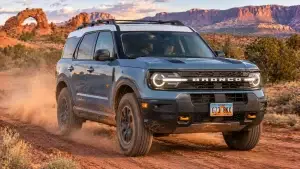

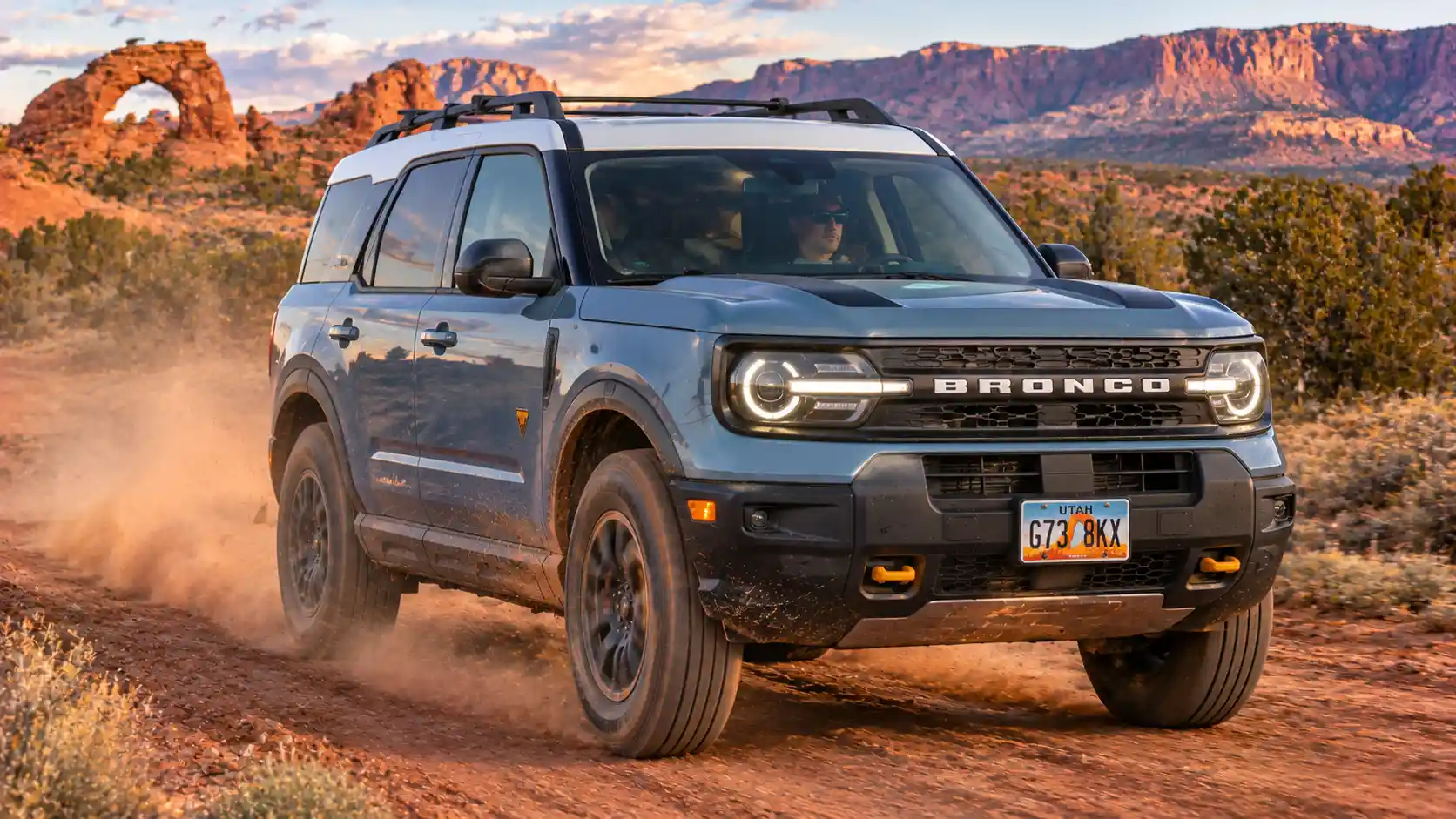
The Ford Bronco Sport is the most trail-capable small SUV you can buy for under $40,000, but it’s also less comfortable and thirstier than most of its rivals. Both things are true, and which one matters more to you decides whether it’s the right buy.
Ford launched the “baby Bronco” for 2021, refreshed it for 2025 with a bigger screen and a Sasquatch package, and for 2027 cut prices while trimming some standard features. With the Ford Escape gone after 2026, the Bronco Sport is now the cheapest SUV in Ford’s US lineup.
This review covers everything that matters before you sign: 2027 Bronco Sport pricing by trim, full specs, how the Big Bend and Badlands actually drive, real-world owner experience, the recall history behind the reliability question, and whether you should spend more on a full-size Bronco instead.
Bronco Sport review at a glance (2027)
- Price: $31,695 to $36,760 MSRP, plus about $1,995 destination
- Engines: 1.5L turbo three-cylinder (180 hp) or 2.0L turbo four-cylinder (250 hp, Badlands only)
- Drivetrain: 4×4 standard on every trim, 8-speed automatic
- EPA fuel economy: 27 mpg combined (1.5L), 23 mpg combined (2.0L)
- Towing: 2,200 lb (1.5L) or 2,700 lb (2.0L)
- Best for: Outdoor-minded drivers who hit dirt roads, trailheads and snow
- Skip it if: You want the best ride, the roomiest back seat or hybrid-level MPG
- Our pick: Badlands, the only trim with the 2.0L engine and the advanced 4×4 system
2027 Bronco Sport Pricing by Trim
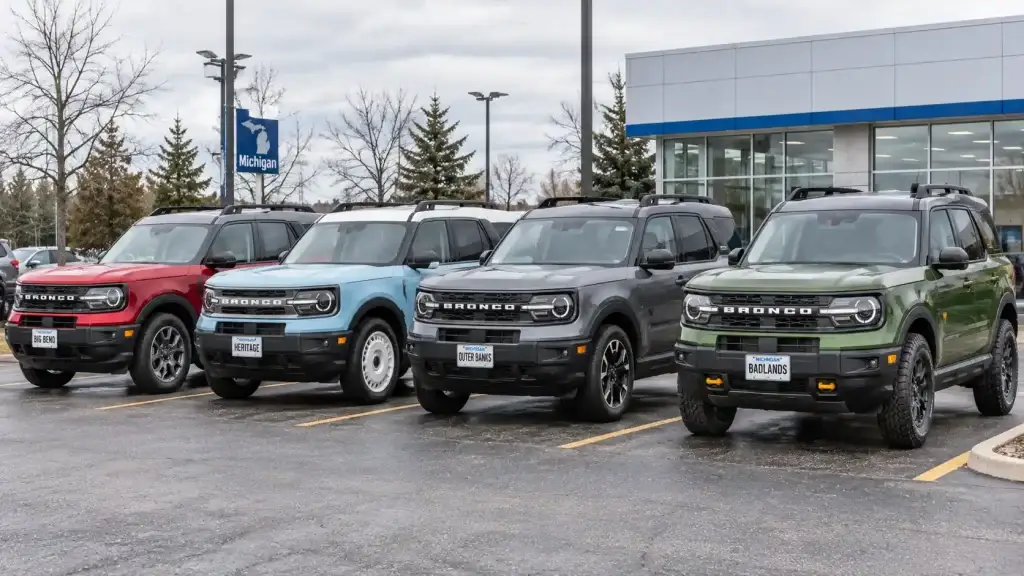
Bronco Sport pricing starts at $31,695 for the 2027 Big Bend and tops out at $36,760 for the Badlands, before options and the roughly $1,995 destination charge. Three of the four trims got cheaper for 2027, but Ford pulled some standard equipment to get there.
| Trim | Engine | 2027 MSRP | Change vs 2026 |
|---|---|---|---|
| Big Bend | 1.5L turbo I-3, 180 hp | $31,695 | −$150 |
| Heritage | 1.5L turbo I-3, 180 hp | $33,490 | +$95 |
| Outer Banks | 1.5L turbo I-3, 180 hp | $34,985 | −$160 |
| Badlands | 2.0L turbo I-4, 250 hp | $36,760 | −$505 |
The catch is the de-contenting. The 2027 Badlands swaps its 8-way power driver’s seat for a manual 6-way seat, loses illuminated vanity mirrors and rubberized seatback mats, and moves the liftgate flood lights into a new Camping Package. The Big Bend also loses some standard content. Check the window sticker carefully if you’re comparing a leftover 2026 against a 2027.
What you’ll really pay
Dealers are discounting modestly. Edmunds reported in late October 2026 that buyers were paying about $1,400 under sticker on average, with no general rebates. Inventory of 2027s was thin, especially the Badlands, so an in-stock car is your best leverage.
Options add up fast. A Badlands with the Sasquatch package, a moonroof and a few accessories can approach the price of a base full-size Bronco, which starts at $40,495. That’s the single most important thing to know about Bronco Sport pricing: the cheap trims are good value, and the fully loaded ones force a tough comparison.
Ford Bronco Sport Specs
Every Bronco Sport uses a turbocharged engine, an 8-speed automatic and standard 4×4. The Badlands is the only trim with the bigger 2.0L engine and Ford’s advanced 4×4 system with a twin-clutch rear drive unit.
| Spec | Big Bend / Heritage / Outer Banks | Badlands |
|---|---|---|
| Engine | 1.5L EcoBoost turbo three-cylinder | 2.0L EcoBoost turbo four-cylinder |
| Horsepower / torque | 180 hp / 190 lb-ft | 250 hp / 280 lb-ft |
| Transmission | 8-speed automatic | 8-speed automatic with paddle shifters |
| 4×4 system | Standard 4×4 | Advanced 4×4, twin-clutch rear drive unit, rear differential lock |
| G.O.A.T. Modes | 5: Normal, Eco, Sport, Slippery, Off-Road | 7: adds Rock Crawl and Rally |
| EPA fuel economy | 27 mpg combined | 23 mpg combined |
| Max towing | 2,200 lb | 2,700 lb |
| Ground clearance (2025+ Ford figures) | 7.8 in (8.8 in Outer Banks Sasquatch) | 8.1 in (8.7 in Sasquatch) |
| Cargo space | 32.5 cu ft behind 2nd row, 65.2 cu ft max | Same |
| Seating | 5 | 5 |
| Warranty | 3-yr/36,000-mi basic, 5-yr/60,000-mi powertrain | Same |
Two specs deserve context. First, towing: 2,200 lb is enough for a small utility trailer, a pair of jet skis or a teardrop camper, but the Toyota RAV4 and Subaru Forester tow more. Our Ford towing guides explain how tongue weight and payload eat into that number. Second, ground clearance: the Badlands Sasquatch actually sits slightly lower than an Outer Banks Sasquatch on paper, but it adds Bilstein remote-reservoir rear dampers, the 2.0L engine and the locking rear differential, which matter more on a real trail.
2022 and 2023 Ford Bronco Sport specs
If you’re shopping used, the core hardware is nearly identical. A 2022 or 2023 Bronco Sport has the 1.5L rated at 181 hp and 190 lb-ft, or the Badlands’ 2.0L rated at 250 hp and 277 lb-ft on premium fuel. Both used the same 8-speed automatic and standard 4×4. The big differences are inside: pre-2025 models have an 8-inch touchscreen with SYNC 3 instead of today’s 13.2-inch SYNC 4 screen, and an analog-style gauge cluster instead of the 12.3-inch digital one. Pre-2025 models topped out at 2,200 lb of towing, and their EPA ratings were around 26 mpg combined for the 1.5L.
How the Bronco Sport Drives
On pavement, the Bronco Sport is pleasant but not polished. Off pavement, it embarrasses most small SUVs. That split runs through every review, including Edmunds’ test, which scored it just 6.3 out of 10 overall and 4.4 out of 10 for comfort while calling it more capable off-road than any other compact SUV.
On the road
The 1.5L three-cylinder is the engine most buyers get, and it’s fine for commuting. It pulls well around town and merges without drama, but it runs out of breath on long uphill grades and when the cargo area is full. The 2.0L in the Badlands feels genuinely quick, and owners consistently say it transforms the car.
The ride is the weak spot. Off-road-tuned suspension and chunky tires make the Bronco Sport jiggle over broken pavement, and its upright, boxy shape lets in more wind and tire noise than a RAV4 or CR-V. On the plus side, steering is light and accurate, the turning circle is tight, and the tall seating position with a visible hood makes it easy to place in parking lots.
Ford’s Co-Pilot360 driver aids, including adaptive cruise and lane centering, work well. One long-term owner on BroncoSportForum said they make long highway trips far less tiring.
Off the road
This is where the Bronco Sport earns the name. Every trim has standard 4×4, an 18:1 crawl ratio and selectable G.O.A.T. Modes, and every trim has enough ground clearance for rutted forest roads and snowy trailheads. The Badlands’ twin-clutch rear drive unit can send most of the rear torque to whichever wheel has grip, which acts like a locking differential when one tire lifts.
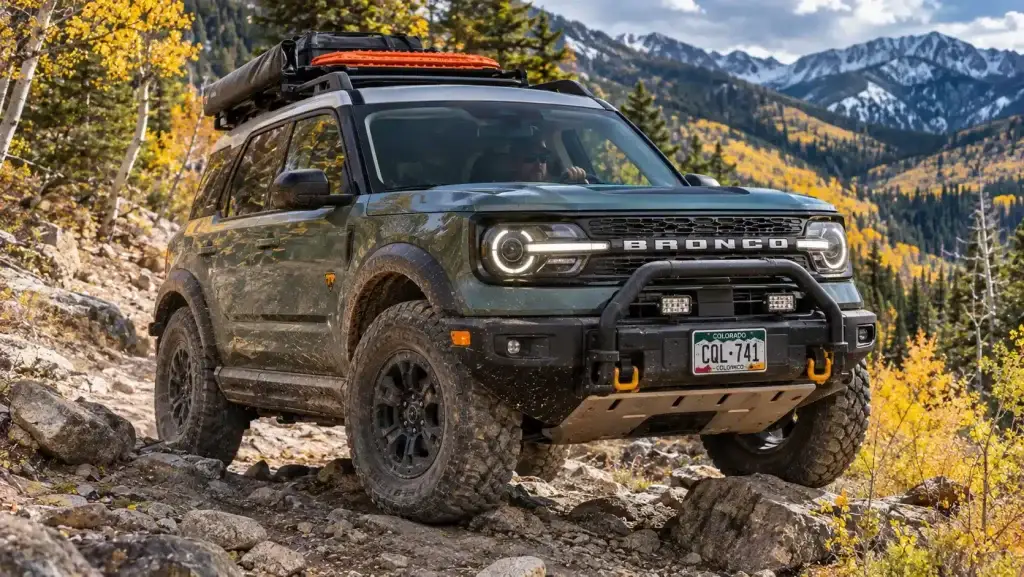
The Badlands also gets Trail Control (low-speed off-road cruise control), an available front off-road camera and, on Sasquatch models, steel bumpers with recovery points, a brush guard and 29-inch all-terrain tires. Ford rates the Badlands Sasquatch for 23.6 inches of water fording, compared with 17.7 inches for a standard Bronco Sport.
Know the limits. This is a unibody crossover with independent suspension, not a body-on-frame rock crawler. Moderate trails, sand and mud ruts are well within its skill set. Big rock ledges and deep ruts are full-size Bronco territory.
Bronco Sport Big Bend vs Badlands Review
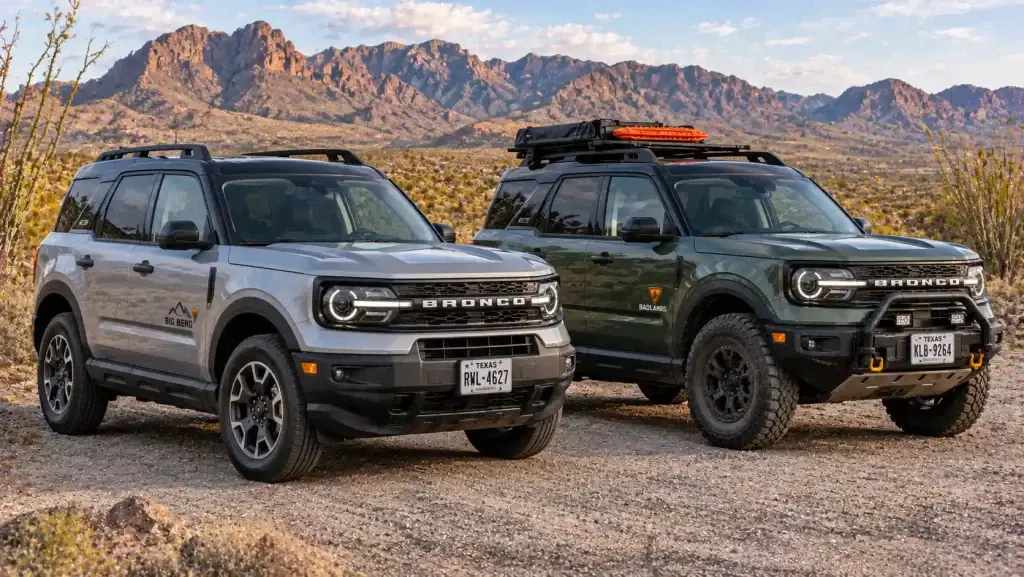
The Big Bend is the smart buy for most people; the Badlands is the one enthusiasts should get. The roughly $5,000 gap buys a much better engine and a much more capable 4×4 system.
Ford Bronco Sport Big Bend review
The Big Bend is the entry trim and Edmunds’ most popular Bronco Sport. For $31,695 you get the 1.5L engine, standard 4×4, five G.O.A.T. Modes, 17-inch wheels, the 13.2-inch touchscreen with wireless Apple CarPlay and Android Auto, and Ford’s Co-Pilot360 safety suite. It doesn’t feel like a stripped base model.
What it lacks is muscle and trail hardware. The three-cylinder is adequate for daily driving but feels strained on steep climbs. One Edmunds owner review of a 2025 Big Bend described having to back down a rocky hill and take a run at it because the 1.5L couldn’t crawl up from a stop. The available Black Diamond Off-Road package adds underbody protection and stronger bumpers if you want a tougher Big Bend without paying for a Badlands.
Verdict: Buy the Big Bend if most of your driving is pavement, with gravel roads, ski trips and campground access on weekends.
Ford Bronco Sport Badlands review
The Badlands is the Bronco Sport Ford should have made the default. Its 250-hp 2.0L turns a slightly sluggish crossover into a quick one, and the advanced 4×4 with the twin-clutch rear drive unit, differential lock and seven G.O.A.T. Modes gives it real trail ability. Edmunds names it their pick of the lineup.
The costs are fuel and comfort. The Badlands is rated at 23 mpg combined, and a long-term owner on BroncoSportForum reported 19–21 mpg in mixed driving with all-terrain tires and a roof platform. For 2027, the Badlands also lost its power driver’s seat.
Verdict: Buy the Badlands if you’ll actually use dirt roads and trails, or if the 1.5L’s performance would bother you every day.
Is “Ford Bronco Big Bend” the same as Bronco Sport Big Bend?
No, and it’s a common mix-up. Ford uses the Big Bend name on both models. The full-size Bronco Big Bend is a four-door, body-on-frame SUV with a 275-hp 2.3L turbo four and removable roof and doors, starting at $40,995 for 2026. The Bronco Sport Big Bend is the compact crossover reviewed here, about $9,300 cheaper. Both are named after Big Bend National Park in West Texas.
Interior, Cargo and Tech
The Bronco Sport’s cabin is built for gear, not luxury. Materials favor durability over softness, and that fits the mission. What reviewers and owners agree on is that it’s one of the cleverest small-SUV interiors for outdoor people.
What works:
- The tech. Since 2025, every trim gets a 13.2-inch touchscreen with SYNC 4, wireless Apple CarPlay and Android Auto, over-the-air updates and a 12.3-inch digital gauge cluster. Edmunds scored the tech 9 out of 10.
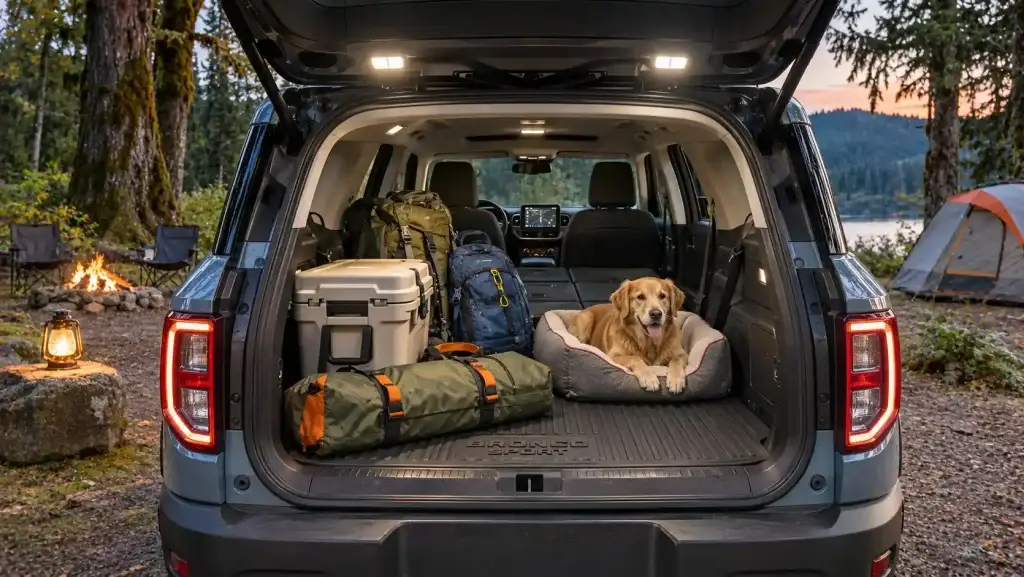
- The cargo area. A tall, boxy load space holds 32.5 cubic feet behind the rear seats and 65.2 cubic feet with them folded. The rear glass flips open on its own, and the available slide-out cargo organizer doubles as a tailgate table.
- Adventure details. Rubberized floors, MOLLE straps on the seatbacks and liftgate flood lights (now part of a Camping Package on the 2027 Badlands) are genuinely useful at a campsite.
- Front-seat space. Headroom is generous, and tall drivers fit well.
What doesn’t:
- Rear legroom. It’s tighter than in a RAV4 or CR-V, and the rear doors don’t open very wide, which makes car seats and big dogs harder to load.
- Seat comfort. Opinions split. Some owners find the seats fine on long trips; S3 Magazine’s reviewer found them narrow, flat and hot.
- Climate controls on the touchscreen. The screen is easy to use, but physical knobs would be better, and one owner complained the A/C waits for the screen to boot before it starts.
Ford Bronco Sport Reliability
The Bronco Sport’s reliability story is mixed: many owners report trouble-free years, but early 1.5L models carry a serious fire-risk recall history. If you’re buying a 2021–2023 Bronco Sport with the three-cylinder, recall completion is the first thing to check.
The 1.5L fuel injector recalls
The biggest issue involves cracked fuel injectors on the 1.5L three-cylinder, shared with the Ford Escape:
- April 2022: Ford recalled Escapes and Bronco Sports with the 1.5L over underhood fire risk, initially linked to oil leaks.
- November 2022 (Ford recall 22S73): Ford expanded the fix to about 522,000 US vehicles, covering 2021–2023 Bronco Sports and 2020–2023 Escapes with the 1.5L, after at least 20 fires. A cracked injector could leak fuel onto hot engine parts.
- April 2024 (NHTSA recall 24V187, Ford 24S16): A further 42,652 2022–2023 Bronco Sports and 2022 Escapes were added after fires in vehicles outside the earlier recall. The fix is an engine software update that detects injector leaks, plus a drain tube.
Consumer Reports’ coverage of the fuel injector recall has a good summary for owners. Before you buy any used Bronco Sport, enter its VIN at NHTSA’s recall lookup and ask the dealer for proof that every open campaign is done.
What owners report
Owner sentiment is better than the recall headlines suggest. The Bronco Sport averages 4.1 out of 5 stars across Edmunds owner reviews. A widely read one-year, 13,000-mile review on BroncoSportForum, from a 2021 Badlands owner who used it as the family’s only car, reported zero issues across camping trips, sand, a week in Big Bend National Park and a cross-country drive, and several replies said the same.
The complaints that come up most aren’t breakdowns. They’re fuel economy below expectations, the stiff ride, rear-door access and some features moving to option packages.
Safety ratings
IIHS gives the Bronco Sport “Good” ratings in the small-overlap front tests, the original moderate-overlap front test, the original side test, roof strength and head restraints. It scores lower in the newer, tougher tests: “Marginal” in the updated moderate-overlap front test (which focuses on rear-seat passengers) and “Acceptable” in the updated side test.
Is the Bronco Sport reliable?
On balance, yes, with a caveat. The injector recalls apply only to 1.5L models from 2021 to 2023, so the 2.0L Badlands and newer model years sit outside them. A used 2021–2023 1.5L is fine if the recall work is documented, but walk away if it isn’t. Ford’s 3-year/36,000-mile basic warranty is average, so an extended plan is worth pricing if you keep cars a long time.
Bronco Sport Year-by-Year Changes (2021–2027)
The Bronco Sport is still in its first generation, so the differences between years come down to equipment, screens and trims rather than a redesign.
| Model year | What changed |
|---|---|
| 2021 | Launch year. Trims: Base, Big Bend, Outer Banks, Badlands and the limited First Edition. 8-inch touchscreen. |
| 2022 | Largely a carryover. 2022 Bronco Sport specs match 2021. |
| 2023 | Heritage-themed special editions joined the lineup. Some 1.5L models later covered by the injector recall. |
| 2024 | Free Wheeling retro trim added. Last year of the 8-inch screen. |
| 2025 | Mid-cycle refresh: 13.2-inch SYNC 4 touchscreen and 12.3-inch digital cluster on every trim, new Off-Road and Rally G.O.A.T. Modes, Sasquatch package for Outer Banks and Badlands, Badlands raised 0.4 inch. |
| 2026 | Free Wheeling dropped; lineup narrowed to Big Bend, Heritage, Outer Banks and Badlands. |
| 2027 | Price cuts on three trims, engine stop-start removed, some standard features moved into packages. Escape discontinued, making the Bronco Sport Ford’s cheapest SUV. |
Best used years: A 2025 or newer gets you the much better screen and cabin tech. If you’re on a budget, a 2021–2023 Badlands is a strong used buy, because it has the 2.0L engine and sits outside the 1.5L injector recalls.
Bronco Sport vs Bronco: Which One Should You Buy?
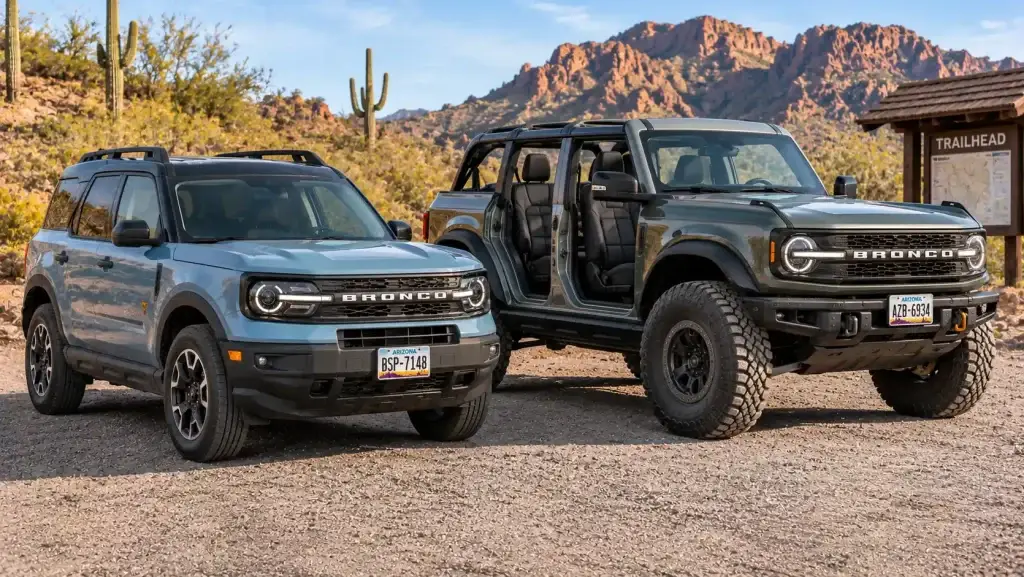
The Bronco Sport and the full-size Bronco share a name and a look, but almost nothing mechanical. The Bronco Sport is a unibody crossover that shares its basic platform with the Ford Escape; the Bronco is a body-on-frame 4×4 related to the Ranger pickup.
| Bronco Sport (2027) | Bronco (2026) | |
|---|---|---|
| Starting MSRP | $31,695 | $40,495 |
| Construction | Unibody crossover | Body-on-frame SUV |
| Engines | 1.5L turbo I-3 or 2.0L turbo I-4 | 2.3L turbo I-4 (275 hp), 2.7L twin-turbo V6, Raptor 3.0L V6 |
| Drivetrain | Standard 4×4, independent rear suspension | Standard 4×4, solid rear axle, low range |
| Removable roof and doors | No | Yes |
| Fuel economy | 23–27 mpg combined | About 15–20 mpg combined |
| Best for | Daily driving with weekend dirt roads | Serious trails, rock crawling, open-air driving |
New Ford Bronco prices
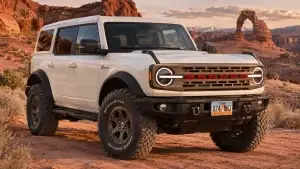
The 2026 full-size Bronco starts at $40,495 for the Base, $40,995 for the four-door Big Bend, $48,090 for the Outer Banks and $48,890 for the Badlands, and runs to $79,995 for the Bronco Raptor. For 2027, Ford is expanding the 3.0L twin-turbo V6 to more trims. Collector-minded buyers should read our look at the Bronco 60th Anniversary Edition, and our Ford Bronco guide covers every generation from 1966 to today.
The honest answer
Buy the Bronco Sport if you commute every day and go off-road a few times a season. It’s cheaper, easier to park and uses noticeably less fuel. Buy the full-size Bronco if trails are the point, not a bonus. A fully loaded Bronco Sport Badlands Sasquatch costs close to a base Bronco, and at that price the bigger truck is far more capable off-road, though rougher and thirstier on the highway.
If you already own a 2021–2024 full-size Bronco and handle your own maintenance, the Ford Bronco Repair Manual PDF Download covers factory service procedures for those model years. Note that it’s for the full-size Bronco, not the Bronco Sport.
And if the Bronco Sport’s ride and rear seat put you off, the Escape it was based on is still worth a look used; our Ford Escape guide covers its generations and common problems.
Who Should Buy a Bronco Sport?
Buy one if you:
- Live somewhere with real winters, dirt roads or trailheads, from Colorado to Maine
- Want an SUV with personality instead of another anonymous crossover
- Haul bikes, coolers, dogs and camping gear more than passengers
- Want genuine 4×4 ability without the price, fuel bill and highway noise of a full-size Bronco
Look elsewhere if you:
- Drive long highway commutes and care about MPG; a RAV4 Hybrid or Forester Hybrid will save real money
- Regularly carry adults or car seats in the back
- Need to tow more than 2,700 lb
- Want the smoothest, quietest ride in the class
Final Verdict
The Ford Bronco Sport is a flawed but genuinely likable small SUV, and it’s the most capable one off-road for the money. The 2027 price cuts make the Big Bend a solid value for everyday drivers who want weekend adventure, while the Badlands remains the trim that truly earns the Bronco badge. Go in knowing its trade-offs, below-average fuel economy, a firm ride and a snug back seat, and check the recall history on any used 1.5L model. If those don’t scare you off, it’s one of the most fun small SUVs on sale.
Our rating: 7.5/10. Big marks for capability, character and tech; points off for comfort, MPG and the shrinking list of standard features.
Bronco Sport FAQs
How much is a 2027 Ford Bronco Sport?
The 2027 Bronco Sport MSRP ranges from $31,695 (Big Bend) to $36,760 (Badlands), plus about $1,995 destination. Heritage starts at $33,490 and Outer Banks at $34,985.
Is the Ford Bronco Sport a good car?
It’s a good choice if you value off-road ability and style. It’s more trail-capable than any rival compact SUV, but it trails the class leaders in ride comfort, rear-seat space and fuel economy.
Is the Ford Bronco Sport reliable?
Mostly. Many owners report years of trouble-free driving, but 2021–2023 models with the 1.5L engine were recalled for cracked fuel injectors that could cause underhood fires. Make sure that recall work is completed on any used example.
What engine does the Bronco Sport have?
Big Bend, Heritage and Outer Banks use a 180-hp turbocharged 1.5L three-cylinder. The Badlands uses a 250-hp turbocharged 2.0L four-cylinder. Both use an 8-speed automatic and standard 4×4.
Does the Bronco Sport have 4WD?
Yes. Every Bronco Sport has standard 4×4. The Badlands adds an advanced system with a twin-clutch rear drive unit and a rear differential lock.
How much can a Bronco Sport tow?
Up to 2,200 lb with the 1.5L and 2,700 lb with the 2.0L, when properly equipped with the tow package.
What gas mileage does the Bronco Sport get?
The EPA rates the 1.5L at 27 mpg combined and the 2.0L Badlands at 23 mpg combined. Owners with all-terrain tires and roof racks often see low 20s.
Which Bronco Sport trim is best?
The Badlands is the best overall because of its stronger engine and advanced 4×4. The Big Bend is the best value for buyers who mostly drive on pavement.
Is the Bronco Sport the same as the Bronco?
No. The Bronco Sport is a smaller, cheaper unibody crossover related to the Ford Escape. The full-size Bronco is a body-on-frame 4×4 with removable roof and doors, starting at $40,495.