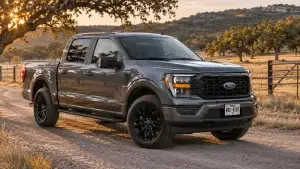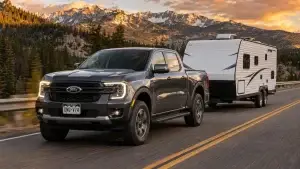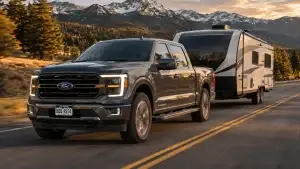

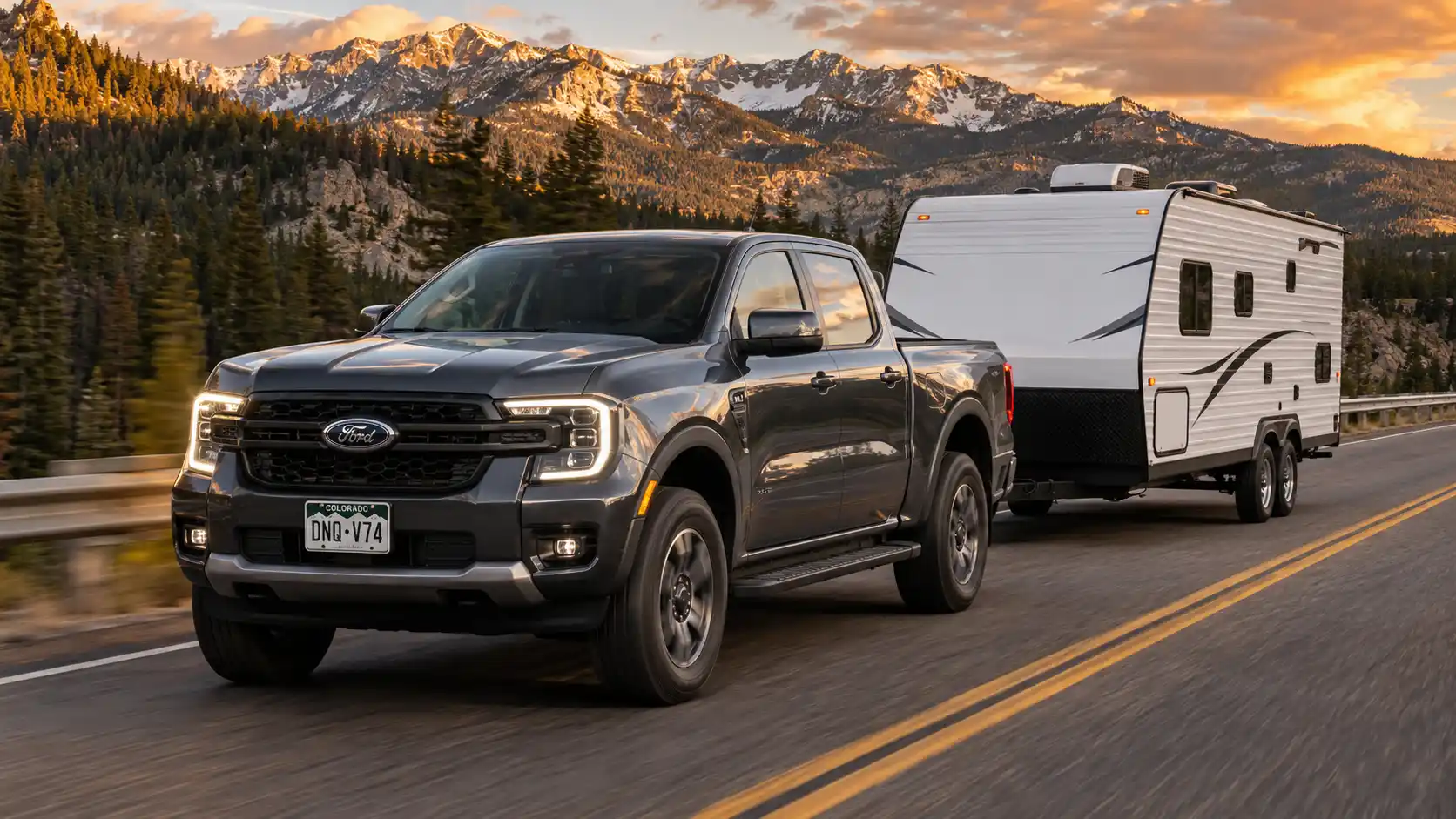
You just found the perfect boat. Or a travel trailer. Or a car hauler for that project Mustang sitting two states away. Now comes the real question: can your Ford Ranger actually pull it?
The short answer is yes, most likely. But the honest answer depends on which Ranger you drive, what year it was built, and what’s sitting in the bed and the back seat when you hook up.
Quick answer: A properly equipped 2019–2026 Ford Ranger has a maximum towing weight of 7,500 lbs (3,402 kg) with the factory Trailer Tow Package. Without it, the limit drops to 3,500 lbs. The 2024–2026 Ranger Raptor is rated at 5,510 lbs. Older 2006–2011 Rangers top out around 6,000 lbs with the 4.0L V6 and an automatic transmission.
In this guide we go deeper than the usual spec sheet. You’ll get the towing capacity for every model year from 2006 to 2026, the numbers for each engine and trim, payload and GVWR figures, a simple way to work out what your truck can safely tow, and what changes when you tow at altitude in states like Colorado or Utah.
If you’re new here, our Ford Ranger guides cover everything else about the truck, from trims to ownership costs.
Ford Ranger Towing Capacity at a Glance (2024–2026)
Every current Ranger except the Raptor tows the same 7,500 lbs once it has the Trailer Tow Package. What changes from one configuration to the next is the Gross Combined Weight Rating (GCWR), and that number decides how much room you have left once people and gear are loaded.
| Configuration | Power / torque | Axle ratio | GCWR | Max trailer weight | Max tongue weight |
|---|---|---|---|---|---|
| 2.3L EcoBoost I4, 4×2 | 270 hp / 310 lb-ft | 3.73 | 12,370 lbs | 7,500 lbs (3,402 kg) | 750 lbs |
| 2.3L EcoBoost I4, 4×4 | 270 hp / 310 lb-ft | 3.73 | 12,590 lbs | 7,500 lbs (3,402 kg) | 750 lbs |
| 2.7L EcoBoost V6, 4×4 | 315 hp / 400 lb-ft | 3.73 | 12,745 lbs | 7,500 lbs (3,402 kg) | 750 lbs |
| 3.0L EcoBoost V6 (Raptor) | 405 hp / 430 lb-ft | 4.27 | 11,465 lbs | 5,510 lbs (2,499 kg) | 550 lbs |
| Any Ranger, bumper only | — | — | — | 3,500 lbs (1,588 kg) | 350 lbs |
Two things jump out from that table.
First, the base 2.3L engine tows exactly as much as the bigger 2.7L V6. The V6 doesn’t raise the ceiling. It gives you more torque (400 vs 310 lb-ft) and the highest GCWR, which means it feels calmer on long grades and leaves a little more margin when the truck is loaded.
Second, the Raptor, the most powerful Ranger, has the lowest tow rating. That’s not a mistake. Its long-travel off-road suspension and 4.27 axle are tuned for desert running, not for carrying 750 lbs of tongue weight down the interstate.
All of these ratings assume a 150-lb driver and a 150-lb passenger. Every extra person, cooler and toolbox comes out of the same budget, which we’ll get to below.
Ford Ranger Towing Capacity by Year (2019–2026)
The Ranger returned to the US for 2019 after a seven-year break, and its towing weight has stayed at 7,500 lbs ever since. The engines around it changed in 2024.
| Model year | Engines | Max towing (with tow package) | Without tow package | Max payload | What changed |
|---|---|---|---|---|---|
| 2026 | 2.3L I4, 2.7L V6, 3.0L V6 Raptor | 7,500 lbs (Raptor 5,510) | 3,500 lbs | Up to about 1,800 lbs | Same towing ratings as 2025 |
| 2025 | 2.3L I4, 2.7L V6, 3.0L V6 Raptor | 7,500 lbs (Raptor 5,510) | 3,500 lbs | Up to 1,788 lbs | Carryover |
| 2024 | 2.3L I4, 2.7L V6, 3.0L V6 Raptor | 7,500 lbs (Raptor 5,510) | 3,500 lbs | Up to about 1,800 lbs | All-new generation; 2.7L V6 and Raptor arrive in the US |
| 2023 | 2.3L EcoBoost I4 | 7,500 lbs | 3,500 lbs | Up to about 1,900 lbs | Last year of the 2019-generation truck |
| 2022 | 2.3L EcoBoost I4 | 7,500 lbs | 3,500 lbs | Up to about 1,900 lbs | Carryover |
| 2021 | 2.3L EcoBoost I4 | 7,500 lbs | 3,500 lbs | Up to about 1,900 lbs | Tremor off-road package added |
| 2020 | 2.3L EcoBoost I4 | 7,500 lbs | 3,500 lbs | Up to 1,860 lbs | Carryover |
| 2019 | 2.3L EcoBoost I4 | 7,500 lbs | 3,500 lbs | Up to 1,860 lbs | Ranger returns to the US |
2024, 2025 and 2026 Ford Ranger towing capacity
The current Ranger is a bigger, more refined truck, and it’s the first US Ranger to offer a choice of engines since 2011. The 2.3L EcoBoost is standard. The 2.7L twin-turbo V6 comes only on 4×4 trucks. The Raptor gets its own 3.0L V6.
For the 2026 model year, Ford’s official towing guide lists a maximum loaded trailer weight of 7,500 lbs for the 2.3L and 2.7L with the Trailer Tow Package (option code 53R), and 5,510 lbs for the Raptor. Those numbers match 2024 and 2025 exactly, so the year you buy makes no difference to how much you can tow.
2019–2023 Ford Ranger towing capacity
Every 2019 to 2023 Ranger uses the 2.3L EcoBoost four-cylinder and a 10-speed automatic. The tow rating for a 2019 Ford Ranger is 7,500 lbs with the factory tow package, and the same holds for 2020, 2021, 2022 and 2023. GCWR on these trucks runs from about 12,150 to 12,500 lbs depending on cab and drivetrain.
These trucks are now a popular used buy because they tow as much as a new one. If you’re shopping for one, check the window sticker or VIN build sheet for the tow package before you pay a premium for “towing ready.”
Towing capacity by trim: XL, XLT, Lariat and Raptor
Trim doesn’t change the maximum rating on its own. Equipment does.
- Ranger XL: 2.3L only. Tows 7,500 lbs once the Trailer Tow Package is added. A good choice for a work truck that pulls an equipment trailer.
- Ranger XLT: 2.3L standard, with the 2.7L V6 available on 4×4 models. The XLT tow capacity is 7,500 lbs with the package, and this is where most buyers find the best mix of price and towing tech.
- Ranger Lariat: Same 7,500-lb rating, with the most comfort and driver-assist features. The 2.7L V6 makes the most sense here if you tow often.
- Ranger Raptor: 5,510 lbs. The hitch, 4-/7-pin wiring and trailer brake controller are standard, so there’s no package to order.
One trim-related detail people miss: heavier trims and options add curb weight. A loaded Lariat 4×4 has less payload left over than a basic XL 4×2, even though the tow rating is identical.
Older Ford Ranger Towing Capacity (2006–2011)
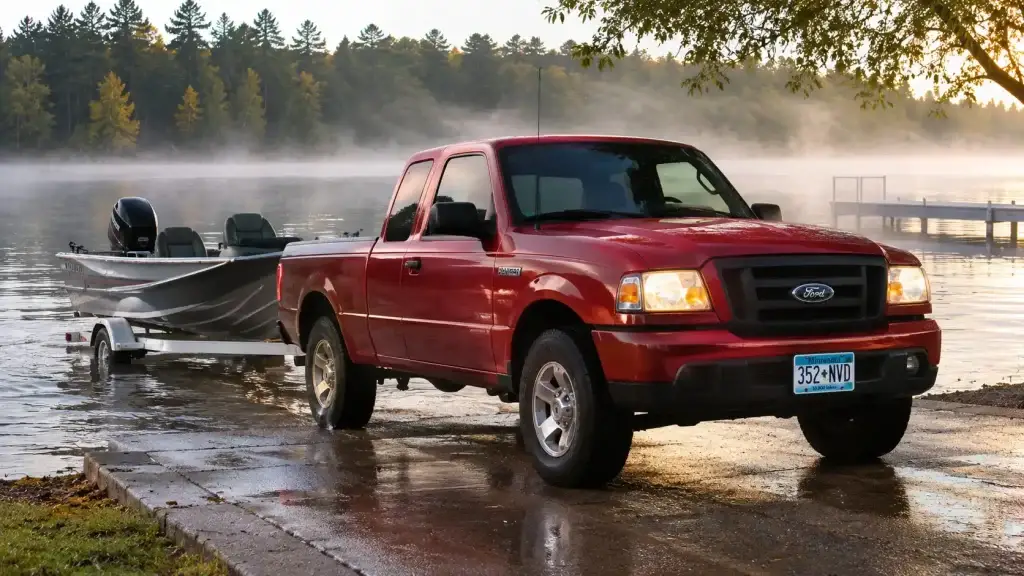
The Ranger left the US market after 2011, so there are no 2012–2018 US models. The older, smaller Rangers are a very different tow vehicle. Engine, transmission, cab and axle all move the number a lot, and the gap between a base truck and the best-equipped one is huge.
| Model year | Engines | Best rating (4.0L V6, automatic, Regular Cab 4×2) | Typical 2.3L I4 rating | 4.0L V6 with manual |
|---|---|---|---|---|
| 2011 | 2.3L I4, 4.0L V6 | 5,940 lbs (2,694 kg) | About 2,160 lbs | About 3,340 lbs |
| 2010 | 2.3L I4, 4.0L V6 | 5,940 lbs (2,694 kg) | About 2,200 lbs | About 3,300 lbs |
| 2009 | 2.3L I4, 4.0L V6 | 6,000 lbs (2,722 kg) | About 2,240 lbs | About 3,400 lbs |
| 2008 | 2.3L I4, 3.0L V6, 4.0L V6 | 6,000 lbs (2,722 kg) | About 2,240 lbs | About 3,400 lbs |
| 2007 | 2.3L I4, 3.0L V6, 4.0L V6 | 6,000 lbs (2,722 kg) | About 2,240 lbs | About 3,380 lbs |
| 2006 | 2.3L I4, 3.0L V6, 4.0L V6 | 6,000 lbs (2,722 kg) | About 2,220 lbs | About 3,400 lbs |
A few things matter more on these trucks than on new ones:
- The 4.0L automatic is the one to have. It carries a 9,500-lb GCWR. Manual-transmission 4.0L trucks were limited to a 7,000-lb GCWR, which cuts the trailer rating roughly in half.
- SuperCab and 4×4 trucks rate lower. A 2011 SuperCab 4×4 with the 4.0L automatic is rated around 5,460–5,580 lbs, not 5,940.
- The 3.0L V6 (2006–2008) is closer to the four-cylinder than to the 4.0L. Expect roughly 2,300–2,600 lbs.
- Trailer brakes need extra wiring. Ford’s own 2006 owner’s guide notes the Ranger’s electrical system wasn’t set up for electric trailer brakes, so anything heavy needs an aftermarket brake controller and wiring.
- Ford’s own documents sometimes disagree by a few pounds. The 2011 owner’s guide says 5,940 lbs, while that year’s towing guide prints 5,960 lbs. When in doubt, use the lower number.
These older ratings were set before Ford rated the Ranger under the SAE J2807 towing standard, which includes tough tests like a full-load hill climb in desert heat. So a 6,000-lb rating on a 2008 Ranger isn’t directly comparable to 7,500 lbs on a 2024.
Also keep in mind these trucks are now 15 to 20 years old. Worn shocks, tired brakes, rusty frames and old transmission fluid all lower the real-world limit. If you’re buying one to tow, run through our used Ford buying checklist first.
Do You Need the Ford Ranger Tow Package?
If your trailer weighs more than 3,500 lbs, yes. Ford’s towing guide is blunt about it: trailers over 3,500 lbs require the Trailer Tow Package (option code 53R), and towing without it may void your New Vehicle Limited Warranty.
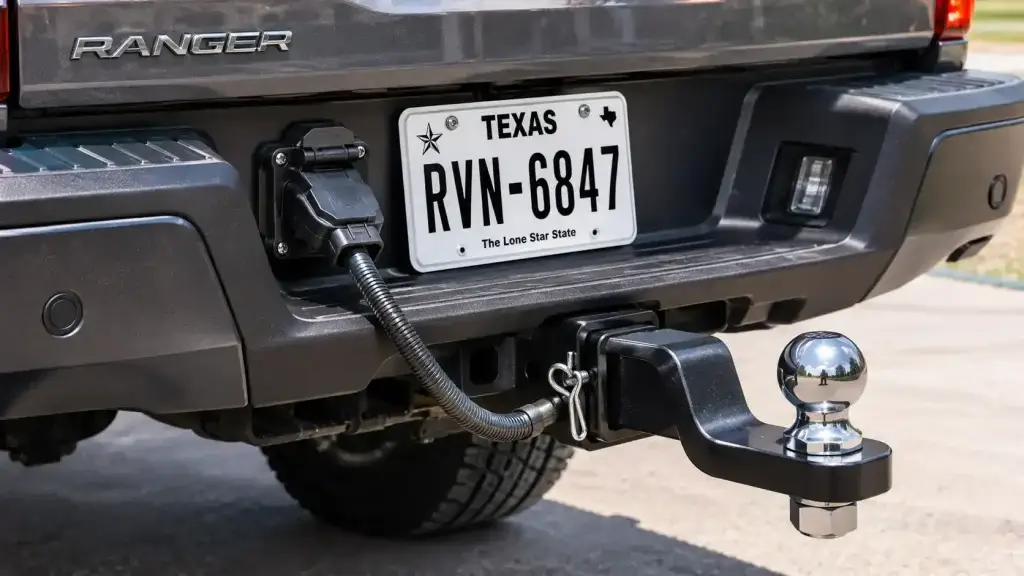
The package includes a frame-mounted Class IV hitch receiver and a 4-pin/7-pin trailer connector. Depending on trim and package, you can also get an integrated trailer brake controller, Pro Trailer Backup Assist and trailer-aware reverse sensors. Trailer Sway Control and Tow/Haul mode are standard on every current Ranger.
The frontal area limit nobody talks about
Weight isn’t the only limit. Ford also caps the trailer’s frontal area, which is how much flat surface hits the wind:
- Without the tow package: 30 sq. ft. maximum
- With the tow package: 55 sq. ft. maximum
This matters most for boxy travel trailers and enclosed cargo trailers. A trailer that’s 8 ft wide and 7 ft tall is already at 56 sq. ft. It may be well under 7,500 lbs and still be more than the Ranger is rated to push through the air.
How to check if your Ranger has the right axle
Open the driver’s door and find the Safety Compliance Certification Label on the door pillar. Below the bar code you’ll see the word AXLE and a two-digit code:
- 71 = 3.73 ratio, open differential
- 73 = 3.73 ratio, electronic locking rear differential
- 4L = 4.27 ratio, electronic locking (Raptor)
The hitch receiver also has a label with its own rating. That’s the most the hitch can hold, not necessarily what your truck can tow.
Ford Ranger Payload, GVWR and Gross Weight Explained
Most towing mistakes don’t come from going over 7,500 lbs. They come from overloading the truck itself. Four numbers decide that:
| Term | What it means | Example (2025 Ranger XLT 2.3L 4×4 SuperCrew) |
|---|---|---|
| Curb weight | The empty truck with fluids | 4,441 lbs |
| Payload | Everything you can put in and on the truck, tongue weight included | 1,729 lbs |
| GVWR (gross vehicle weight rating) | Max weight of the truck plus everything in it | 6,170 lbs |
| GCWR (gross combined weight rating) | Max weight of truck plus loaded trailer | 12,590 lbs |
For reference, the 2025 Ford Ranger GVWR is about 6,050 lbs on a 2.3L 4×2 and 6,170 lbs on a 2.3L 4×4. The Raptor’s GVWR is 6,790 lbs, but its payload is only about 1,375 lbs because the truck itself is so heavy. Ford advertises up to 1,788 lbs of payload on the best-equipped 2025 Ranger.
Tongue weight is payload. The trailer pushes down on the hitch ball with 10–15% of its weight, and every pound of that counts against payload. A 7,500-lb trailer puts 750 to 1,125 lbs on the hitch. On a truck with 1,729 lbs of payload, that leaves as little as 600 lbs for you, your passengers and your gear.
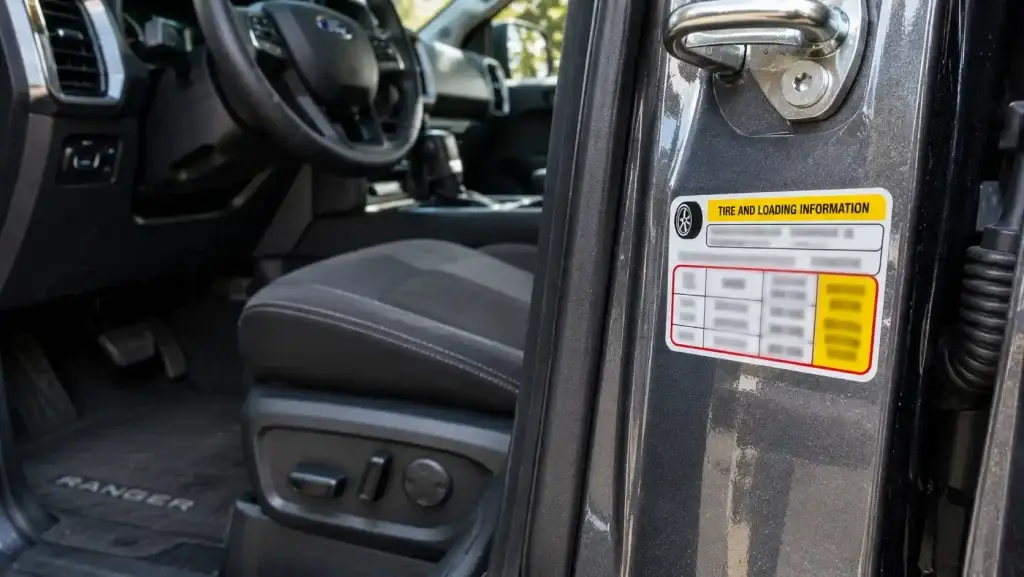
Your truck’s exact numbers are printed on the Tire and Loading Information label inside the driver’s door. NHTSA’s tire safety guidance explains how to read that label and why running tires at the right cold pressure matters even more when you’re loaded.
How to Work Out What Your Ranger Can Really Tow
The 7,500-lb figure is a ceiling, not a promise. Here’s a simple four-step check you can do with a calculator and your door sticker.
- Find your GCWR in the owner’s manual or Ford’s towing guide for your year, engine and drivetrain.
- Add up your loaded truck: curb weight + everyone on board + everything in the bed and cab.
- Subtract the loaded truck from the GCWR. The answer, or 7,500 lbs, whichever is lower, is your trailer limit.
- Check payload: add the trailer’s tongue weight (10–15% of its loaded weight) to your people and gear. That total must stay under your payload rating.
Example 1: Two people heading to the lake
A 2025 Ranger XLT 2.3L 4×4 weighs 4,441 lbs. Add a driver and passenger (350 lbs) and 200 lbs of gear, and the truck weighs 4,991 lbs. Its GCWR is 12,590 lbs, so 12,590 − 4,991 = 7,599 lbs. The truck can pull the full 7,500 lbs. A 7,000-lb boat with 700 lbs of tongue weight brings payload use to 1,250 lbs, well under the 1,729-lb limit. You’re good.
Example 2: The family camping trip
Same truck, but now there are four people (700 lbs) and 300 lbs of camping gear. The travel trailer weighs 6,500 lbs loaded with 12% on the tongue, which is 780 lbs. Payload used: 700 + 300 + 780 = 1,780 lbs. That’s 51 lbs over the 1,729-lb payload, even though the trailer is 1,000 lbs under the tow rating. The fix is simple: move heavy gear into the trailer (ahead of its axle) or leave some at home.
Example 3: Towing at altitude in Colorado
Ford says to reduce gross vehicle and gross combined weight by 2% for every 1,000 ft of elevation. In Denver, at about 5,280 ft, that’s roughly 10.5%. The truck in Example 1 drops from a 12,590-lb GCWR to about 11,260 lbs, so its real trailer limit falls to around 6,250 lbs. If you tow over passes like Eisenhower Tunnel (11,000+ ft), plan for even less.
What Can a Ford Ranger Tow? Real-World Examples
These are typical loaded weights. Always weigh your own trailer at a CAT scale before a long trip; dry weights in brochures leave out water, propane, batteries and gear.
| Trailer | Typical loaded weight | Ranger with tow package? | Ranger without tow package? |
|---|---|---|---|
| Two personal watercraft on a trailer | 1,500–2,000 lbs | Easy | Yes |
| Teardrop or small pop-up camper | 1,500–3,000 lbs | Easy | Usually |
| 18–20 ft fishing or bass boat | 2,500–4,000 lbs | Yes | Only the lighter ones |
| 6×12 enclosed cargo trailer, loaded | 3,000–4,500 lbs | Yes | No |
| 20–22 ft travel trailer | 4,500–6,000 lbs | Yes, watch payload and frontal area | No |
| Car hauler with a midsize car | 5,500–6,500 lbs | Yes, near the limit | No |
| 26 ft+ travel trailer or fifth wheel | 7,000+ lbs | No | No |
The Ranger can’t tow fifth-wheel or gooseneck trailers at all. It’s rated for conventional ball-hitch trailers only.
Safe Towing Tips for Ranger Owners
Most of these come straight from Ford’s own towing guide, plus a few lessons from people who tow every weekend:
- Load the trailer 60/40. Put about 60% of the cargo weight in the front half of the trailer and 40% in the back. Too little tongue weight is the number one cause of trailer sway.
- Use Tow/Haul mode. It holds gears longer on hills and uses engine braking on the way down, which saves your brakes.
- If the trailer sways, use the trailer brakes, not the truck’s. Squeeze the manual lever on the brake controller and ease off the gas. Hitting the truck’s brakes can make sway worse.
- Carry a full-size spare. Ford requires a matching full-size spare for towing. A mini spare isn’t safe with a trailer on the back.
- Check everything after 50 miles. Stop and re-check the hitch, wiring, lights and trailer lug nuts.
- Turn off cruise control in hilly country and with heavy loads.
- Consider a weight-distributing hitch once trailers get into the 5,000-lb range. It levels the truck and puts weight back on the front axle for better steering and braking.
- Know your state’s trailer brake rules. Most states require brakes on trailers above a set weight, but that weight varies a lot from state to state. Check the DMV rules for every state on your route before a long trip.
Our Ford towing guides go deeper on hitches, brake controllers and towing with other Ford models. And if you find yourself pulling near 7,500 lbs every weekend, it may be time to look at a half-ton like the F-150 PowerBoost hybrid, which has far more headroom.
Doing your own towing setup?
Wiring a trailer connector, adding a brake controller, or servicing the transmission after a hot summer of towing is much easier with factory procedures, wiring diagrams and torque specs in front of you.
Ford Ranger vs Other Midsize Trucks: Towing Compared (2026)
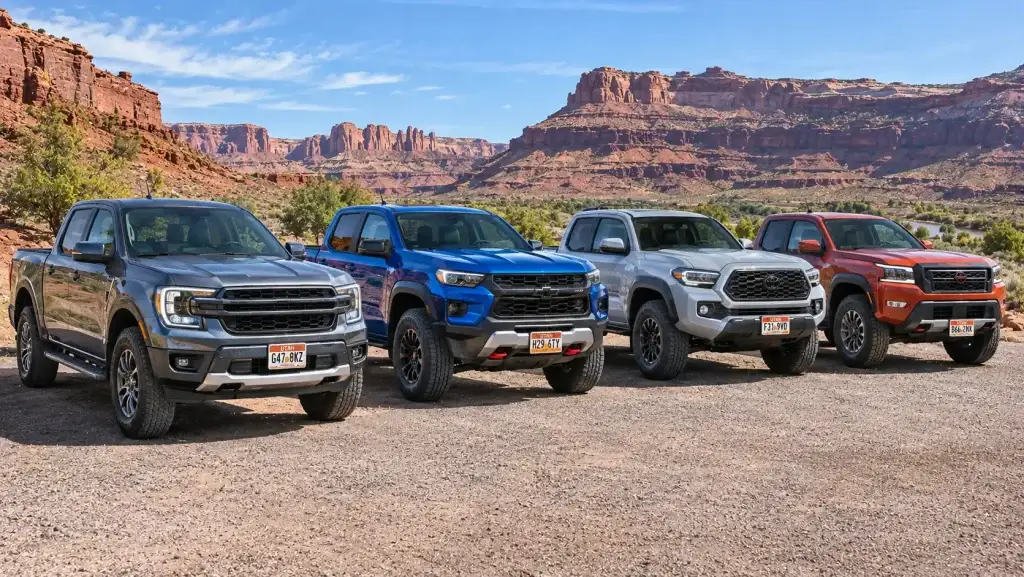
The Ranger sits near the top of its class, just behind the Chevy Colorado.
| 2026 midsize truck | Max towing capacity | Engine needed for max rating |
|---|---|---|
| Chevrolet Colorado | 7,700 lbs | 2.7L TurboMax with trailering package |
| Ford Ranger | 7,500 lbs | 2.3L or 2.7L EcoBoost with Trailer Tow Package |
| Nissan Frontier | About 7,150 lbs | 3.8L V6, select configurations |
| Toyota Tacoma | 6,500 lbs | 2.4L turbo (non-hybrid) |
On paper the gap between the Ranger and the Colorado is only 200 lbs, which you’d never notice in practice. The Ranger’s 10-speed automatic and the option of a 400 lb-ft V6 make it one of the more relaxed midsize trucks to tow with, and it out-pulls the Tacoma by a full 1,000 lbs.
Frequently Asked Questions
How much can a Ford Ranger tow?
A 2019–2026 Ford Ranger can tow up to 7,500 lbs with the factory Trailer Tow Package, or 3,500 lbs without it. The Ranger Raptor tows up to 5,510 lbs.
What is the Ford Ranger towing capacity in kg?
7,500 lbs is 3,402 kg. The Raptor’s 5,510 lbs is about 2,499 kg, and the 3,500-lb bumper limit is about 1,588 kg.
What is the Ford Ranger 2.3 EcoBoost towing capacity?
The 2.3L EcoBoost four-cylinder is rated at 7,500 lbs in both 4×2 and 4×4 form when the truck has the Trailer Tow Package. That’s true for every model year from 2019 to 2026.
What is the Ford Ranger 2.7 EcoBoost towing capacity?
Also 7,500 lbs. The 2.7L V6 doesn’t raise the maximum, but it has more torque (400 lb-ft) and a higher GCWR (12,745 lbs), so it handles heavy trailers and hills with less strain.
What is the Ranger Raptor towing capacity?
The 2024–2026 Ranger Raptor tows up to 5,510 lbs, with a 550-lb maximum tongue weight. Its hitch, wiring and trailer brake controller are standard.
What is the tow rating for a 2019 Ford Ranger?
The 2019 Ford Ranger is rated to tow 7,500 lbs with the 2.3L EcoBoost and the factory Trailer Tow Package. Without the package, it’s limited to 3,500 lbs.
What was the towing capacity of a 2006 or 2007 Ford Ranger?
Up to 6,000 lbs with the 4.0L V6, an automatic transmission and a Regular Cab 4×2 body. Four-cylinder trucks were rated around 2,200 lbs, and manual-transmission V6 trucks around 3,400 lbs.
What is the 2025 Ford Ranger GVWR?
About 6,050 lbs for a 2.3L 4×2 and 6,170 lbs for a 2.3L 4×4. The Raptor’s GVWR is 6,790 lbs. Your truck’s exact figure is on the label in the driver’s door jamb.
Does 4×4 reduce the Ford Ranger’s towing capacity?
Not the maximum rating. Current 4×2 and 4×4 Rangers both tow 7,500 lbs. The 4×4 system adds weight, though, which slightly lowers payload.
Can a Ford Ranger tow a travel trailer?
Yes. Most single-axle and many lighter dual-axle travel trailers, roughly 4,500–6,000 lbs loaded, are a good match. Check the trailer’s loaded weight, its tongue weight against your payload, and its frontal area (55 sq. ft. max with the tow package).
The Bottom Line
The Ford Ranger’s towing weight is one of the strongest in the midsize class: 7,500 lbs for every 2019–2026 truck with the tow package, 5,510 lbs for the Raptor, and up to about 6,000 lbs for well-equipped 2006–2011 trucks.
But the number on the brochure is only the starting point. The tow package, your payload, your passengers and even the altitude you drive at decide what you can safely pull. Do the quick math above, check the stickers on your door, and your Ranger will handle that boat, camper or car hauler without breaking a sweat.