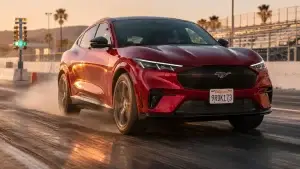

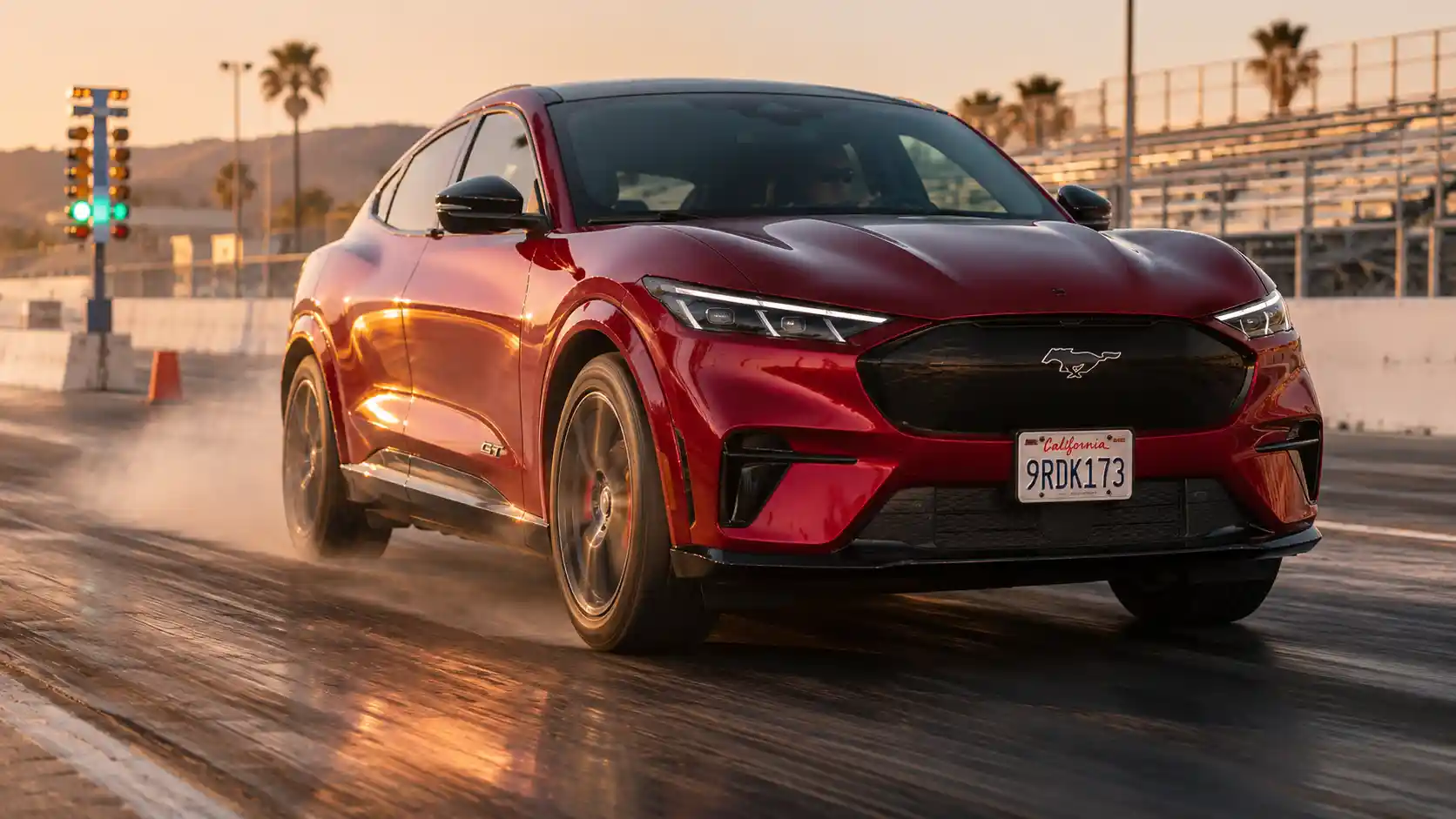
The quickest Mustang Mach-E hits 60 mph in 3.3 seconds. That’s a 2024-or-newer Mach-E GT with Ford’s Performance Upgrade, and that’s quicker than the V8 Mustang GT and even the 500-hp Dark Horse in published magazine tests.
But “the Mach-E does 0-60 in 3.3” is only true for one configuration. The same badge covers a rear-drive Select that takes 5.6 seconds, early 2021 cars rated as slow as 6.1, and a Rally that sits in between the two GTs. Battery size, drivetrain, model year and one $995 software unlock all change the answer.
This guide sorts it out. You’ll find Ford’s official Mustang Mach-E 0-60 times for every trim, how the numbers changed from 2021 to 2026, what independent testers actually measured, why your own car may feel slower, and how the electric Mustang stacks up against the Mustang GT and Mach 1.
Quick answer: Mustang Mach-E 0-60 times (2025–2026, Ford figures)
- GT with Performance Upgrade: 3.3 seconds
- Rally: 3.4 seconds
- GT (standard): 3.8 seconds
- Select / Premium, extended range, eAWD: 4.2 seconds
- Select / Premium, standard range, eAWD: 4.6 seconds
- Premium, extended range, RWD: 5.4 seconds
- Select / Premium, standard range, RWD: 5.6 seconds
2026 Mustang Mach-E 0-60 Times by Trim
Every 2026 Mach-E reaches 60 mph in under 6 seconds, and the gap between the slowest and quickest version is 2.3 seconds. Here is the full lineup, using Ford’s published figures for horsepower, torque, 0-60 and EPA-estimated range.
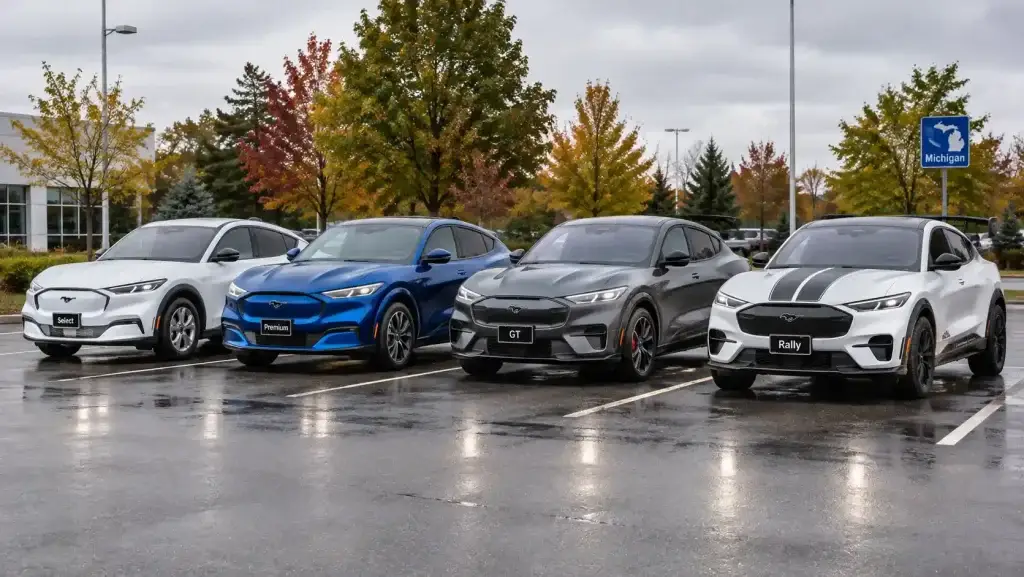
| Trim and setup | Battery | Horsepower | Torque | 0-60 mph | EPA range |
|---|---|---|---|---|---|
| GT eAWD + Performance Upgrade | Extended (91 kWh) | 480 hp | 700 lb-ft | 3.3 sec | 280 mi |
| Rally eAWD | Extended (91 kWh) | 480 hp | 700 lb-ft | 3.4 sec | 255 mi |
| GT eAWD | Extended (91 kWh) | 480 hp | 600 lb-ft | 3.8 sec | 280 mi |
| Select / Premium eAWD | Extended (88 kWh) | 370 hp | 500 lb-ft | 4.2 sec | 300 mi |
| Select / Premium eAWD | Standard (73 kWh) | 325 hp | 500 lb-ft | 4.6 sec | 240 mi |
| Premium RWD | Extended (88 kWh) | 272 hp | 387 lb-ft | 5.4 sec | 320 mi |
| Select / Premium RWD | Standard (73 kWh) | 264 hp | 387 lb-ft | 5.6 sec | 260 mi |
Two patterns jump out. First, all-wheel drive matters more than battery size: a standard-range eAWD car beats an extended-range RWD car by almost a full second, because the front motor adds 113 lb-ft and puts power through all four tires. Second, the quickest Mach-E is not the longest-range Mach-E. If you want both speed and miles, the extended-range eAWD Premium at 4.2 seconds and 300 miles is the sweet spot.
Ford measures these times with a one-foot rollout, the same method most US magazines use. That means the clock starts after the car has already moved about a foot, which trims a couple of tenths compared with a stopwatch from a dead stop.
Mach-E GT 0-60: 3.8 or 3.3 Seconds?
A Mach-E GT runs 0-60 in 3.8 seconds as it leaves the factory, or 3.3 seconds with the GT Performance Upgrade. Both versions make 480 hp. The difference is torque: the upgrade unlocks an extra 100 lb-ft, from 600 to 700 lb-ft.
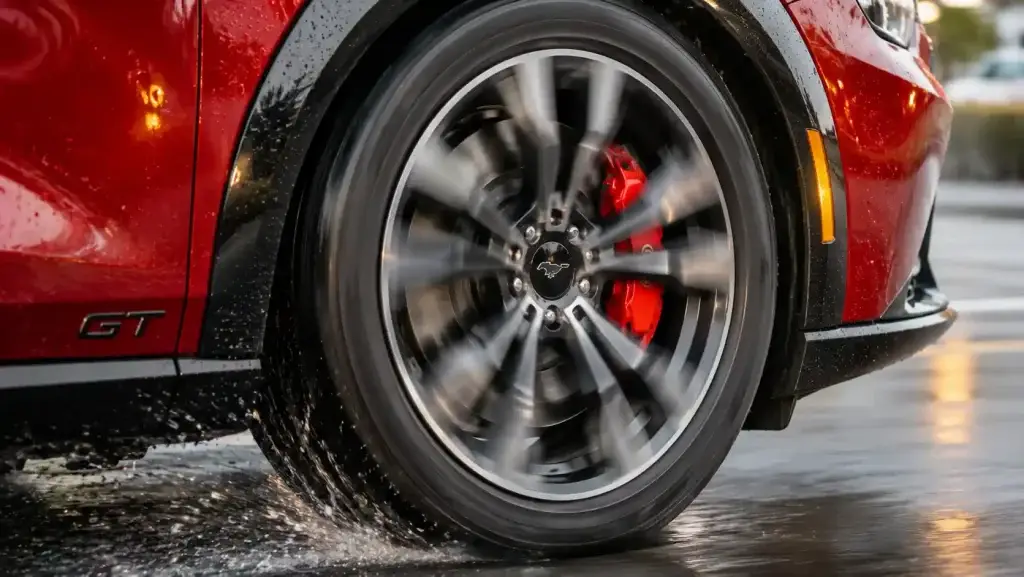
Ford introduced the upgrade for the 2024 model year. It was possible because the 2024 GT got a new Ford-designed rear motor plus revised thermal-management and motor-control software. Ford also claims a quarter-mile of 11.8 seconds at 114 mph for an upgraded GT, down from 12.4 seconds without it.
What you should know before buying a GT for its 0-60 time:
- It’s a software unlock. US owners could add it at purchase or later through the FordPass app for a one-time $995.
- It only works on 2024 and newer GTs. The 2021–2023 GT lacks the hardware, so no update turns an older car into a 3.3-second car.
- It’s standard on the Rally. Every Rally already has 700 lb-ft.
- The 2026 name changed. Ford lists a new GT Performance & Handling Package for 2026, so check the window sticker or build sheet rather than trusting a listing’s description.
What about the old GT Performance Edition?
From 2021 to 2023, Ford sold a separate GT Performance Edition with 634 lb-ft, Pirelli summer tires and MagneRide dampers, rated at 3.5 seconds. The regular GT of those years was rated at 3.8 seconds. The Performance Edition ended after 2023, when the new upgrade replaced it. Shopping used, a “GT Performance” badge from 2022 is a 3.5-second car on paper, not a 3.3.
Mach-E Rally 0-60
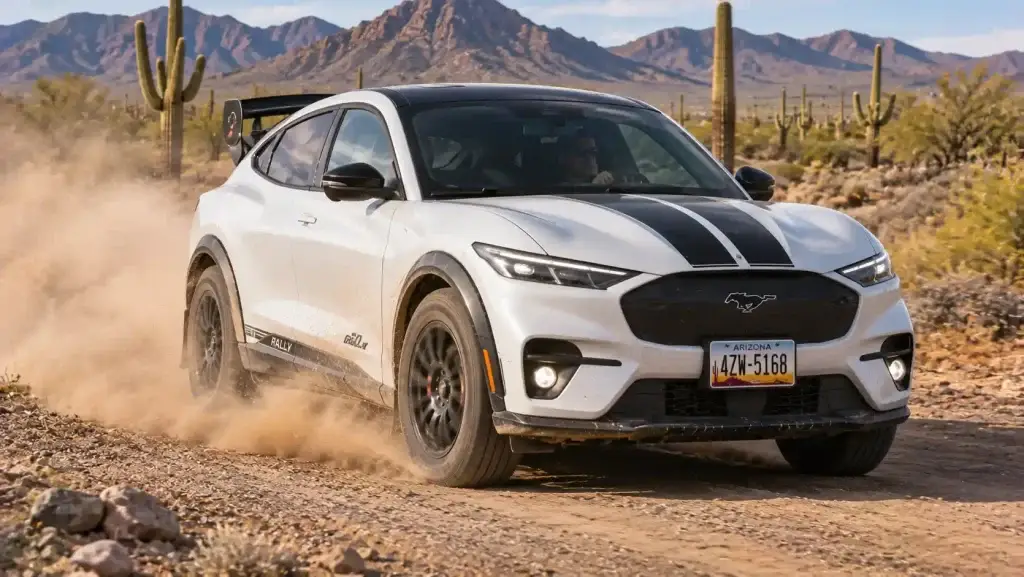
The Rally does 0-60 in 3.4 seconds, a tenth behind an upgraded GT. It has the same 480 hp and 700 lb-ft, but it adds rallycross-tuned MagneRide dampers, an aluminum underbody shield, a raised rear spoiler and 19-inch wheels, a setup tuned for loose surfaces rather than a dry drag strip. It also gives up range: 255 miles versus the GT’s 280. You buy the Rally for gravel roads and the look, and you get nearly GT acceleration as a bonus.
Mach-E Premium and Select 0-60
The Mach-E Premium 0-60 time ranges from 4.2 to 5.6 seconds, and the Select runs 4.2 to 5.6 as well, because both trims share the same four powertrains. Premium adds comfort and tech, not speed. The one exception: only the Premium offers the extended-range battery with rear-wheel drive, the 320-mile range king, at 5.4 seconds.
So when someone asks for the “Mach-E Premium 0-60,” the honest answer depends on the window sticker:
- Premium extended-range eAWD: 4.2 seconds. The quickest non-GT Mach-E and the trim most owners pick.
- Premium standard-range eAWD: 4.6 seconds.
- Premium extended-range RWD: 5.4 seconds, with the longest range in the lineup.
- Premium standard-range RWD: 5.6 seconds.
For context, 4.2 seconds is quicker than a 2024 Mustang EcoBoost, which Car and Driver tested at 4.5 seconds. Even the base rear-drive Select at 5.6 seconds feels lively in traffic, because an electric motor delivers its full torque from zero rpm. There’s no waiting for a turbo to spool or a transmission to kick down.
Independent testing backs this up. Car and Driver reportedly clocked a 2025 Premium extended-range eAWD at 4.1 seconds, a tenth better than Ford’s own claim.
Mustang Mach-E 0-60 by Model Year (2021–2026)
The Mach-E got noticeably quicker for 2024, and that matters most if you’re shopping used. Ford raised torque on every non-GT powertrain that year (standard RWD went from 317 to 387 lb-ft, eAWD from 428 to 500 lb-ft), and 0-60 times dropped by as much as 0.7 seconds.
| Configuration | 2021–2023 (Ford claim) | 2024–2026 (Ford claim) |
|---|---|---|
| Standard range RWD | 5.8 sec (2023 Select quoted at 6.3) | 5.6 sec |
| Standard range eAWD | 5.2 sec | 4.6 sec |
| Extended range RWD | 6.1 sec | 5.4 sec |
| Extended range eAWD | 4.8 sec | 4.2 sec (4.1 quoted at the 2024 launch) |
| GT | 3.8 sec | 3.8 sec |
| GT Performance Edition (2021–2023) | 3.5 sec | Discontinued |
| GT + Performance Upgrade | Not available | 3.3 sec |
| Rally (2024 on) | Not offered | 3.4 sec |
A few model-year notes that most spec sheets skip:
- 2021: The launch year. Ford quoted conservative times for the base cars; the extended-range RWD was officially the slowest Mach-E at 6.1 seconds because its bigger, heavier pack drove the same single rear motor.
- 2022: A carryover year for acceleration. The Mach-E GT and GT Performance Edition were the stars, and New York City put 184 Mach-E GTs into its emergency-vehicle fleet that year.
- 2023: Ford began using LFP battery cells in some standard-range cars, and its quoted figure for the base Select slipped to 6.3 seconds.
- 2024: The big performance year: more torque across the range, a new rear motor for the GT, the $995 Performance Upgrade and the new Rally trim.
- 2025–2026: Times unchanged from 2024. For 2026, Ford added a California Special package and lists a new GT Performance & Handling Package.
If you’re comparing a 2022 and a 2024 listing at similar prices, the 2024 car is quicker in every non-GT configuration and charges faster too.
Ford’s Claims vs Real-World Tests
Independent tests mostly match or beat Ford’s 0-60 claims, but early GTs ran out of breath after 60 mph. Here’s what US testers have recorded:
| Car tested | Tester | 0-60 mph | Quarter mile |
|---|---|---|---|
| 2024 Mach-E Rally | Car and Driver (reported) | 3.3 sec | 11.8 sec at 113 mph |
| 2021 GT Performance Edition | Car and Driver | 3.7 sec | 12.7 sec at 101 mph |
| 2021 GT Performance Edition | Edmunds | 3.8 sec | 12.4 sec at 102.6 mph |
| 2025 Premium ext. range eAWD | Car and Driver (reported) | 4.1 sec | 13.0 sec at 104 mph |
| 2021 Premium ext. range eAWD | Car and Driver | 5.1 sec | 13.8 sec at 101 mph |
Look at the trap speeds. The 2021 GT Performance Edition was more than a second quicker to 60 than the regular extended-range car, yet crossed the quarter-mile at the same 101 mph. Testers found the reason: on hard runs the early GT cut power after roughly five seconds, and Car and Driver’s gauges showed it pulling back around 80 mph. Edmunds’ track test of the Mach-E GT found the GT was barely faster than a Premium extended-range car by the end of the quarter mile.
Ford’s answer was the 2024 hardware and software rework. The reported 2024 Rally result, 11.8 seconds at 113 mph, shows a car that keeps pulling well past 60, a 12-mph jump in trap speed over the early GT Performance Edition.
One owner who took a 2021 GT Performance Edition to an Iowa drag strip ran 12.66 seconds at 100 mph with a 3.89-second 0-60 on a Dragy meter. That’s a useful reality check: a normal driver on a normal day lands a few tenths behind the magazine numbers.
Why Your Mach-E Feels Slower Than the Spec Sheet
Most owners who time their own Mach-E come up a few tenths short of Ford’s number, and that’s normal. Electric cars are sensitive to conditions in ways gas cars aren’t. These are the usual culprits:
- Battery state of charge. An EV pack delivers its peak power when it’s well charged. Below roughly a third, many owners notice softer launches.
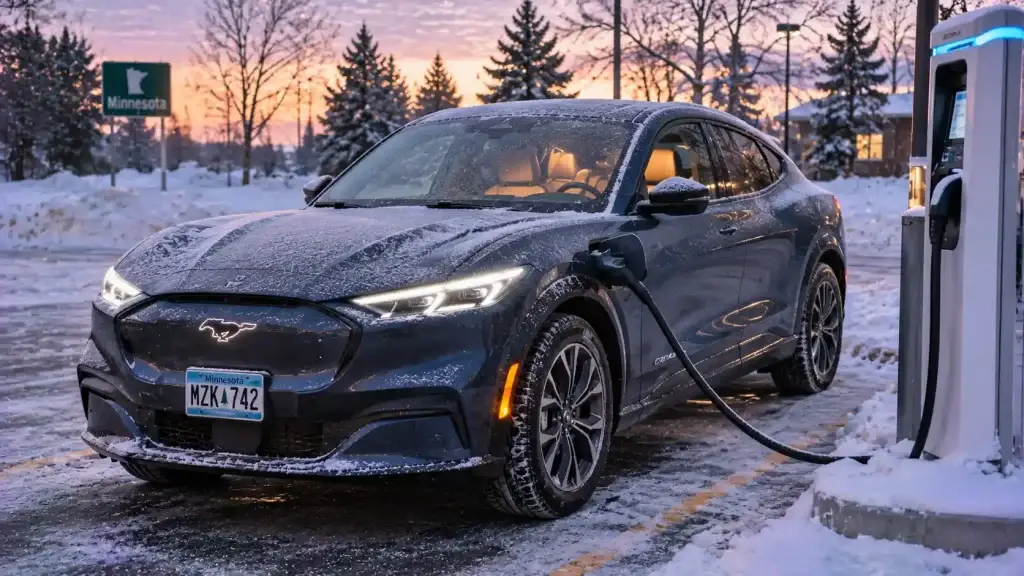
- Battery temperature. A cold pack can’t release full power. A Mach-E that sat outside on a January morning in Minnesota won’t match its summer self until the battery warms up.
- Drive mode. Ford’s three modes are Whisper, Engage and Unbridle. Whisper softens throttle response; Unbridle sharpens it. Timed runs belong in Unbridle.
- Tires. Worn tread, all-season rubber or the wrong pressures cost traction off the line. This hits RWD cars hardest.
- No rollout. Ford and magazines start the clock after the first foot of travel. Phone apps and GPS meters often don’t, which adds about two to three tenths.
- Missing upgrade. A used GT without the Performance Upgrade is a 3.8-second car. Confirm the feature on the actual vehicle, not the badge.
- Load and grade. Two adults, a full cargo area and a slight uphill all add time.
How to get your best 0-60 run safely
Only test on a closed course or at a drag strip’s test-and-tune night. Many US tracks run them for a small entry fee, and you’ll get a timing slip that counts.
- Charge to 80–90% and drive 15–20 minutes beforehand so the battery is warm.
- Set tire pressures to the door-jamb placard.
- Select Unbridle mode.
- Hold the brake, then release it and go to full throttle in one smooth motion. Unlike a turbo car, an EV gains nothing from brake-torquing, so a clean release matters more than technique.
- Make two or three runs and use the best one. Repeated hard runs heat the battery and motors, so expect the later runs to be a bit slower.
Electric Mustang 0-60 vs Mustang GT and Mach 1
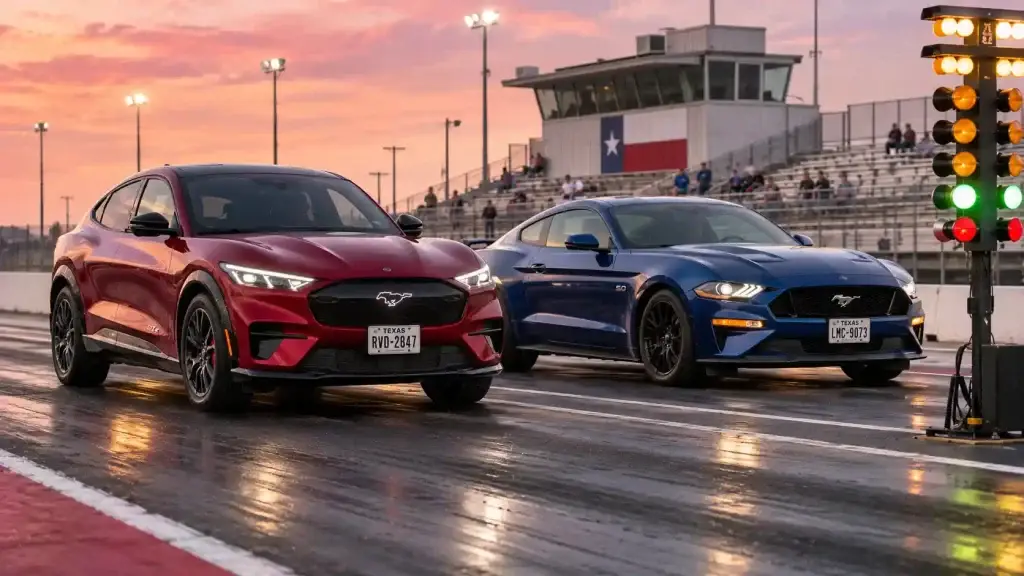
An upgraded Mach-E GT is quicker to 60 than any V8 Mustang GT, Mach 1 or Dark Horse in published magazine tests. The gas cars win back ground at higher speeds and on track, but from a stop the electric Mustang gets there first.
| Mustang | Years | Power | 0-60 mph (tested) |
|---|---|---|---|
| Mach-E GT + Performance Upgrade | 2024–2026 | 480 hp, electric | 3.3 sec (Ford) |
| Mustang Dark Horse, 10-speed auto | 2024– | 500 hp, 5.0L V8 | 3.7 sec (MotorTrend) |
| Mustang GT, 10-speed auto | 2024– | 480 hp, 5.0L V8 | 3.9 sec |
| Mustang GT, 10-speed auto | 2018–2023 | 460 hp, 5.0L V8 | 3.9 sec (MotorTrend, 2018) |
| Mustang Mach 1 | 2021–2023 | 480 hp, 5.0L V8 | 4.2 sec auto (MotorTrend), 4.3 sec manual (Car and Driver) |
| Mustang GT, 6-speed manual | 2018–2023 | 460 hp, 5.0L V8 | 4.4 sec (MotorTrend, 2018) |
| Mustang EcoBoost | 2024– | 2.3L turbo four | 4.5 sec (Car and Driver) |
2022 Ford Mustang GT 0-60
A 2022 Mustang GT is a sixth-generation S550 car with the 460-hp Coyote V8. Expect about 3.9 seconds with the 10-speed automatic and roughly 4.4 seconds with the 6-speed manual, based on MotorTrend’s testing of the same powertrain. That puts a 2022 GT automatic right next to a standard Mach-E GT at 3.8.
Mustang Mach 1 0-60
The gas Mustang Mach 1 (2021–2023) runs 0-60 in about 4.2 to 4.5 seconds depending on the transmission and the test. With the available Handling Package’s sticky Michelin Pilot Sport Cup 2 tires, it’s built for road courses, not drag-strip launches. Fun fact: Ford originally teased the electric crossover as “Mach 1” and dropped the idea after fan backlash, and the Mach-E name still nods to it. If you want the full family tree, our Mustang generations guide covers every era from the 1964½ car to today’s S650.
One more Mustang truth: the Mach-E is heavier than any coupe, roughly 4,400 to 4,900 lb depending on trim, so it wins the sprint with instant torque and all-wheel-drive grip, not lightness. Browse the rest of our Ford Mustang guides for model-by-model specs and ownership advice.
How the Mach-E compares with Ford trucks
The Mach-E is also the quickest thing in most Ford driveways. Edmunds measured a 2024 Ranger at 6.7 seconds with the 2.3L four and 6.2 seconds with the 2.7L V6, and even the 405-hp Ranger Raptor needed about 6.1 seconds in their test. Plenty of Mach-E owners keep a truck for the heavy lifting; if yours is a Ranger, our Ranger towing weight guide shows exactly what each version can pull, and a Ford Mustang Mach-E covers the 2021–2024 trucks if you do your own servicing.
Want electric torque in a pickup instead? The F-150 PowerBoost hybrid pairs a 3.5L twin-turbo V6 with an electric motor for 430 hp and 570 lb-ft.
Which Mach-E Should You Buy for Acceleration?
For most buyers, the extended-range eAWD Premium is the best balance: 4.2 seconds to 60 and 300 miles of EPA range. It’s genuinely quick, it costs far less than a GT, and it gives up very little in daily driving. Check exact ranges for any year on the EPA’s fueleconomy.gov before you buy.
- You want the quickest Mach-E: A 2024-or-newer GT with the Performance Upgrade (3.3 sec). Verify the upgrade on the actual car.
- You want quick plus gravel-road ability: The Rally (3.4 sec), accepting 255 miles of range.
- You want the best all-rounder: Premium extended-range eAWD (4.2 sec, 300 mi).
- You want the most range per dollar: Premium extended-range RWD (5.4 sec, 320 mi).
- You’re on a budget: Select standard-range eAWD (4.6 sec). It’s quicker than an extended-range RWD car and keeps the all-weather grip.
- You’re buying used: Favor 2024 and newer for the torque boost, or a 2021–2023 GT Performance Edition if you want a sub-4-second car for less.
Final Verdict
The Mustang Mach-E 0-60 time runs from 5.6 seconds in a base rear-drive Select to 3.3 seconds in an upgraded GT, and every version is quicker than its price suggests. The number that matters is the one for your exact trim, battery, drivetrain and model year, so check all four before you compare. Get those right and the electric Mustang delivers what the badge promises: in Rally or upgraded GT form, it launches harder than any V8 Mustang on a dealer lot.
Mustang Mach-E 0-60 FAQs
How fast is a Mustang Mach-E 0-60?
Between 3.3 and 5.6 seconds for 2024–2026 models, depending on trim. The GT with the Performance Upgrade is quickest at 3.3 seconds; the standard-range rear-drive Select and Premium are slowest at 5.6.
What is the Mach-E GT 0-60 time?
The Mustang Mach-E GT does 0-60 in 3.8 seconds, or 3.3 seconds with the GT Performance Upgrade on 2024 and newer cars. The 2021–2023 GT Performance Edition was rated at 3.5 seconds.
What is the Mach-E Premium 0-60 time?
A Mach-E Premium runs 0-60 in 4.2 seconds with the extended-range battery and eAWD, 4.6 seconds with the standard-range battery and eAWD, 5.4 with extended-range RWD and 5.6 with standard-range RWD.
Is the Mustang Mach-E faster than a Mustang GT?
To 60 mph, yes, in its GT and Rally forms. An upgraded Mach-E GT is rated at 3.3 seconds versus about 3.9 seconds for a V8 Mustang GT automatic. The gas Mustang GT has a higher top speed and is stronger on a road course.
Is the Mach-E faster than a Mustang Mach 1?
Yes, every Mach-E GT and Rally beats the 2021–2023 Mach 1, which tested between 4.2 and 4.5 seconds. An extended-range eAWD Premium at 4.2 seconds roughly ties it.
Can I add the Performance Upgrade to my 2022 Mach-E GT?
No. The upgrade requires hardware first used on the 2024 GT, so it’s only offered for 2024 and newer GTs.
Does cold weather slow down a Mach-E?
Yes. A cold battery limits peak power, so 0-60 times are slower until the pack warms up. Driving for 15 to 20 minutes or preconditioning while plugged in helps.
What is the fastest electric Mustang ever?
For street cars, the 2024-and-newer Mach-E GT with the Performance Upgrade, at 3.3 seconds. Ford’s one-off Mach-E 1400 prototype and the Super Mustang Mach-E hill-climb racer are far quicker, but neither is a road car.