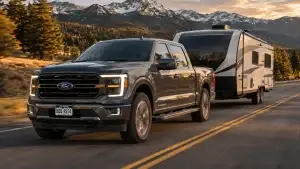

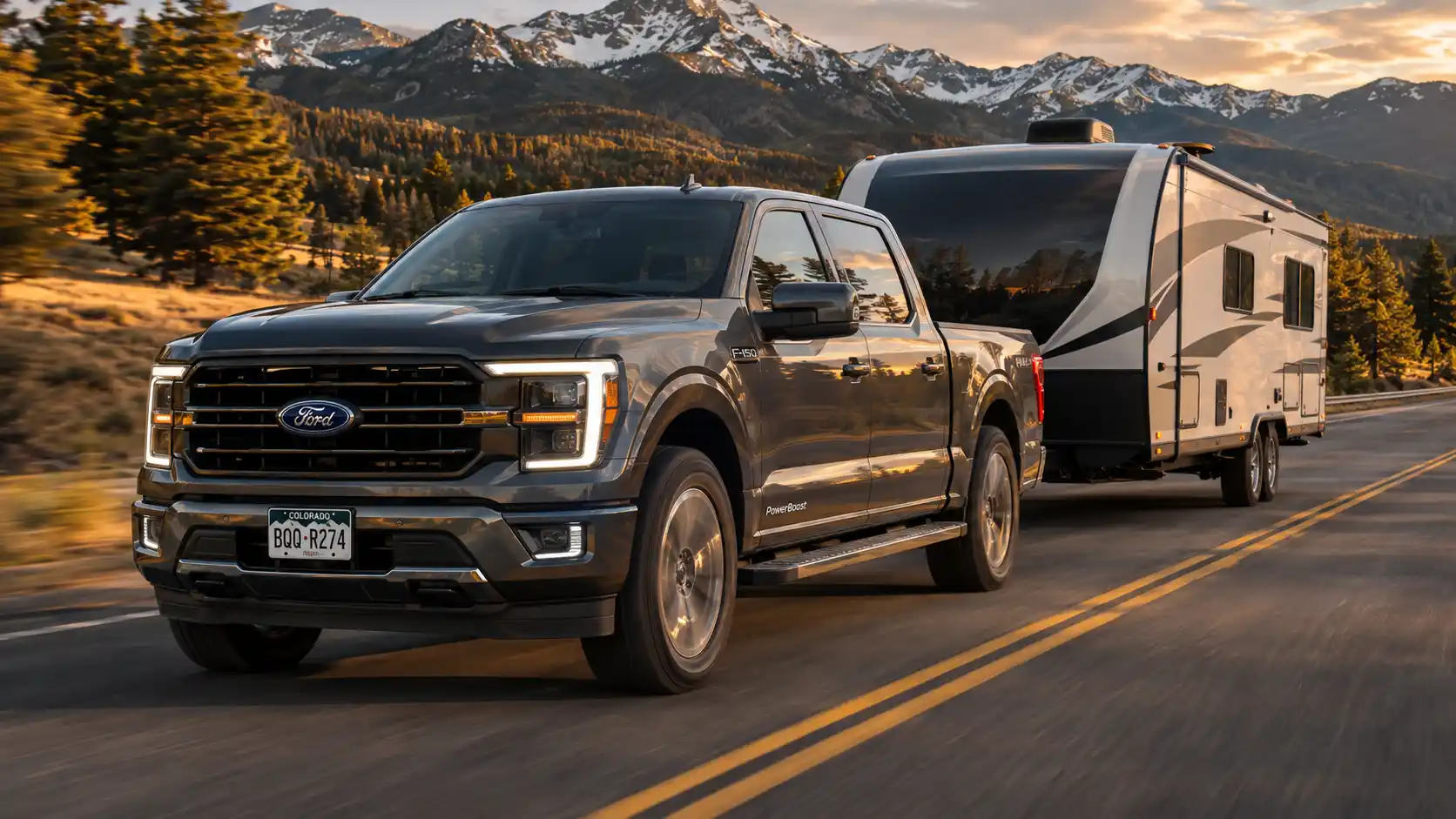
The Ford F-150 PowerBoost hybrid is the strangest kind of efficient truck: the most fuel-thrifty F-150 you can buy is also the one with the most torque outside the Raptor. It never needs a plug, it can tow a 30-foot camper, and with the right option box it can run a jobsite or a refrigerator during a blackout.
It is also a truck with a complicated reputation. Early 2021 and 2022 trucks earned some of the worst reliability scores in the industry, while later model years have climbed to average. That split matters a lot if you are shopping for a used F150 PowerBoost.
This guide covers everything in one place. You get the real specs, EPA and real-world MPG, towing by model year, what Pro Power Onboard can and cannot do, 2026 pricing, what changes for 2027, and a checklist for buying one used.
Quick answer: The Ford F-150 PowerBoost is a full hybrid (not a plug-in) that pairs Ford’s 3.5L twin-turbo EcoBoost V6 with a 47-hp electric motor and a 1.5 kWh battery. It makes 430 hp and 570 lb-ft, returns up to 24 mpg combined (2WD), tows up to 11,600 lbs on 2026 models (12,700 lbs on 2021), and offers up to 7.2 kW of exportable power. New 2026 PowerBoost trucks start around $56,625 (STX). For used buyers, 2023 and newer trucks have far fewer owner complaints than 2021–2022.
New to the 14th-generation truck? Our Ford F-150 guide covers the full lineup and every engine.
What Is the Ford PowerBoost, and How Does It Work?
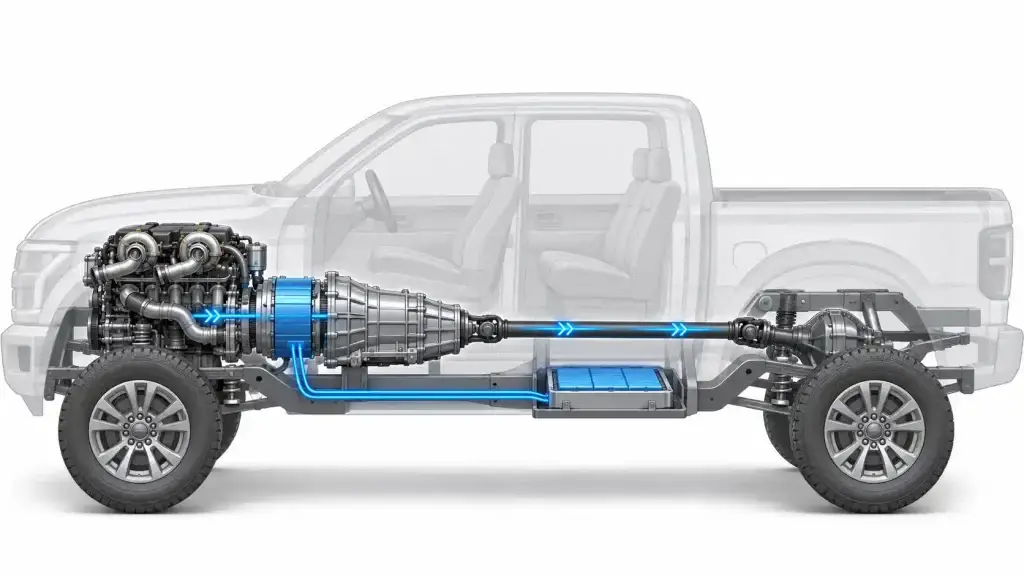
The Ford PowerBoost is a full-hybrid version of the F-150 that arrived with the 14th-generation truck for the 2021 model year. It was the first hybrid ever offered in a Ford pickup, and it took over from the 3.0L Power Stroke diesel, which Ford dropped after 2021, as the F-150’s efficiency pick. You can read how it fits into the truck’s long timeline in our Ford F-Series generations guide.
The hardware is simpler than it sounds. Ford took its familiar 3.5L twin-turbo EcoBoost V6 and slipped a 47-hp (35 kW) electric motor-generator between the engine and the 10-speed automatic. A small 1.5 kWh lithium-ion battery stores energy for that motor.
Here is what happens as you drive:
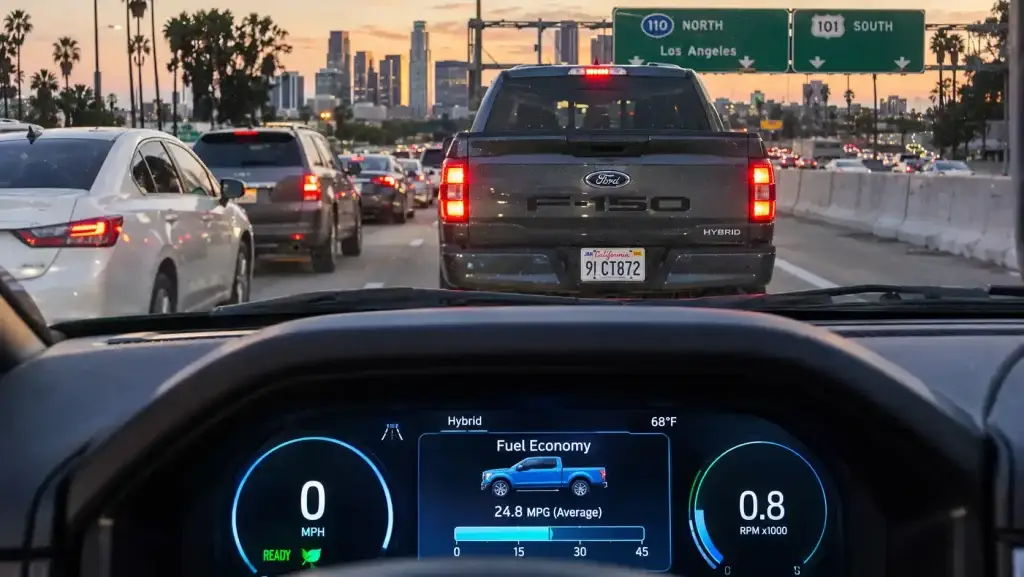
- Pulling away and parking-lot speeds: the truck can move on electric power alone for short stretches, which is why it shines in city traffic.
- Hard acceleration and towing: the motor adds instant torque on top of the turbo V6, filling the gap before the turbos spool.
- Braking and coasting: the motor works as a generator, sending energy back into the battery instead of wasting it as brake heat.
- Cruising: the gas engine does most of the work, and the engine can shut off more often than a normal auto start-stop system.
You never plug a PowerBoost in. The battery charges itself from the engine and from regenerative braking, so you fuel it exactly like any other F-150. That is the key difference from the F-150 Lightning EV, which Ford stopped building in 2025 and which always needed a charger.
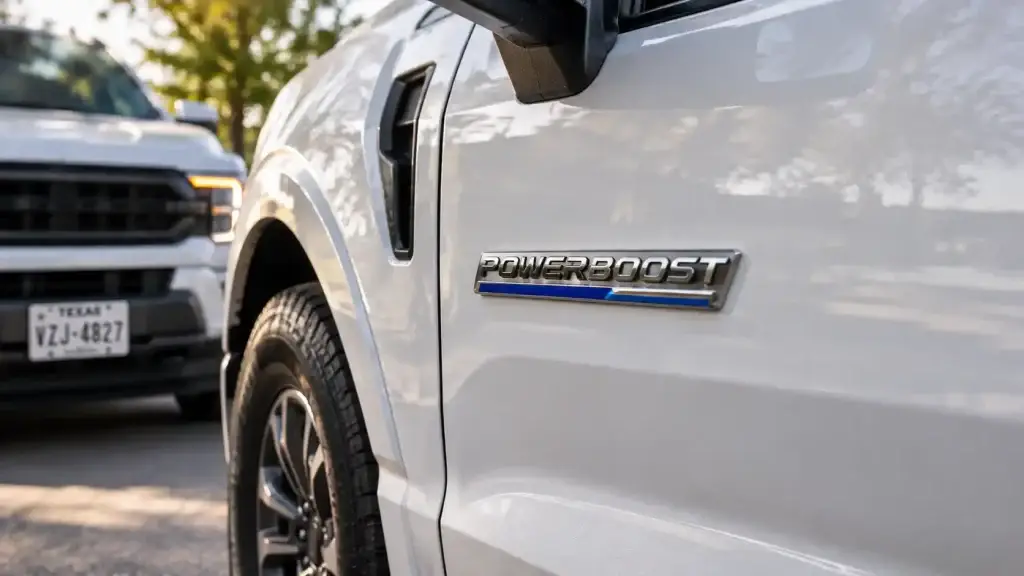
The PowerBoost is only built as a four-door SuperCrew. If you want a Regular Cab or SuperCab, you will need a gas engine.
F-150 PowerBoost Specs at a Glance
The numbers below are for the current 2026 truck unless noted. The biggest spec change since launch is towing, which has come down from the original 2021 rating.
| Spec | Ford F-150 PowerBoost hybrid |
|---|---|
| Engine | 3.5L twin-turbo EcoBoost V6 + 47 hp (35 kW) electric motor |
| Battery | 1.5 kWh lithium-ion, self-charging |
| Transmission | 10-speed hybrid automatic |
| Output | 430 hp / 570 lb-ft (some 2026 Ford trim pages list 420 hp) |
| EPA fuel economy (2026) | 2WD 23 city / 25 hwy / 24 combined; 4WD 22 / 24 / 23 |
| Max towing (2026) | Up to 11,600 lbs, properly equipped (12,700 lbs on 2021 models) |
| Max payload (2026) | Up to 1,740 lbs on 4×4 (up to 2,120 lbs on 2021 models) |
| Pro Power Onboard | 2.4 kW standard, 7.2 kW optional (with 240V outlet) |
| Cab | SuperCrew only |
| Hybrid warranty | 8 years / 100,000 miles on hybrid components |
A note on horsepower: Ford has rated the PowerBoost at 430 hp since 2021, and its 2027 ordering data still says 430. Some 2026 Ford trim pages and towing materials list 420 hp, which is why you will see both figures on dealer sites. Torque is consistently 570 lb-ft.
That torque figure is the headline. It beats the 3.5L EcoBoost’s 500 lb-ft by a wide margin, and only the supercharged Raptor R tops it in the F-150 family.
Ford F150 PowerBoost MPG: EPA Ratings vs Real-World Results
The PowerBoost is the most fuel-efficient F-150 you can buy, but its advantage lives almost entirely in the city. On the highway, the hybrid and the gas EcoBoost engines are rated within a single mpg of each other.
| 2026 F-150 engine (2WD) | City | Highway | Combined | EPA annual fuel cost |
|---|---|---|---|---|
| 3.5L PowerBoost hybrid | 23 | 25 | 24 | $2,600 |
| 2.7L EcoBoost V6 | 19 | 25 | 21 | $2,950 |
| 3.5L EcoBoost V6 | 17 | 25 | 20 | $3,100 |
| 5.0L V8 | 16 | 24 | 19 | $3,300 |
The 4WD PowerBoost drops one mpg across the board to 22 city, 24 highway and 23 combined, with an EPA fuel cost estimate of about $2,700 a year. You can compare any configuration yourself on FuelEconomy.gov, the official EPA and Department of Energy site.
What the numbers mean in dollars: using EPA’s own estimates (15,000 miles a year), a 2WD PowerBoost saves about $500 a year in fuel over the 3.5L EcoBoost and about $350 over the 2.7L. Over a typical five-year ownership, that is roughly $1,750 to $2,500, which matters when you compare it with the price of the hybrid option.
Real-world MPG: what owners actually see
Real-world economy usually lands at or just below the sticker. A recent road test of a 2026 4WD Lariat averaged about 22 mpg against its 23 combined rating. Owners commonly report the following patterns:
- Best results come from suburban and stop-and-go driving, where the electric motor does the most work. Some owners report mid-20s on mixed trips.
- Highway at 75 mph and up erases most of the hybrid’s edge, because the gas engine is doing nearly all the work.
- Winter costs more mpg than you might expect. The engine runs more often to make cabin heat and keep the battery in its comfort zone.
- Towing cuts economy sharply, just as it does in any half-ton truck. Expect low double digits with a big travel trailer.
The 2021 trucks were rated slightly higher (25 combined for 2WD, 24 for 4WD) than every model year since. So on paper, an early 2021 F 150 PowerBoost is actually a touch more efficient than a new one.
How Much Can the F-150 PowerBoost Tow?
A properly equipped 2026 F-150 PowerBoost tows up to 11,600 lbs. That requires a 4×4 SuperCrew with the Tow/Haul package and the optional Max Tow axle, so many hybrid trucks on dealer lots are rated lower.
The rating has moved over the years, which matters if you are shopping used:
| Model year | Max towing | Max payload | Note |
|---|---|---|---|
| 2026 | 11,600 lbs | 1,740 lbs (4×4) | Current Ford rating |
| 2025 | 11,200 lbs | 1,750 lbs (4×4) | Per Ford dealer materials |
| 2021 | 12,700 lbs (4×2) / 12,400 lbs (4×4) | 2,120 lbs | Launch rating, the hybrid’s peak |
For context, the 2026 3.5L EcoBoost tows up to 13,500 lbs, so the gas engine is still the pick for the heaviest trailers. The hybrid gives up towing because its battery and motor add weight, and that weight comes out of payload and towing margin.
What 11,600 lbs means in the real world
- Comfortable: utility and landscape trailers, most bass and pontoon boats, small and mid-size travel trailers.
- Doable with care: larger travel trailers up to the low 30-foot range, if you stay within payload and use a weight-distributing hitch.
- Better left to the EcoBoost or a Super Duty: heavy fifth-wheels, car haulers near the limit, and frequent mountain towing at max weight.
Payload is usually the real limit, not the tow rating. A trailer’s tongue weight (10 to 15 percent of its weight), plus passengers and gear, all count against payload. Always read the yellow Tire and Loading sticker in the driver’s door jamb for your exact truck.
One genuine towing advantage: the electric motor’s instant torque makes slow, precise moves easier, like backing a boat down a ramp or creeping a camper into a tight site.
Pro Power Onboard: The Real Reason to Buy a PowerBoost
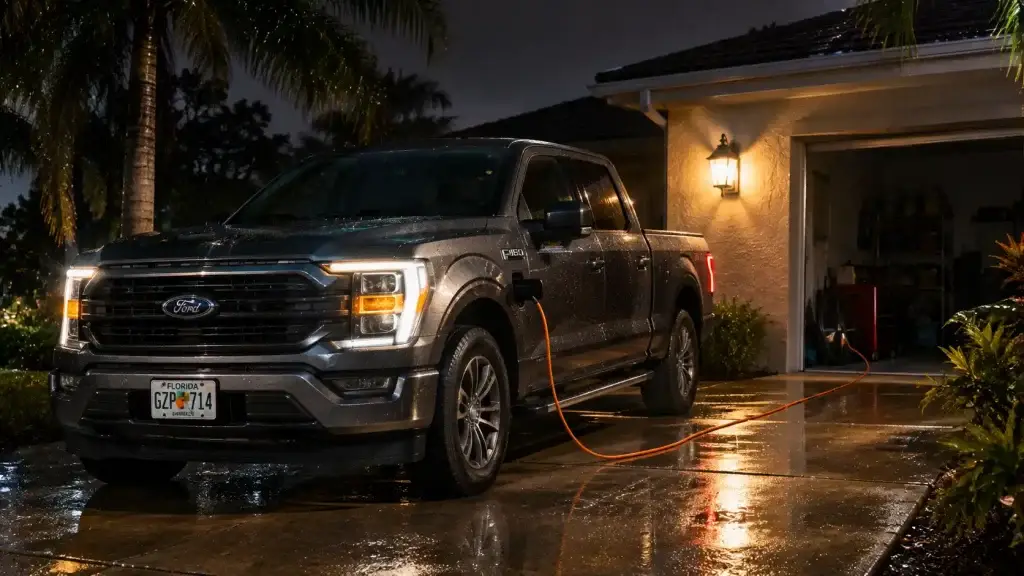
For many owners, the built-in generator matters more than the fuel savings. Every F-150 PowerBoost comes with Pro Power Onboard, and only the hybrid can get the big 7.2 kW version.
| System | Available on | Outlets | Good for |
|---|---|---|---|
| 2.0 kW | 3.5L EcoBoost gas trucks | 120V | Chargers, small tools, camp lights |
| 2.4 kW | Standard on every PowerBoost | 120V | Circular saws, small air compressors, coffee makers |
| 7.2 kW | PowerBoost only (option) | Four 120V/20A plus one 240V/30A (NEMA L14-30) | Welders, table saws, a fridge plus freezer, home essentials in an outage |
The system runs from the truck’s gas engine and hybrid battery. When the battery runs low, the engine starts automatically to recharge it, then shuts off again. That means it can keep running for many hours on a full tank, far longer than a typical portable generator.
Common uses owners mention
- Running miter saws, compressors and work lights on a jobsite with no temporary power.
- Tailgating and camping with a slow cooker, electric griddle or projector.
- Keeping a fridge, freezer, sump pump and a few lights alive during a storm outage.
Limits you should know
- Home backup needs extra hardware. To feed a house safely, Ford calls for the 7.2 kW system plus a GenerLink transfer switch installed by an electrician. Never backfeed a house through an extension cord.
- Startup surges count. Motors in compressors and fridges briefly pull far more than their running wattage.
- Output can drop while driving and in very hot or cold conditions.
If you plan to use the truck as a generator often, the 7.2 kW upgrade is the one option worth stretching for. It turns the PowerBoost from “a slightly thriftier F-150” into a tool no gas half-ton can match.
F-150 PowerBoost by Model Year (2021–2027)
The core hybrid hardware has not changed since 2021. What changed is price, towing, trim availability and, most of all, reliability.
| Model year | What changed | Buyer takeaway |
|---|---|---|
| 2027 | Carries over with 570 lb-ft and 2.4 or 7.2 kW Pro Power. Offered on STX, XLT, Lariat, King Ranch and Platinum; standard on the Platinum Plus package. Lineup adds BlueCruise with towing; 3.0L EcoBoost replaces the 2.7L. | Little reason to wait if you only want the hybrid. Note the hybrid can’t be paired with the 36-gallon tank. |
| 2026 | Hybrid offered on the STX trim for the first time. Max towing 11,600 lbs. Consumer Reports rates the F-150 lineup average for reliability. | Cheapest way into a new PowerBoost. |
| 2025 | Named one of Wards 10 Best Engines. Small fuse recall covering 47 trucks. | Strong used buy once prices settle. |
| 2024 | Mid-cycle refresh with new styling and tech. Ford priced the hybrid the same as the 3.5L EcoBoost on many trims. | Good value point for used shoppers. |
| 2023 | Mostly a carryover; owner complaints fall sharply. | Sweet spot for value and improved reliability. |
| 2022 | Consumer Reports named the hybrid its least reliable vehicle (4 out of 100). | Buy only with records and recall work done. |
| 2021 | Launch year: 430 hp, 570 lb-ft, 12,700-lb max tow, 25 mpg combined (2WD). The hybrid option averaged about $3,200 extra. | Highest towing rating, but the most complaints. |
If you are looking at a 2021 F 150 PowerBoost or a 2022 Ford F150 PowerBoost, the table’s last two rows are the important ones. These trucks can be great buys, but only after a careful check of recall and service history (see the used-buying checklist below).
Ford PowerBoost Price: What a New One Costs in 2026
A new 2026 F-150 PowerBoost starts at about $56,625 for an STX SuperCrew, before destination. The XLT hybrid starts at about $60,730, and well-optioned Lariat hybrids sit in the high $70,000s to low $80,000s.
| 2026 trim with PowerBoost | Approx. starting MSRP | Who it suits |
|---|---|---|
| STX | $56,625 | Budget buyers who want the hybrid and 2.4 kW power |
| XLT | $60,730 | The volume pick; most hybrid stock on lots |
| Lariat | High $70Ks with typical options | Heated and cooled seats, BlueCruise availability |
| King Ranch / Platinum | $80K and up | Luxury buyers; 7.2 kW often optioned |
The hybrid is no longer a big premium at the top of the range, because Ford has priced it close to the 3.5L EcoBoost on higher trims since 2024. On cheaper trims, it is a bigger jump over the base engine.
Pay less than sticker. Real 2026 XLT hybrid listings in fall 2026 commonly show MSRPs around $65,000 to $70,000, with dealer discounts and rebates of $4,000 to $10,000 off. Check Ford’s regional incentives before you visit, and ask for the window sticker so you know which Pro Power system and axle the truck actually has.
Remember the destination charge, which runs a few thousand dollars on top of every price above.
Is the F-150 PowerBoost Reliable?
The honest answer depends on the model year. Early PowerBoost trucks were among the least reliable vehicles on sale, while recent ones have climbed to roughly average.
Consumer Reports’ owner surveys gave the hybrid a reliability score of just 4 out of 100 in late 2022, the lowest of any vehicle it tracked. It later put 2021–2022 hybrids on its list of used vehicles to avoid. Owners reported problems with the powertrain and hybrid battery, driveline vibrations and coolant leaks.
The picture has improved a lot since. NHTSA owner-complaint counts fell from about 600 for the 2021 model year to 84 for 2024. For 2026, Consumer Reports rated the entire F-150 lineup, hybrid included, as average.
Problems owners most often report
- Hybrid system warnings and shutdowns, sometimes leaving the truck in a reduced-power mode.
- Battery-management and 12-volt power issues that drain or confuse the electrical system.
- Rough or clunky shifts between electric and gas power, especially at low speed.
- Driveline vibrations on some early trucks.
- Software glitches in SYNC and the digital cluster, often fixed with updates.
Many early issues were addressed by recalls, technical service bulletins and over-the-air software updates. Before buying, run the VIN through NHTSA’s recall lookup and confirm every open recall has been completed. Our Ford recall guide explains how to read a notice and book the repair.
Warranty coverage
| Coverage | Term |
|---|---|
| Bumper to bumper | 3 years / 36,000 miles |
| Powertrain | 5 years / 60,000 miles |
| Hybrid unique components (high-voltage battery and more) | 8 years / 100,000 miles |
The 8-year hybrid coverage is the big safety net. A 2021 truck bought new in late 2020 or 2021 still has hybrid coverage into 2028 or 2029, as long as it is under 100,000 miles. Check the warranty start date on any used truck, because the clock starts at the first sale, not the model year.
Good maintenance helps too. The hybrid uses the same engine-oil and fluid basics as other EcoBoost trucks, plus the hybrid-specific checks listed in your owner’s manual. Our Ford maintenance guides cover service schedules, fluids and warning lights.
Ford F150 PowerBoost for Sale: How to Buy a Used One
Shopping for an F150 PowerBoost for sale is now mostly a used-truck game, and the best value sits in 2023 and 2024 trucks. They have the improved reliability record without the price of a 2026.
For context, CarGurus’ average asking prices for all used F-150s (every engine and trim) are roughly $31,750 for 2021, $36,200 for 2022 and $40,800 for 2023. PowerBoost trucks are always SuperCrew models, usually in XLT trim or higher, so expect most to list above those averages.
Best and worst years to buy
- Best value: 2023 F150 PowerBoost and 2024 trucks, with far fewer complaints and plenty of hybrid warranty left.
- Buy with care: a 2021 F 150 PowerBoost or 2022 Ford F 150 PowerBoost hybrid. They can be bargains with the highest tow rating, but insist on full records.
- Newest and safest: 2025 and 2026 trucks, the best reliability data so far, at a higher price.
Used PowerBoost checklist
- Run the VIN for open recalls and confirm the hybrid warranty start date.
- Ask for service records, especially any hybrid-system, software update or transmission work.
- Scan for stored codes and check the cluster for hybrid or “reduced power” warnings on a cold start.
- Test-drive at low speed. Feel for clunks or shudder when the truck switches between electric and gas power.
- Test Pro Power Onboard. Plug in a real load, like a heater or a saw, at every outlet, including the 240V one on 7.2 kW trucks.
- Check the door-jamb sticker for actual payload, and confirm the axle ratio and tow package if you plan to tow.
- Get a pre-purchase inspection from a Ford dealer or a shop that knows hybrids.
Searching “Ford F150 PowerBoost for sale near me” works best with filters. Filter by engine (“3.5L PowerBoost” or “hybrid”), not just by model, because many listings bury the engine in the description.
Planning to do your own repairs?
Hybrid trucks reward owners who know their wiring diagrams, torque specs and the correct hybrid service steps. A factory-level manual covering 2021 to 2024 trucks is worth keeping in the glovebox or on your phone.
PowerBoost F150 vs 3.5L EcoBoost vs Toyota Tundra Hybrid
The 3.5L EcoBoost is the PowerBoost’s closest sibling, because the hybrid is built on the very same engine. Choose the hybrid for city driving and onboard power; choose the EcoBoost for the heaviest towing.
| 2026 comparison | PowerBoost hybrid | 3.5L EcoBoost |
|---|---|---|
| Output | 430 hp / 570 lb-ft | 400 hp / 500 lb-ft |
| EPA combined (2WD) | 24 mpg | 20 mpg |
| Max towing | 11,600 lbs | 13,500 lbs |
| Max Pro Power | 7.2 kW | 2.0 kW |
| Cab choices | SuperCrew only | Several |
Against the Toyota Tundra hybrid: Toyota’s i-Force Max uses a strikingly similar recipe, with a twin-turbo V6, a 10-speed automatic, a 48-hp motor and a 1.87 kWh nickel-metal hydride battery. The Tundra is the PowerBoost’s only true full-hybrid rival in the full-size segment, since Ram, Chevrolet and GMC don’t sell an equivalent. The Ford’s trump card is the 7.2 kW generator, which the Tundra can’t match.
Who Should Buy a Ford F-150 PowerBoost Hybrid?
Buy one if you:
- Drive mostly in town or suburbs, where the hybrid saves the most fuel.
- Need jobsite, camping or outage power. No other gas or hybrid half-ton offers a 7.2 kW built-in generator.
- Tow mid-size trailers and like the extra low-end torque.
- Want a four-door family truck and plan to keep it for years.
Skip it if you:
- Tow near or above 11,000 lbs often. Get the 3.5L EcoBoost or a Super Duty.
- Drive mostly long highway miles, where the fuel savings shrink to almost nothing.
- Need a Regular Cab or SuperCab.
- Are buying a 2021–2022 truck with no service history.
The verdict: the Ford F-150 PowerBoost hybrid is not just a greener F-150. It is the most capable all-rounder in the lineup, a truck that tows, saves fuel in traffic and doubles as a generator. Buy a 2023 or newer used, or a discounted 2026 new, and it is one of the smartest full-size pickups you can own.
Ford F-150 PowerBoost FAQ
Is the F-150 PowerBoost a plug-in hybrid?
No. It is a full hybrid that charges its own 1.5 kWh battery through the engine and regenerative braking. You fuel it with regular gasoline and never plug it in.
How much horsepower does the Ford PowerBoost have?
Ford rates it at 430 hp and 570 lb-ft of torque, though some 2026 Ford materials list 420 hp. Either way, it has more torque than any F-150 except the Raptor R.
What MPG does the F150 PowerBoost get?
The 2026 2WD model is EPA-rated at 23 city, 25 highway and 24 mpg combined. The 4WD version is rated 22/24/23. Real-world results are usually close, but drop in winter, at high highway speeds and when towing.
How much can a hybrid F-150 tow?
Up to 11,600 lbs for 2026 when properly equipped. The 2021 model was rated higher, at up to 12,700 lbs.
What is the Ford PowerBoost price?
New 2026 PowerBoost trucks start around $56,625 (STX) and $60,730 (XLT) before destination. Loaded Lariat, King Ranch and Platinum models run from about $75,000 to well over $80,000.
Which F-150 PowerBoost years should I avoid?
The 2021 and 2022 model years drew the most complaints and very poor Consumer Reports scores. They are not automatic no’s, but buy one only with full service records and all recalls completed.
How long does the PowerBoost hybrid battery last?
Ford covers the high-voltage battery for 8 years or 100,000 miles from the original sale date. Some early 2021–2022 owners reported battery faults, so on an older truck, ask whether the battery or hybrid system has been serviced or replaced.
Is the 2027 F-150 PowerBoost different?
Not mechanically. The 2027 hybrid carries over with 570 lb-ft and the same Pro Power options. It is offered on STX through Platinum and comes standard on the Platinum Plus package.
Can the F-150 PowerBoost power my house?
It can run essential circuits during an outage with the 7.2 kW system and a properly installed GenerLink transfer switch. It cannot safely power a house through an extension cord plugged into a wall outlet.