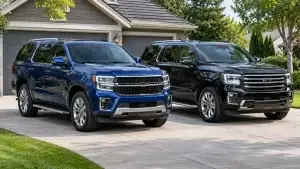

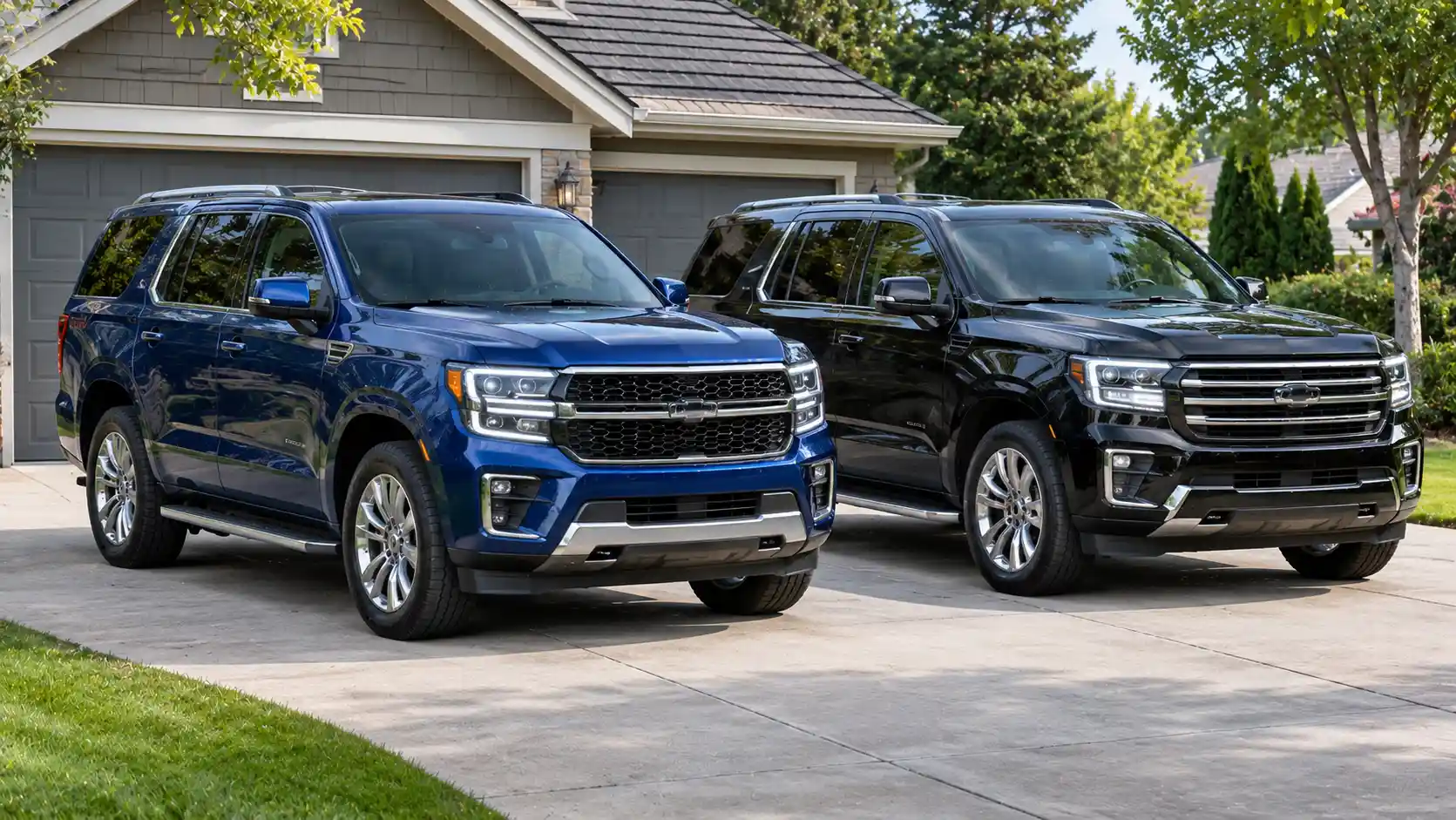
The redesigned Ford Expedition wins overall for most buyers in 2026, with more power, more towing, a plusher cabin, and a roomier, reclining third row. But the Chevy Tahoe genuinely beats it on raw cargo space, a nine-seat option, and an efficient Duramax diesel the Expedition cannot offer, and Chevy’s reliability scores run higher.
So Ford Expedition or Chevy Tahoe? Choose the Expedition for towing, comfort, and tech, and the Tahoe for maximum cargo, a diesel, more seats, or a stronger reliability record. This comparison sits under our wider Ford vs Chevy guide.
2026 Ford Expedition vs Chevy Tahoe specs
Here is the head-to-head on the 2026 models.
| Spec (2026) | Ford Expedition | Chevy Tahoe |
|---|---|---|
| Base engine | 3.5L EcoBoost twin-turbo V6 | 5.3L V8 |
| Base power | 400 hp, 480 lb-ft | 355 hp, 383 lb-ft |
| Other engines | High-output V6 (440 hp, 510 lb-ft) | 6.2L V8, 3.0L Duramax diesel (305 hp, 495 lb-ft) |
| Transmission | 10-speed automatic | 10-speed automatic |
| Max towing | Up to 9,600 lbs | Up to 8,400 lbs |
| Cargo behind 3rd row | 21.6 cu ft | 25.5 cu ft |
| Cargo behind 2nd row | 60.8 cu ft | 72.5 cu ft |
| Max cargo | 108.5 cu ft | 122.7 cu ft |
| Seating | Up to 8 | Up to 9 |
| Length / wheelbase | About 210 in / 122.5 in | About 211.3 in / 120.9 in |
| Fuel economy | About 18 to 19 mpg combined | About 16 to 17 mpg gas, up to 24 diesel |
| Starting MSRP | From about $57,700 | From about $60,700 |
| Warranty | 3 yr/36,000 mi, 5 yr/60,000 mi powertrain | 3 yr/36,000 mi, 5 yr/60,000 mi powertrain |
The split is clear right away. The Expedition hits harder on power and towing, while the Tahoe holds more cargo, seats one more person, and offers a fuel-sipping diesel the Ford cannot match.
Engines and performance
The two take very different paths to power. Every Expedition uses a 3.5-liter twin-turbo EcoBoost engine, making 400 horsepower and 480 lb-ft in standard tune and 440 horsepower and 510 lb-ft in the high-output version. That turbo torque arrives early and pulls hard, which helps with towing and passing.
The Tahoe gives you choice. The base 5.3-liter V8 makes 355 horsepower, a 6.2-liter V8 steps up to 420 horsepower, and a 3.0-liter Duramax diesel makes 305 horsepower and a strong 495 lb-ft while returning far better fuel economy. Buyers who love a V8 rumble, or who want diesel efficiency, only find that in the Chevy.
Verdict: The Expedition’s standard engine is more powerful and feels gutsier, a win for Ford. But the Tahoe’s three-engine lineup, including the efficient diesel, gives it more variety. Pick the Expedition for the strongest standard engine, the Tahoe if you want a V8 or a diesel.
Towing
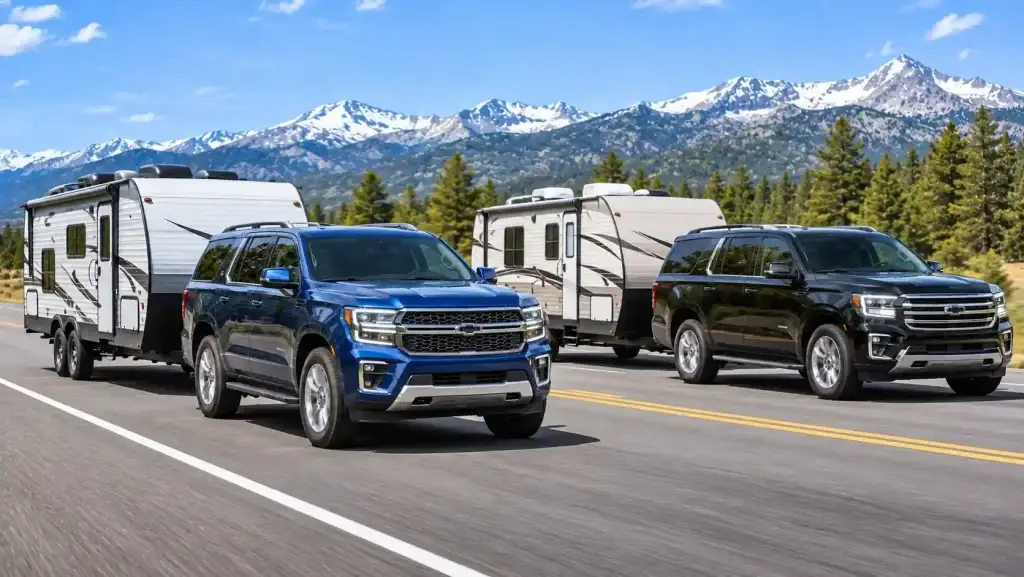
Can a Ford Expedition tow 10,000 pounds? Not quite. The 2026 Expedition is rated to tow up to 9,600 pounds when you add 4×4 and the Heavy-Duty Trailer Tow Package, so it lands just under the 10,000-pound mark. Be careful with older listings that quote 9,300 pounds, which was the previous generation.
The Tahoe tops out at 8,400 pounds, so the Expedition out-tows it by about 1,200 pounds. For a big boat or a heavy travel trailer, that gap can matter.
Verdict: The Expedition wins towing clearly. If pulling heavy loads is your main job, it is the stronger choice of the two.
Size and dimensions
Which is bigger, the Tahoe or the Expedition? They are very close, but the Tahoe is slightly larger outside. The Tahoe measures about 211.3 inches long and 81 inches wide, while the Expedition is about 210 inches long and 79.9 inches wide. The Expedition rides on a marginally longer 122.5-inch wheelbase, which helps its interior room.
In person you would struggle to tell them apart in a parking lot, and both are large enough to need a full-size garage spot. If you want even more length, each brand offers a stretched version, the Expedition MAX and the Chevy Suburban, covered further down. Verdict: The Tahoe is a touch bigger outside, the Expedition uses its wheelbase well inside. Call exterior size a narrow Tahoe win.
Passenger space and the third row

Both seat a crowd, but they do it differently. The Expedition seats up to 8 and focuses on comfort, with a roomy third row that offers about 36.5 inches of legroom and even reclines. Edmunds found the Expedition’s second row the more comfortable of the two, and the reclining third row is a real perk for adults on long trips.
The Tahoe answers with seating for up to 9 when you choose the front bench, one more than the Expedition can hold. That extra seat matters for big families and carpools, even if the Tahoe’s third row is a bit tighter on legroom.
Verdict: The Expedition wins third-row comfort and reclining seats, the Tahoe wins on total headcount with its nine-seat option. Pick by whether you value a comfier third row or one more seat.
Cargo space
This is a clear Tahoe win, so let us give Chevy its due. The Tahoe holds up to 122.7 cubic feet of cargo with the rear seats folded, 72.5 cubic feet behind the second row, and 25.5 cubic feet behind the third. That is a lot of room for luggage, gear, and big-box hauls.
The standard Expedition offers 21.6 cubic feet behind the third row, 60.8 cubic feet behind the second row, and 108.5 cubic feet maximum. Those are generous numbers, but across the board the Tahoe simply swallows more.
Verdict: The Tahoe wins cargo space at every configuration. If maximum hauling room is your top priority, the Chevy is the better box. The Expedition closes the gap only if you step up to the longer Expedition MAX.
Interior, tech and driver assistance
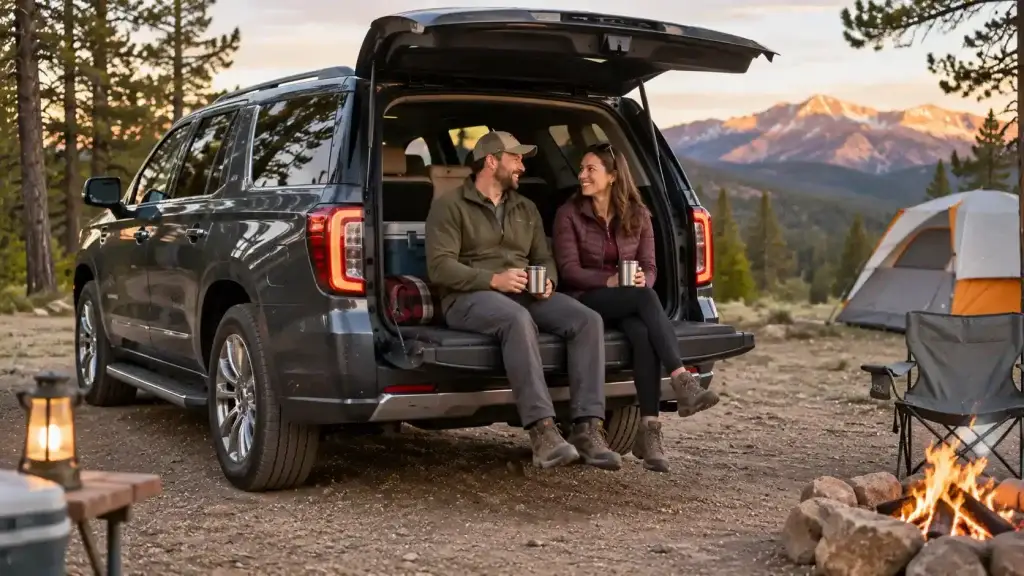
The fully redesigned Expedition shows its newness inside. Reviewers praise its upscale cabin materials and large, easy-to-use screens, and it offers Ford’s available Split Gate, a split tailgate that makes a handy seat or load stop at a campsite or tailgate party.
The Tahoe was refreshed last year with a revamped interior and new tech, and it is roomy and practical, though some reviewers find its newest infotainment still has a few kinks. Both SUVs offer excellent hands-free highway driving systems: Ford’s BlueCruise and Chevy’s Super Cruise, which works on roughly 700,000 miles of North American roads but costs extra on the Tahoe.
Verdict: The Expedition edges ahead on cabin feel, screen usability, and the clever split tailgate. The Tahoe’s tech is strong too, and Super Cruise is superb, just priced as an add-on. Give interior and tech a slight Ford win.
Off-road trims: Expedition Tremor vs Tahoe Z71
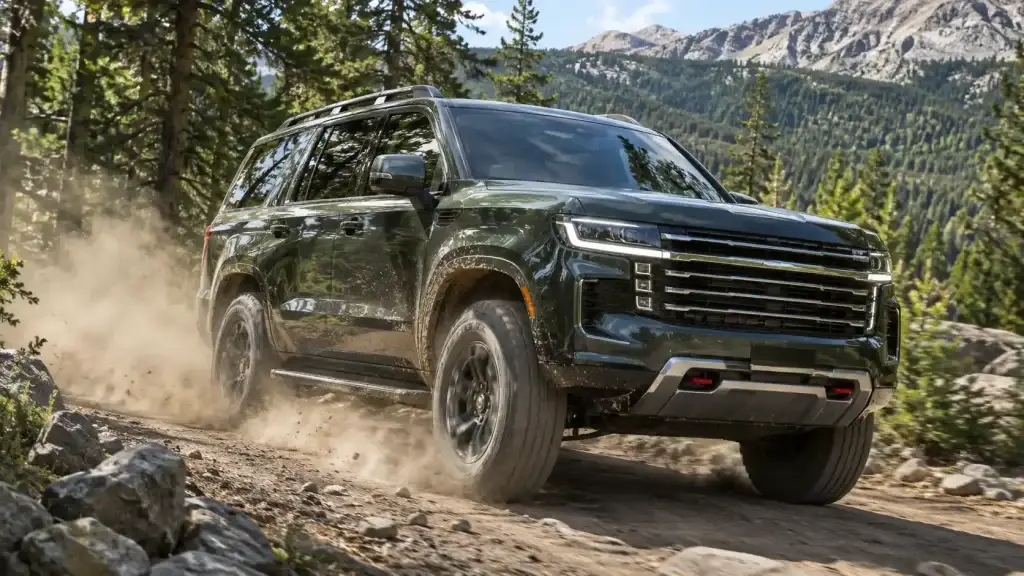
Both brands build a trail-ready version of their big SUV. The Expedition Tremor is the Ford off-roader, pairing the high-output 440-horsepower V6 with off-road suspension, all-terrain tires, and skid protection for confident dirt-road and light-trail duty.
The Tahoe Z71 brings a 2-inch factory lift feel, off-road suspension, a two-speed transfer case, and rugged styling, and it has long been a capable big-SUV trail trim. Verdict: Close. The Tremor has the power edge thanks to its high-output engine, while the Z71 is a proven, well-rounded off-roader. Either will handle far more than most owners ever ask of a full-size SUV.
Reliability and common problems
Ford Expedition vs Chevy Tahoe reliability tilts toward the Chevy, and fairness means saying so. The Auto Reliability Index scores the Tahoe ahead of the Expedition, about 72 to 61. Consumer Reports predicts the 2026 Expedition will be less reliable than the average new car, based on the previous generation’s data, and J.D. Power’s recent studies also give the edge to the Tahoe.
The Expedition’s history is the main reason. Earlier 3.5-liter EcoBoost V6s were known for cam phaser problems and other issues, which you can read about in our guide to 3.5 EcoBoost problems. A quick note on older generations: if you are cross-shopping a used 2021 Ford Expedition vs Chevy Tahoe, check that specific model year’s reliability record closely, since both have had strong and weak years.
Verdict: On predicted reliability, the Tahoe wins across the major sources. The redesigned Expedition is a nicer vehicle in many ways, but it has to prove itself over time, so factor that in if long-term dependability is your top concern.
Price, trims and resale value
Pricing is close at the bottom and high at the top for both. The Ford Expedition opens around $57,700 and climbs through Active, Platinum, Tremor, and King Ranch past $84,000. The Chevy Tahoe starts near $60,700 in base form and runs up through LT, Z71, and High Country, also topping $80,000.
So the base Expedition actually undercuts the base Tahoe, though well-equipped Expeditions tend to run expensive, landing close to a GMC Yukon. On resale value, full-size Chevy SUVs have a long reputation for holding their money well, and the Tahoe tends to score at or above the Expedition on retained value.
Verdict: The Expedition can be cheaper to get into, but the Tahoe’s strong resale and simpler base pricing keep Chevy competitive on long-term value.
Expedition MAX vs Suburban
If even these big SUVs are not big enough, both brands sell a long-wheelbase version. The Expedition MAX stretches the wheelbase by almost ten inches, which boosts cargo to about 123 cubic feet maximum, though it adds room behind the third row rather than more third-row legroom. The MAX starts around $61,825.
The Chevy Suburban is the longer, even roomier choice and the cargo champ of the pair, seating up to nine and offering more maximum cargo than the Expedition MAX, starting near $66,495. In an Expedition MAX vs Suburban matchup, the MAX brings the Expedition’s newer design and strong towing, while the Suburban brings the most sheer space and a diesel option. This one could fill a whole comparison of its own.
Where the GMC Yukon and Toyota Sequoia fit
Two more full-size SUVs belong in this shopping list. The GMC Yukon is the Tahoe’s upscale twin, sharing its engines, including the Duramax diesel, but with more luxury and a higher price, from around $69,600. If you like the Tahoe but want a plusher cabin, the Yukon is the Chevy family’s step up.
The Toyota Sequoia takes a different path with a standard i-Force Max hybrid powertrain, giving it strong towing and better fuel economy than the gas V8s here, though its third row and cargo area are tighter. In an Expedition vs Sequoia or Expedition vs Yukon decision, the Expedition counters with its roomier, reclining third row and modern cabin.
Which should you buy?
Match the SUV to your priority.
Towing. Expedition. Its 9,600-pound max beats the Tahoe’s 8,400 by a clear margin.
Big family. Tahoe, if you need the ninth seat. Expedition, if you want the comfier, reclining third row for eight.
Cargo. Tahoe. It holds more at every row, and the Suburban holds even more.
Diesel. Tahoe. Only the Chevy offers the efficient 3.0-liter Duramax, so if diesel range matters, the Expedition is out.
Budget. A split. The base Expedition can cost a bit less to get into, but the Tahoe’s resale and simpler pricing help long-term value.
Luxury. Expedition for its newer, plusher cabin, or step up to a GMC Yukon on the Chevy side.
The bottom line is that the Expedition is the stronger all-around pick for towing, comfort, and tech, while the Tahoe earns clear wins on cargo, seating, diesel, and reliability. Want more head-to-heads? See our Ranger vs Colorado comparison for the midsize truck fight.
Frequently asked questions
Can a Ford Expedition tow 10,000 lbs?
Not quite. The 2026 Expedition is rated to tow up to 9,600 pounds with 4×4 and the Heavy-Duty Trailer Tow Package, which is just under 10,000 pounds but still more than the Tahoe.
Which Tahoe should you stay away from?
Recent Tahoes are solid, but as with any SUV, be cautious with the first model year of a redesign and check that exact year’s complaint and recall record before buying used.
Which SUV is more reliable, Ford or Chevy?
By current predicted-reliability scores from sources like the Auto Reliability Index, Consumer Reports, and J.D. Power, the Tahoe edges out the Expedition. Still, reliability varies by model year, so check the specific one you want.
What are the biggest complaints about Ford Expeditions?
The most common historical gripes trace to the 3.5-liter EcoBoost V6, especially cam phaser issues on earlier model years. Our guide to 3.5 EcoBoost problems explains what to watch for.