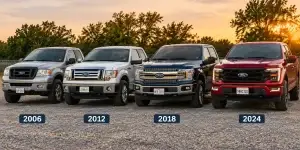

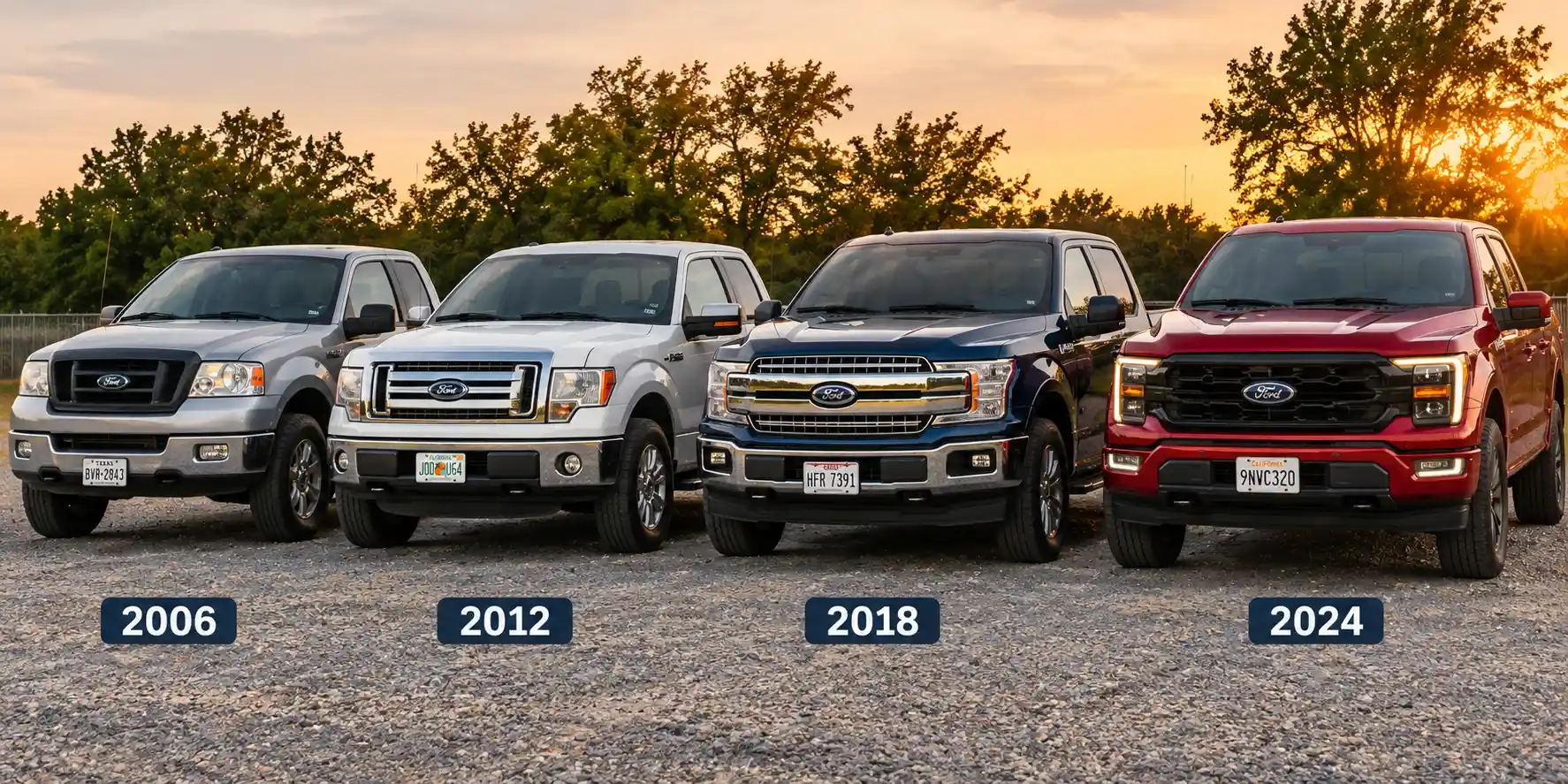
Ask five people for the best year of F-150 and you’ll get five answers, and most of them will be right for a different truck. The F-150 has been built with half a dozen engines, three transmissions and two body materials since 2004, so the year matters less than the year and the engine.
This guide rates every model year from 2004 to 2026, compares what the biggest sources say (including where they disagree), and tells you which engines to choose or avoid. Then it covers the best year for your budget and how you’ll use the truck.
Quick answer: The best years for Ford F-150 are 2009, 2014 and 2019–2020, with 2018 and 2022 and newer close behind. The F-150 years to avoid are 2004–2006 (5.4L Triton spark plug and cam phaser problems), 2017 with the 3.5L EcoBoost, and the 2021 launch year, especially the PowerBoost hybrid. The engine matters as much as the year: a 5.0L V8 or a later 2.7L EcoBoost is the safest bet in most years.
Best and Worst F-150 Years: What the Top Sources Say
No two sources agree completely. Here’s where they line up and where they don’t.
| Model year | Google AI Overview* | CarGurus (Jul 2026) | RealTruck (Apr 2026) | Owners and dealers** | Our verdict |
|---|---|---|---|---|---|
| 2004–2006 | Caution | Skip | Avoid | — | Avoid |
| 2007–2008 | Caution | Better, still Triton concerns | 2008 Best | — | Good (with records) |
| 2009 | Best | — | Best | Pettijohn: recommended | Best |
| 2010 | Caution | — | Avoid | — | Caution |
| 2011–2012 | — | EcoBoost reliable | 2011 Avoid | — | Good (5.0L) |
| 2013 | Caution | Transmission problems | Avoid | — | Caution |
| 2014 | — | Reliable across the board | Best | Pettijohn: recommended | Best |
| 2015–2016 | Best | 2016 electrical issues | Avoid | Reddit: 2015–2017 with 2.7L/5.0L | Caution |
| 2017 | Best | 3.5L EcoBoost and transmission issues | Best | Reddit: favored with 2.7L/5.0L; Pettijohn: recommended | Good (avoid 3.5L) |
| 2018–2019 | Best | Most reliable 13th-gen years | — | — | 2018 Good / 2019 Best |
| 2020 | Best | — | Best ever | Pettijohn: recommended | Best |
| 2021 | — | Several documented problems | Best | — | Caution |
| 2022 | — | — | Best | Pettijohn: recommended | Good |
| 2023–2026 | — | Newest you can afford | — | Pettijohn: 2024, 2026 | Good |
*Google’s AI Overview changes often. This column reflects what it showed in November 2026. **Owner views from Reddit r/f150 and the recommendations of Pettijohn Ford of Trenton, a dealer, as summarized at time of writing.
The pattern is clear even where sources disagree: launch years and early 5.4L Triton trucks are the riskiest, and the last years of each generation are the safest. Where sources clash, as with 2015–2017 and 2021, the engine and transmission in the specific truck usually explain why.
Ford F-150 Reliability by Year: Every Generation Rated
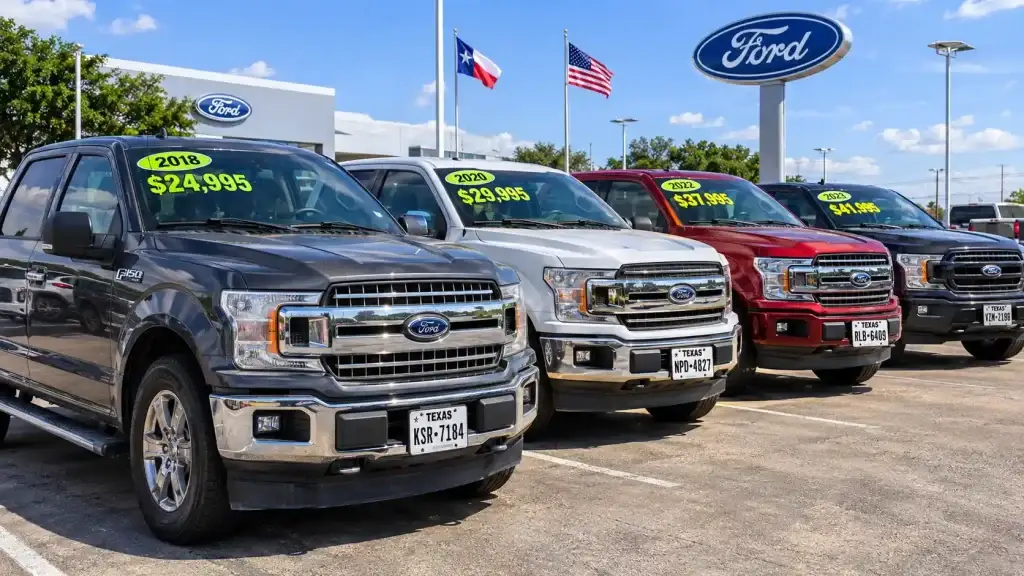
11th generation (2004–2008)
A big redesign with a stiffer frame and a nicer cabin, powered mostly by the 4.6L and 5.4L Triton V8s with three valves per cylinder (3V) and a four-speed automatic. The 5.4L 3V defines this generation’s reputation.
| Year | Verdict | Why |
|---|---|---|
| 2004 | Avoid | First year of the 3V Triton; most complaints of any F-150 year per CarComplaints; spark plug and cam phaser problems |
| 2005 | Avoid | Same engine issues; spark plugs, coils and misfires |
| 2006 | Avoid | Engine issues plus fuel and brake complaints, per CarGurus |
| 2007 | Good (with records) | Better than 2004–2006, but still the 3V Triton |
| 2008 | Good (with records) | Most refined year; engines built from October 2007 got one-piece spark plugs |
12th generation (2009–2014)
New body, more upscale cabins and, from 2011, a new engine lineup: the 5.0L Coyote V8, 3.5L EcoBoost, 3.7L V6 and 6.2L V8, with the 6R80 six-speed automatic.
| Year | Verdict | Why |
|---|---|---|
| 2009 | Best | Strong first year; 5.4L 3V with improved spark plugs; few complaints |
| 2010 | Caution | Last year of the old engines; more complaints than 2009 |
| 2011 | Good (5.0L) / Caution (3.5L) | New 5.0L Coyote is tough; early 3.5L EcoBoost has timing chain and condensation issues; downshift recall |
| 2012 | Good | Mature first-gen EcoBoost and 5.0L; check the downshift recall |
| 2013 | Caution | Six-speed transmission problems; included in the downshift recall |
| 2014 | Best | Most refined 12th-gen year; CarGurus calls it reliable across the board |
2011 F150 5.0 reliability: the first-year Coyote V8 has held up well, and it’s the safer pick over the first-year EcoBoost. 2013 F150 5.0 reliability: the engine is solid; the risk in 2013 is the transmission, so confirm recall 19S07 was done. 2014 Ford F150 reliability: the best of the 12th generation, and a 2014 F150 5.0 is one of the safest used F-150 picks if it has service records.
13th generation (2015–2020)
The aluminum-body F-150. Engines were the 2.7L and 3.5L EcoBoost, 5.0L V8 and a base V6 (3.5L, then 3.3L from 2018). The 10R80 ten-speed arrived with the 3.5L EcoBoost for 2017 and spread to most engines for 2018.
| Year | Verdict | Why |
|---|---|---|
| 2015 | Caution | First aluminum year; first 2.7L EcoBoost; launch-year bugs |
| 2016 | Caution | Electrical issues, per CarGurus |
| 2017 | Good (2.7L/5.0L) / Avoid (3.5L) | New second-gen 3.5L EcoBoost and first 10R80; owners favor 2.7L/5.0L trucks with the six-speed |
| 2018 | Good | Refresh; standard backup camera; but 5.0L oil consumption and 10R80 harsh shifting |
| 2019 | Best | Most early bugs fixed; strong CarGurus marks |
| 2020 | Best | Final 13th-gen year; RealTruck’s pick for best F-150 ever |
2018 Ford F150 reliability: a good truck overall, but the 2018 F150 5.0 reliability story includes excessive oil consumption (Ford TSB 19-2365), and CarComplaints ranks 2018 as its worst F-150 year because of engine complaints. Check oil use before you buy. 2019 Ford F150 reliability: one of the best years, after Ford’s early 10-speed shift updates. The 5.0L oil consumption bulletin still covers 2019, so check oil use on a V8. 2020 Ford F150 reliability: the most polished 13th-gen year. The 2020 F150 5.0 is still covered by the oil consumption bulletin, so the same check applies.
14th generation (2021–2026)
A new cab and interior, the PowerBoost hybrid, Pro Power Onboard generator and, from 2022, the Lightning EV. All gas models use the 10-speed.
| Year | Verdict | Why |
|---|---|---|
| 2021 | Caution | Launch year; PowerBoost complaints; 2.7L intake valve recall (24V-635); rear axle bolt recall |
| 2022 | Good | Fewer bugs; check the valve and axle recalls |
| 2023 | Good | Settled design; some trucks covered by the rear axle bolt recall |
| 2024 | Good | Refresh; some recalls (check by VIN) |
| 2025 | Good | Too new to judge long term |
| 2026 | Good | Too new; last year before the 3.0L EcoBoost replaces the 2.7L for 2027 |
Best years for Ford F150 2022 and newer: if your budget reaches the 14th generation, a 2022 or later avoids the worst launch-year issues. Best years for Ford F150 hybrid: skip the 2021 PowerBoost if you can; a 2023 or newer has had more time for fixes.
Ford F-150 Years to Avoid (and What Went Wrong)
What year F-150 to avoid depends on the engine as much as the badge on the tailgate. Here’s what went wrong with each risky year or range.
2004–2006: the 5.4L Triton 3-valve years
The redesigned 2004 introduced the 5.4L 3-valve Triton V8, and it’s the main reason these years top most avoid lists. The 3V engines used a two-piece spark plug that often seized in the head and broke during removal, turning a routine tune-up into a costly extraction job. Ford’s service bulletin covers 5.4L 3V engines built before October 2007. The same engines are known for cam phaser and timing chain noise, often called the “Triton tick” or death rattle, which gets worse with skipped oil changes.
The 2004 also has the most complaints of any F-150 model year per CarComplaints, many about power windows. CarGurus adds engine misfire and exhaust problems for 2005 and fuel and brake complaints for 2006.
Note: the 2004 F-150 Heritage was a carryover of the older truck with the 2-valve engine, so it doesn’t share the 3V plug problem.
2010: the outgoing year
The 2010 was the last year of the old 4.6L and 5.4L engines in this body. It isn’t a disaster, but it draws far more NHTSA complaints than the 2009, and RealTruck and Google’s AI Overview both flag it. If you’re shopping 12th-gen trucks, a 2009 or a 2011–2014 with the 5.0L is the better buy.
2011–2013: the six-speed downshift recall
Ford recalled about 1.5 million 2011–2013 F-150s with the 6R80 six-speed (recall 19S07, 2019) because the transmission could suddenly downshift into first gear. That could cause a loss of control. The fix is a software update, so confirm it was done. CarGurus specifically flags the 2013 for slipping, unexpected downshifts and rough shifts.
The first-generation 3.5L EcoBoost in these years also has known timing chain stretch and intercooler condensation issues. That’s why the 5.0L is the safer engine for 2011–2013.
2015–2016: aluminum launch years
The first aluminum-body trucks brought new tech and new bugs. RealTruck lists both years to avoid for engine, brake and door-latch issues, and CarGurus flags 2016 for electrical problems, including backup cameras and power steering assist. NHTSA also investigated 2015–2017 F-150s for unexpected downshifts. They’re not bad trucks, but a 2018–2020 is the better buy if the budget stretches.
2017 with the 3.5L EcoBoost
2017 was the first year of the second-generation 3.5L EcoBoost and the 10R80 ten-speed. CarGurus reports the 3.5L in 2017 trucks was prone to coolant leaks and overheating, and Ford issued TSBs for harsh or delayed shifts on 2017 10R80 trucks. The second-gen 3.5L is also the engine most associated with cam phaser rattle, which Ford addressed with a bulletin and an extended-coverage program that has now ended. Phaser repairs commonly run $2,500 to $4,500 or more out of warranty. A 2017 with the 5.0L or 2.7L and the six-speed is a different, safer truck.
2018–2020 with the 5.0L: check the oil
These aren’t years to avoid, and 2019–2020 are among the best. But some 2018–2020 5.0L trucks burn excessive oil. Ford’s bulletin 19-2365 describes more than a quart per 3,000 miles with no visible leaks, and a class action (Lyman v. Ford) is ongoing. A well-maintained Coyote is still a great engine; just check the oil level and ask about consumption.
2021: the redesign year
The 14th-gen launch year carries the most baggage of the modern trucks:
- PowerBoost hybrid complaints: loss of power, hybrid battery and drivetrain faults on 2021–2022 trucks.
- 2.7L intake valve recall: 2021–2022 trucks with 2.7L or 3.0L engines built May–October 2021 (recall 24V-635).
- Rear axle hub bolt recall: 2021–2023 trucks with certain equipment.
With the recalls done, a 2021 can be fine, but a 2022 or newer is the lower-risk choice.
Most Reliable F-150 Engines (and the Ford F-150 Engines to Avoid)
For most buyers, picking the right engine matters more than picking the perfect year. Every turbocharged F-150 engine since 2011 is an EcoBoost engine, and each one has its own track record.
| Engine | Years in F-150 | Verdict | Watch for |
|---|---|---|---|
| 5.4L Triton V8 (3-valve) | 2004–2010 | Avoid 2004–2006 | Two-piece spark plugs that break; cam phasers; timing chain noise |
| 5.0L Coyote V8 | 2011–2026 | Most reliable overall | Oil consumption on 2018–2020 trucks |
| 3.5L EcoBoost V6 | 2011–2026 | Good in the right years | Timing chains (2011–2016); cam phasers (2017–2020) |
| 2.7L EcoBoost V6 | 2015–2026 | Good, especially 2018+ | Oil pan leaks (2015–2017); valve recall (2021–2022) |
| 3.3L V6 | 2018–2020 | Reliable but basic | Modest power for towing |
| 3.5L PowerBoost hybrid | 2021–2026 | Caution on 2021–2022 | Loss of power, hybrid system faults, coolant loss on early trucks |
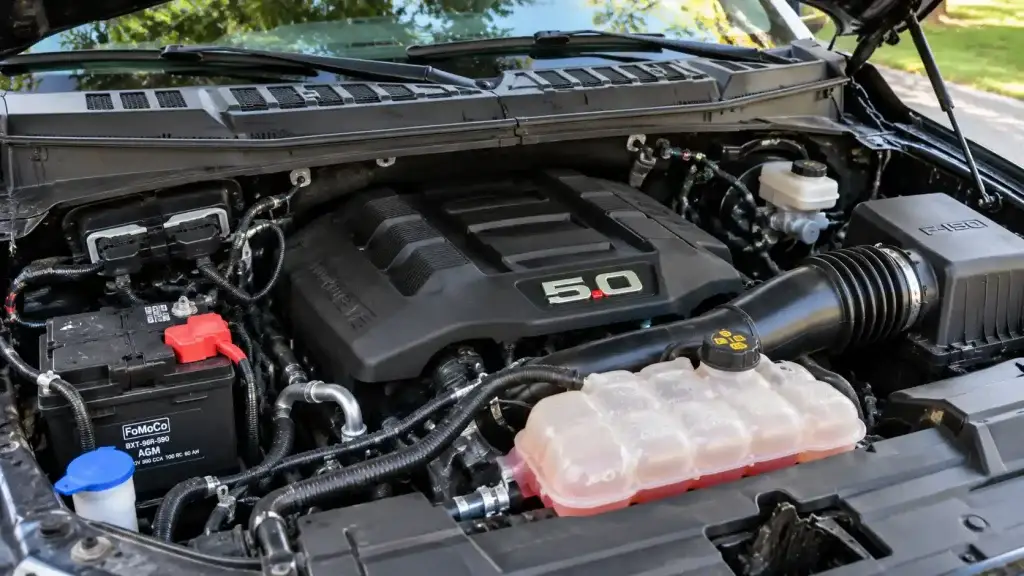
5.0L Coyote V8: the most reliable F-150 engine
The naturally aspirated 5.0L V8 is the engine most mechanics and owners point to as the most reliable F-150 engine. It has no turbos to fail, a simpler cooling and intake system, and a long track record in both the F-150 and the Mustang. The third-generation Coyote (2018 on) added dual injection (port plus direct), which reduces carbon buildup.
The weak spot is oil consumption on some 2018–2020 trucks, covered by Ford bulletin 19-2365. Check the dipstick, ask how often it’s topped up and look for a record of the bulletin repair.
3.5L EcoBoost: strong, but year-sensitive
The 3.5L twin-turbo V6 is the towing favorite, but its history splits by generation. First-gen trucks (2011–2016) can suffer timing chain stretch and intercooler condensation misfires. Second-gen trucks (2017–2020) are known for cam phaser rattle at cold start, a repair that commonly costs $2,500 to $4,500 or more. Third-gen trucks (2021 on) have the best record so far. Our full guide to 3.5 EcoBoost problems breaks it down year by year.
2.7L EcoBoost: the sleeper pick
The smaller twin-turbo V6 has quietly become one of the most reliable F-150 engines. Early 2015–2017 versions are known for oil pan leaks, and some 2021–2022 trucks built from May to October 2021 are under an intake valve recall (24V-635), but second-gen 2018 and newer engines are well regarded. See our 2.7 EcoBoost reliability guide for the details. Ford is replacing the 2.7L with a 3.0L EcoBoost as the standard F-150 engine for 2027.
3.3L V6: the simple work-truck engine
The 3.3L V6 in 2018–2020 base trucks has a reputation as a simple, low-drama engine, paired with the six-speed automatic. It’s the right choice for fleet and light-duty buyers. It’s the wrong choice if you tow regularly, because it’s the least powerful option.
5.4L Triton 3-valve: the one to avoid
This is the engine behind most “years to avoid” lists. Two-piece spark plugs that break during removal (engines built before October 2007), plus cam phaser and timing chain problems, make 2004–2006 trucks with the 5.4L a gamble. If you must buy one, insist on records showing new plugs, regular oil changes and any phaser or timing work.
PowerBoost hybrid: great features, early growing pains
The PowerBoost pairs the 3.5L EcoBoost with an electric motor for 430 hp and 570 lb-ft, plus Pro Power Onboard generator power. Owners of 2021–2022 trucks have reported loss of power, hybrid system faults and coolant loss (Ford issued bulletins for trucks built on or before April 18, 2022). A 2023 or newer PowerBoost is the safer buy.
Ford F-150 engines to avoid, in short: the 2004–2006 5.4L Triton, a 2017 3.5L EcoBoost without phaser records, and an early 2021 PowerBoost.
Best Year for Ford F-150 by Budget
Prices vary widely with mileage, trim and cab, so treat these as starting points. Averages are from CarGurus’ July 2026 market data.
- Under $15,000: 2009 or 2011–2014 with the 5.0L. Many 12th-gen trucks sell for $10,000 or less, according to CarGurus. A 2014 5.0L is the top pick, and a 2009 is the best value if you can find a clean one. Avoid 2004–2006 even if the price is tempting.
- $15,000 to $30,000: 2018–2020. 13th-gen averages run from about $18,000 for a 2015 to about $29,300 for a 2020, per CarGurus. Spend up for a 2019 or 2020 if you can. Choose the 5.0L (check oil use), the 2.7L, or a 3.5L with phaser records.
- $30,000 and up: 2022 or newer. CarGurus puts the average 2021 at about $33,900, the 2022 at about $38,800 and the 2023 at about $43,500. A 2022 or 2023 avoids the 2021 launch-year bugs at a modest premium.
The best years for Ford F-150 to buy on a budget are usually the last year or two of a generation, because the early problems have been fixed and prices have already dropped.
Best Year for Ford F-150 by Use
- Towing: a 3.5L EcoBoost (2021 or newer, or an earlier one with records) or the 5.0L V8, with the factory towing packages. For heavy trailers, the 10-speed (2018 on for most engines) and Pro Trailer Backup Assist on newer trucks are worth having. Always check the specific truck’s towing rating on the door-jamb sticker and in Ford’s towing guide.
- Daily driving: a 2018 or newer 2.7L EcoBoost balances power and fuel economy. A 2023 or newer PowerBoost is the most efficient choice and adds the onboard generator.
- Off-road: an FX4 package truck, a Tremor (2021 on) or a Raptor. Mechanically, apply the same year and engine rules as above; off-road packages don’t fix a bad engine year.
- Best resale value: trucks with the 5.0L V8 or 3.5L EcoBoost in popular trims (XLT, Lariat) tend to be easiest to sell later.
Used F-150 Buying Checklist
Even the best year can be a bad truck if it was neglected. Run through this list before you buy.
- Run the VIN through the NHTSA recall lookup and Ford’s recall lookup. Confirm the big ones are done: the 2011–2013 downshift recall (19S07), the 2.7L valve recall (24V-635) and the axle bolt recall on 2021–2023 trucks.
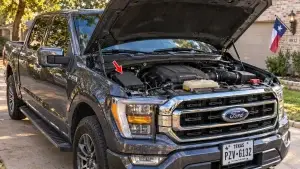
- Listen to a cold start. A rattle for a few seconds on a 3.5L EcoBoost or 5.4L Triton points to cam phasers or timing chains.
- Check the oil level and ask about consumption, especially on a 2018–2020 5.0L.
- Ask for spark plug records on a 2004–2008 5.4L. If the original two-piece plugs are still in, budget for a careful (and possibly costly) plug job.
- Test the transmission. Look for harsh or delayed shifts on 10-speed trucks and sudden downshifts on 2011–2013 six-speeds.
- Look under the truck for rust on the frame, brake lines and rocker panels, especially on steel-body trucks from salt-belt states.
- Check every electrical feature: backup camera, SYNC screen, power windows and 4×4 engagement. If something is dead, a blown fuse is the cheapest possible cause. Our F-150 fuse box diagram shows where to look for every generation.
- Check for towing wear: a worn hitch, sagging rear springs or a transmission cooler that’s been working hard.
- Get a pre-purchase inspection from an independent shop, including a scan for stored codes.
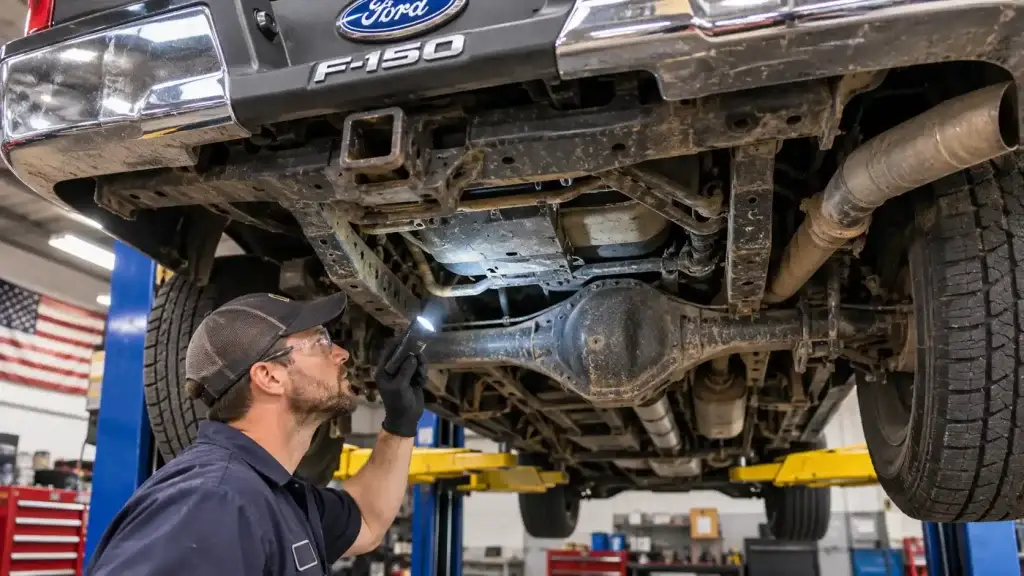
If you plan to do your own maintenance on a 13th-gen truck, a Ford F-150 2015–2020 workshop manual covers factory procedures and specs for jobs like spark plugs, cooling system work and transmission service.
Best Years for F-150: FAQs
What is the most reliable F-150 year?
The most reliable F-150 years are 2009, 2014, 2019 and 2020, with 2018 and 2022 and newer also strong. For the most reliable Ford F-150 overall, pair one of those years with the 5.0L V8 or a 2018-or-newer 2.7L EcoBoost.
Is the Ford 2.7 or 5.0 more reliable?
Both are among the most reliable F-150 engines. The 5.0L V8 is simpler, with no turbos, and has the longer track record, which makes it the safer bet overall. Its main issue is oil consumption on some 2018–2020 trucks. The 2.7L EcoBoost is quicker and more fuel efficient. Avoid early 2015–2017 versions with oil pan leaks and check the 2021–2022 valve recall.
What are the different generations of Ford F-150s?
The F-Series dates back to 1948, and the F-150 name arrived for the 1975 model year. The generations most used-truck shoppers see are:
- 10th generation: 1997–2003, plus the 2004 F-150 Heritage
- 11th generation: 2004–2008
- 12th generation: 2009–2014
- 13th generation: 2015–2020, the aluminum body
- 14th generation: 2021–present
What year to avoid on the 3.5 EcoBoost?
The 3.5 EcoBoost years most worth avoiding without records are 2011–2013 (timing chain stretch and intercooler condensation) and 2017–2019 (cam phaser rattle). The 2021 and newer engines have the best record.
What is the best month to buy a Ford F-150?
December is widely cited as the best month to buy a new truck, because dealers push to hit year-end sales goals and clear out the outgoing model year. For used trucks, iSeeCars’ data shows January and December have the most deals. The last days of any month or quarter are also good times to negotiate.
Are F150s reliable?
Yes, in the right year and with the right engine. The F-150 has some well-documented problem years, but the late years of each generation, and trucks with the 5.0L V8 or a later 2.7L EcoBoost, have strong records. Maintenance history matters as much as the model year.
What do Reddit owners say are the best years for Ford F150?
On r/f150, owners often favor 2015–2017 trucks with the 2.7L or 5.0L and the six-speed automatic, avoiding the early 10-speed. As with any forum, opinions vary widely, so pair them with recall and complaint data for the specific truck you’re looking at.