
The Ford Escape was one of America’s best-selling compact SUVs for a quarter century, so the used market is packed with them. That’s good news for prices and bad news for the unprepared, because the gap between a great Escape and a money pit is mostly about which year, and which engine, you pick.
This guide ranks every Ford Escape model year from 2001 to 2026 using NHTSA owner-complaint data, recall records and Ford’s own service bulletins. You’ll get the Ford Escape years to avoid, the best years to buy, the engine to choose and a checklist to use before you hand over any money.
Quick answer: The Ford Escape years to avoid are 2008, 2009, 2013, 2014, 2017 (especially with the 1.5L EcoBoost) and 2020. The best Ford Escape years to buy used are 2012, 2019, 2022 and 2023–2026, with the 2011 and a late-build 2018 or 2019 as solid budget picks. Whatever the year, confirm every recall is done and the coolant level is stable before you buy.
The Escape ran for four generations: the first gen (2001–2007), second gen (2008–2012), third gen (2013–2019) and fourth gen (2020–2026). Ford ended production in December 2025, and 2026 is the final model year.
Ford Escape Problems by Year: Every Model Year Ranked
| Year | Gen | NHTSA complaints* | Verdict | Main reason |
|---|---|---|---|---|
| 2001 | 1 | 795 | Avoid | First year; stuck-throttle recall on V6; rust; fire reports |
| 2002 | 1 | 816 | Avoid | Most first-gen fire reports; transmission failures |
| 2003 | 1 | 486 | Caution | Old; V6 stuck-throttle recall; rust |
| 2004 | 1 | 428 | Caution | Better than 2001–2002; still old |
| 2005 | 1 | 1,305 | Avoid | Refresh year; transmission and engine failures |
| 2006 | 1 | 616 | Caution | Transmission failures common around 84,000 miles |
| 2007 | 1 | 322 | Good buy (budget) | Fewest first-gen complaints |
| 2008 | 2 | 2,091 | Avoid | Steering recall; transmission; most second-gen complaints |
| 2009 | 2 | 1,507 | Avoid | Electric power steering failures |
| 2010 | 2 | 1,841 | Caution | Steering and speed control complaints |
| 2011 | 2 | 1,184 | Good buy (with recall done) | Mature second gen; steering recall covers it |
| 2012 | 2 | 528 | Good buy | Best second-gen year; proven 2.5L |
| 2013 | 3 | 2,587 | Avoid | 1.6L fire recalls; stalling; transmission |
| 2014 | 3 | 2,000 | Avoid | Transmission failures; most fire reports of any year |
| 2015 | 3 | 1,107 | Caution | OK with 2.5L or 2.0L; transmission still a concern |
| 2016 | 3 | 1,155 | Caution | Similar to 2015; check coolant |
| 2017 | 3 | 2,648 | Avoid (1.5L) | Most complaints of any year; coolant intrusion |
| 2018 | 3 | 1,792 | Caution | Early builds share the coolant problem |
| 2019 | 3 | 582 | Good buy | Late builds got the coolant fixes |
| 2020 | 4 | 1,526 | Avoid | Redesign year; many recalls |
| 2021 | 4 | 347 | Caution | Far fewer complaints, but 2020’s recalls apply |
| 2022 | 4 | 233 | Good buy | Low complaints; check recall completion |
| 2023 | 4 | 99 | Good buy | Refresh year; very few complaints |
| 2024 | 4 | 76 | Good buy | Fewest complaints on record |
| 2025 | 4 | Too new | Good buy | Too new to judge fully |
| 2026 | 4 | Too new | Good buy | Final model year |
*NHTSA owner complaints per ForCar’s count of NHTSA data, November 2026. These are raw counts, not adjusted for sales, so high-volume years naturally collect more. Read them as patterns, not failure rates.
Ford Escape Years to Avoid
These are the worst Ford Escape years, with what went wrong, the recalls involved and what repairs typically cost.
2008 Ford Escape: steering and transmission
The first year of the second generation drew 2,091 NHTSA complaints, the most of any second-gen year. The headline problem is the electric power steering (EPAS): the steering torque sensor can fail and suddenly remove power assist, making the SUV very hard to steer at low speed. Ford recalled 740,878 Escapes and Mercury Mariners from 2008 to 2011 for this under NHTSA campaign 14V-284 (Ford 14S05).
The 2008 also carried over a four-speed automatic with a history of failures, and owners report body rust around the rear wheel wells and subframe in salt-belt states.
Cost if the recall doesn’t cover it: steering repairs outside the recall can run well into four figures because the fix often means a new steering column or gear. A transmission replacement typically costs $3,000 or more.
2009 Ford Escape: power steering failures
The 2009 got a new 2.5L four-cylinder and a six-speed automatic, which helped, but it shares the 2008’s power steering defect. Steering is by far the top 2009 complaint category with NHTSA. Some owners report the recall software update didn’t prevent a later failure, so ask whether the steering parts were actually replaced or only reprogrammed.
2013 Ford Escape: the worst redesign year
The all-new third-generation Escape had a rough launch. The 2013 drew 2,587 NHTSA complaints and 90 fire reports. The 1.6L EcoBoost was recalled several times in its first year: for a fuel line that could split (12V-336), a cylinder head cup plug that could pop out and dump coolant (12V-431), coolant leaks that could cause overheating and fire (12V-551), and a cylinder head that could overheat and crack (13V-583).
The 2013 Ford Escape transmission is the other weak spot. The 6F35 six-speed automatic can slip, shift harshly or fail outright. Owners also report stalling, “Engine Fault Service Now” messages and sudden power loss.
Is the 2013 Ford Escape reliable? Not compared with the years around it. If you’re considering one, it needs every recall completed, no history of overheating and documented transmission service.
Typical repair costs: a replacement transmission for a 2013 Escape runs roughly $4,900 to $7,000 at a shop, according to Kelley Blue Book’s fair repair range.
2014 Ford Escape: transmission failures and fire reports
The 2014 has fewer complaints than the 2013 (2,000), but CarComplaints rates it the worst Escape year because its problems are expensive and arrive early. The top trend is the 2014 Ford Escape transmission stopping working at around 70,000 to 84,000 miles, with an average repair cost of about $4,200. Kelley Blue Book puts a full replacement at roughly $5,100 to $6,700.
The 2014 also has the most fire reports of any Escape year (102). A recall (17V-209) covered 1.6L engines whose cylinder heads could crack and leak oil onto hot parts if the engine ran low on coolant.
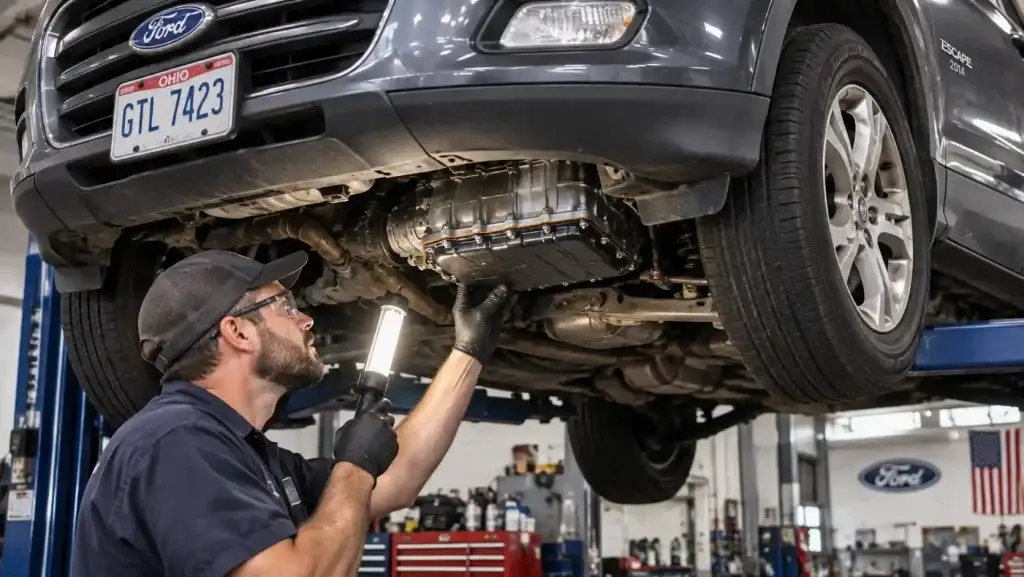
2014 Ford Escape reliability, in short: avoid it unless the transmission has already been replaced with documentation, and only consider the 2.5L or 2.0L engine.
2017–2019 Ford Escape: it depends on the engine
The 2017 refresh brought new engines, and its complaint count (2,648) is the highest of any Escape year. But the story is different for each engine, so don’t judge these three years as a block.
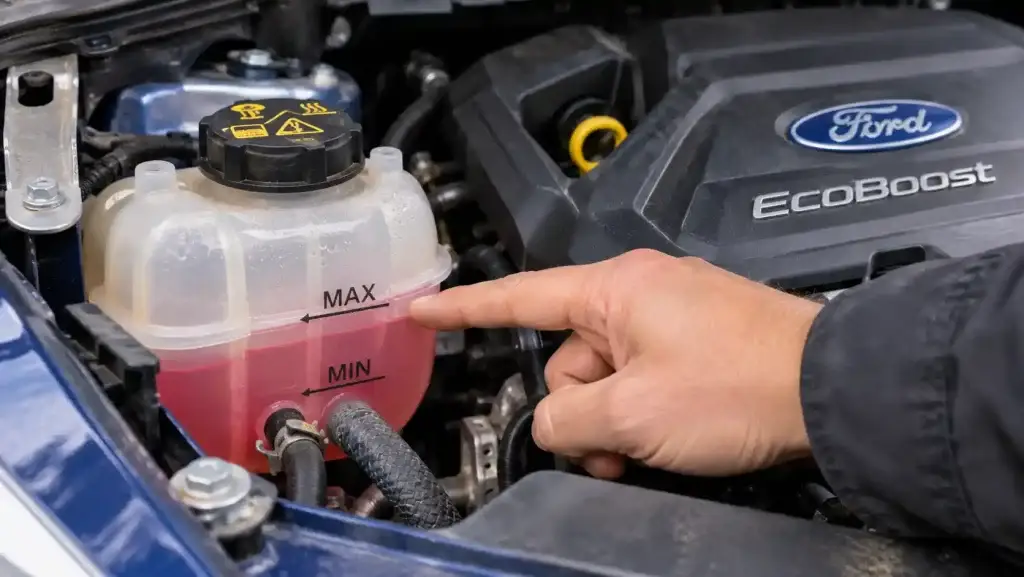
- 1.5L EcoBoost (2017–2019): the problem engine. Coolant can leak into the cylinders, causing low coolant, white exhaust smoke, misfires and eventually engine failure. Ford’s bulletin 19-2139 covers 2017–2019 Escapes built on or before April 6, 2019, and the fix is a new short block. Ford’s program 21N12 covers that repair for 7 years or 84,000 miles from the original warranty start date, which has expired for most 2017–2018 models but may still apply to some 2019s. Ask a dealer to check the VIN.
- 2.0L EcoBoost (2017–2019): Ford has a separate bulletin for coolant entering the cylinders on 2017–2019 Escapes with the 2.0L built on or before May 16, 2019. It’s less common than on the 1.5L, but check for it.
- 2.5L (base S trim, 2017–2019): naturally aspirated, no turbo and no coolant intrusion pattern. The simplest third-gen engine.
All 2013–2019 Escapes with the six-speed automatic are also covered by shifter cable bushing recalls (18V-471 and 22V-413), because a detached bushing can leave the vehicle in a different gear than the shifter shows.
2017 Ford Escape reliability: the 2017 is the year to avoid with a 1.5L engine. A 2.5L or a 2.0L with documented coolant checks is a different, much safer buy.
2018 Ford Escape reliability: better than 2017 (1,792 complaints), but early builds carry the same 1.5L and 2.0L coolant risk.
2019: complaints drop sharply to 582. A 2019 built after April 6 (1.5L) or May 16 (2.0L) has the production fix for coolant intrusion, making a late-build 2019 one of the best third-gen buys.
Repair cost: an engine or short block replacement after coolant intrusion typically costs $4,000 to $7,000 or more out of warranty.
2020 and 2021 Ford Escape: redesign-year recalls
The fourth-generation Escape launched for 2020 with a new 1.5L three-cylinder, an 8-speed automatic and new hybrid and plug-in hybrid models, and a long list of recalls:
- Fuel injector cracking (1.5L, 2020–2023): an injector can crack and leak fuel onto the hot engine, creating a fire risk. Ford recalled about 522,000 Escapes and Bronco Sports (22V-859) and issued follow-ups (24V-187, 25V-165 and 25V-467).
- Oil separator housing cracks (1.5L, 2020–2022): an oil leak that can reach hot exhaust parts (22V-191).
- Hybrid engine failure fire risk (2020–2023): if the 2.5L hybrid engine fails, oil and fuel vapor can ignite (22V-484, about 100,700 vehicles, plus 23V-380 and 25V-345).
- High-voltage battery failures (2020–2024 hybrids): sudden loss of drive power (22V-149 and 24V-954).
The 2020 drew 1,526 NHTSA complaints. The 2021 drew only 347, which is why we rate it Caution rather than Avoid: it shares the recalls, but owners report far fewer problems. With every recall completed, a 2021 is a reasonable buy.
Other years to avoid: 2001, 2002 and 2005
The earliest Escapes are now 20-plus years old, and most buyers should pass. The 2001–2004 V6 was recalled (12V-353, about 423,600 vehicles) because the cruise control cable could interfere with the engine cover and hold the throttle wide open. The 2001 and 2002 have high fire-report counts, and the 2005 refresh brought a spike in transmission and engine failures.
Best Ford Escape Years to Buy Used
The best Ford Escape years combine low complaint counts with known fixes already in place. Here are the picks by budget.
- 2023–2026: the most reliable Ford Escape years. The 2023 refresh brought the fewest complaints on record (99 for 2023, 76 for 2024), and the injector and battery recalls have had time to be completed. If budget allows, the most reliable Ford Escape year is a 2023 or newer. The 2026 is the final model year of the Escape.
- 2022: best value fourth gen. Only 233 complaints, all the fourth-gen tech, and prices that have already dropped. Confirm the injector recall is complete.
- 2019: best third gen, especially a late build. Complaints fall to 582, and engines built after the coolant fix dates (April 6, 2019 for the 1.5L, May 16, 2019 for the 2.0L) have the updated design. A 2.0L 2019 is a strong all-rounder.
- 2012: best budget pick. The last and most refined second-gen year, with the simple 2.5L four-cylinder, a six-speed automatic and just 528 complaints. Check for rust.
- 2011: solid budget pick. Similar to the 2012, with the steering recall needing to be confirmed complete.
- 2007: best first gen, for very tight budgets. It has the fewest first-gen complaints (322), but it’s now nearly 20 years old, so condition matters far more than the badge.
In short, the best year for a Ford Escape depends on your budget: 2023 or newer if you can stretch, a 2022 or late-build 2019 for value, and a 2012 if you want something cheap and simple. Browse our Ford Escape guides for model-specific details.
Ford Escape Reliability by Generation
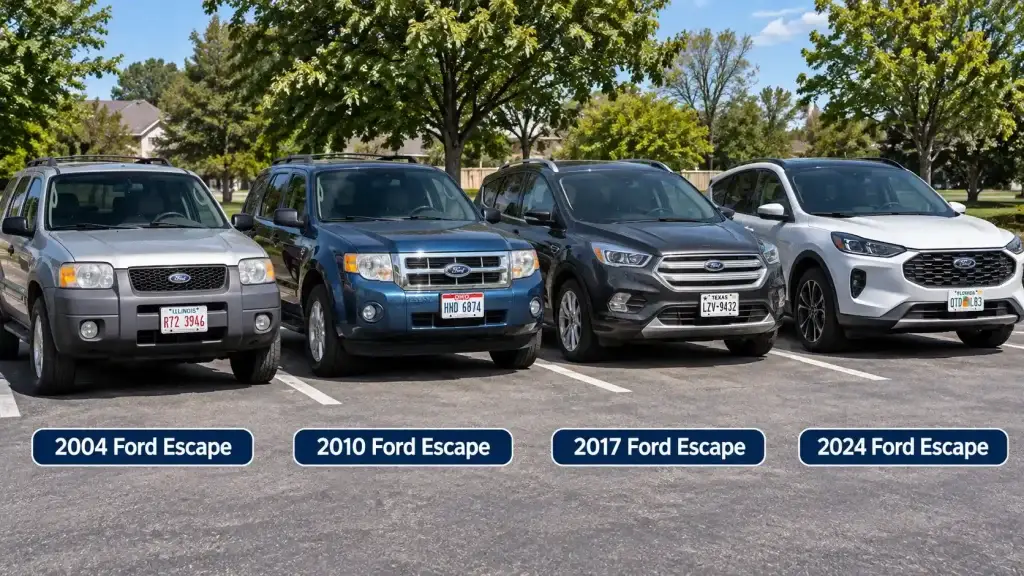
First generation (2001–2007)
The original boxy Escape, co-developed with Mazda (as the Tribute), offered a 2.0L or 2.3L four-cylinder and a 3.0L Duratec V6. Its known problems are automatic transmission failures (common on V6 models, often around 80,000 to 90,000 miles), the 2001–2004 V6 stuck-throttle recall, rust on the rear subframe and wheel wells, and early fire reports. A hybrid version arrived in 2005, one of the first hybrid SUVs. Today these are cheap, high-mileage vehicles best bought on condition.
Second generation (2008–2012)
A restyled body on the same basic platform. The 2008 kept the four-speed automatic; 2009 brought the 2.5L Duratec four-cylinder and a six-speed automatic, which improved reliability. The big weakness is the electric power steering (EPAS) on 2008–2011 models, covered by recall 14V-284. Rust is the other issue to check. By 2011–2012, the second gen had matured into one of the most dependable Escapes.
Third generation (2013–2019)
A modern, car-like Escape with turbocharged EcoBoost engines (1.6L and 2.0L at first, then 1.5L and 2.0L from 2017), plus a naturally aspirated 2.5L in base trims. This generation has the most complaints overall. The causes are the 1.6L overheating and fire recalls (2013–2014), 6F35 transmission failures (worst on 2013–2014) and coolant intrusion on the 1.5L and 2.0L EcoBoosts (worst on 2017–2018). Late 2019 models are the best of the bunch.
Fourth generation (2020–2026)
A lighter, more efficient Escape with a 1.5L three-cylinder EcoBoost, a 2.0L EcoBoost, an 8-speed automatic, and hybrid and plug-in hybrid models with an e-CVT. The 2020 launch year brought recalls for fuel injectors, oil separators, hybrid engine failures and high-voltage batteries. Complaints fell steadily from 2021 on, and 2023–2026 models have the cleanest records of any Escape.
Which Ford Escape Engine to Choose (and Which to Avoid)
On a used Escape, the engine often matters more than the model year. Here’s how each one stacks up.
| Engine | Years | Verdict | Why |
|---|---|---|---|
| 2.5L Duratec I4 (non-turbo) | 2009–2019 | Choose | Simple, proven, no turbo or coolant intrusion pattern |
| 2.0L EcoBoost I4 | 2013–2026 | Choose with checks | Strong and smooth; Ford coolant bulletin covers 2017–2019 builds before May 16, 2019, and lawsuits name 2013–2019 |
| 1.5L EcoBoost I4 | 2017–2019 | Avoid unless repaired | Coolant intrusion; short block replacement common |
| 1.6L EcoBoost I4 | 2013–2016 | Avoid | Overheating, cracked heads and fire recalls |
| 1.5L EcoBoost I3 | 2020–2026 | OK with recalls done | Fuel injector and oil separator recalls |
| 2.5L hybrid / plug-in hybrid | 2020–2026 | Choose (with recalls done) | Excellent mpg; engine-failure fire and battery recalls on 2020–2024 |
| 3.0L V6 | 2001–2012 | Caution | Old; transmission failures on first-gen V6 models |
What is EcoBoost, and why does it matter here?
Every turbocharged Escape engine since 2013 is an EcoBoost: a turbocharged, direct-injection gasoline engine that makes more power from less displacement. If you want to understand what that means for long-term ownership, our explainer on the EcoBoost engine covers how it works and which versions have the best track records.
The short version for Escape shoppers: the 2.0L EcoBoost is the best turbo choice, the 1.5L four-cylinder (2017–2019) and 1.6L (2013–2016) are the ones to avoid, and the non-turbo 2.5L is the low-risk pick if you don’t need the extra power.
If you’re keeping a third-gen Escape and doing your own maintenance, a Ford Escape 2013–2019 workshop manual gives you factory repair procedures and wiring diagrams for the third-generation Escape. It’s useful for jobs like checking for coolant leaks or servicing the cooling system.
Hybrid and plug-in hybrid
The fourth-gen Escape Hybrid and Plug-In Hybrid use a 2.5L Atkinson-cycle four-cylinder and an e-CVT, with no turbo and no conventional automatic transmission to fail. They’re the most fuel-efficient Escapes. The catch is a set of 2020–2024 recalls for engine-failure fire risk and high-voltage battery cells, so confirm every one is closed. The original 2005–2012 Escape Hybrid is now old enough that its battery health is the deciding factor.
Ford Escape Recalls: How to Check and the Biggest Ones
The Escape has been part of dozens of recall campaigns across its 26 model years, so checking the specific vehicle matters more than knowing the model’s history. Recall repairs are free at any Ford dealer, no matter how old the vehicle is or how many owners it has had.
How to check a Ford Escape for recalls by VIN
- Find the 17-digit VIN on the driver’s side of the dashboard, on the driver’s door jamb sticker or on the registration.
- Enter it at the NHTSA recall lookup. Open recalls show as “Recall Incomplete.”
- Check Ford’s recall lookup as well. It also shows Ford customer satisfaction programs and extended coverage, such as the 21N12 coolant program, which won’t appear on NHTSA’s site.
- If you’re buying from a dealer, ask for a printout showing every recall as completed.
For more on how recalls and service programs work, see our Ford recall guides.
The biggest Ford Escape recalls
| Recall | Years | Problem |
|---|---|---|
| 12V-353 | 2001–2004 (V6) | Cruise control cable can hold the throttle open; about 423,600 vehicles |
| 14V-284 | 2008–2011 | Electric power steering assist can fail; 740,878 Escapes and Mariners |
| 12V-336, 12V-431, 12V-551, 13V-583 | 2013 (1.6L) | Fuel line split, coolant loss, overheating, cracked head; fire risk |
| 17V-209 | 2014 (1.6L) | Cylinder head can crack if run low on coolant; fire risk |
| 18V-471, 22V-413 | 2013–2019 | Shifter cable bushing can detach; vehicle may roll away |
| 22V-191 | 2020–2022 (1.5L) | Oil separator housing can crack and leak oil |
| 22V-859 + follow-ups | 2020–2023 (1.5L) | Fuel injector can crack and leak fuel; about 522,000 Escapes and Bronco Sports |
| 22V-484, 23V-380, 25V-345 | 2020–2023 hybrids | Engine failure can release oil and fuel vapor that may ignite |
| 22V-149, 24V-954 | 2020–2024 hybrids | High-voltage battery failure; loss of drive power |
Is there a class action lawsuit against the Ford Escape?
Yes. Owners have filed class actions alleging that the 1.5L, 1.6L and 2.0L EcoBoost engines in 2013–2019 Escapes (and other Ford and Lincoln models) let coolant leak into the cylinders, causing overheating, cracked heads and engine failure. In 2025 the cases were consolidated into a single class action in California, and a separate class action covers the 2.3L EcoBoost in other models. These are allegations, not court findings, and no settlement had been announced that we could confirm as of November 2026. Owners have also brought suits over the 6F35 transmission; a mass action over that transmission was dismissed.
Used Ford Escape Buying Checklist
Use this list on any used Escape, whatever the year. It takes about 20 minutes and can save you thousands.
- Run the VIN through NHTSA and Ford’s recall lookup, and confirm every recall shows as complete.
- Check the coolant cold. On a 2013–2019 EcoBoost, the reservoir should be at the full line. A low reservoir with no visible leak is the classic sign of coolant intrusion.
- Look for white exhaust smoke at a cold start, and for a sweet coolant smell from the tailpipe.
- Ask for service records, especially oil changes and any engine, short block or transmission replacement invoices.
- Test the transmission. Drive from a stop several times and on the highway. Slipping, flare between gears, harsh 1–2 or 2–3 shifts, or a “Transmission Fault” message on a 2013–2016 model are red flags.
- Watch for “Engine Fault Service Now.” It can mean anything from a weak battery to a misfire or coolant intrusion, so have the codes read before you buy.
- Check the steering on a 2008–2012. Any “Power Steering Assist Fault” message or heavy steering at parking speeds means the EPAS needs attention.
- Inspect for rust on 2001–2012 models, especially the rear subframe, rear wheel wells and rocker panels in salt-belt states.
- On a hybrid, scan for hybrid-system codes and confirm it drives in EV mode.
- Get a pre-purchase inspection from an independent shop, including a cooling-system pressure test on EcoBoost models.
- Consider an extended warranty on a 2013–2020 EcoBoost, given the cost of an engine or transmission replacement.
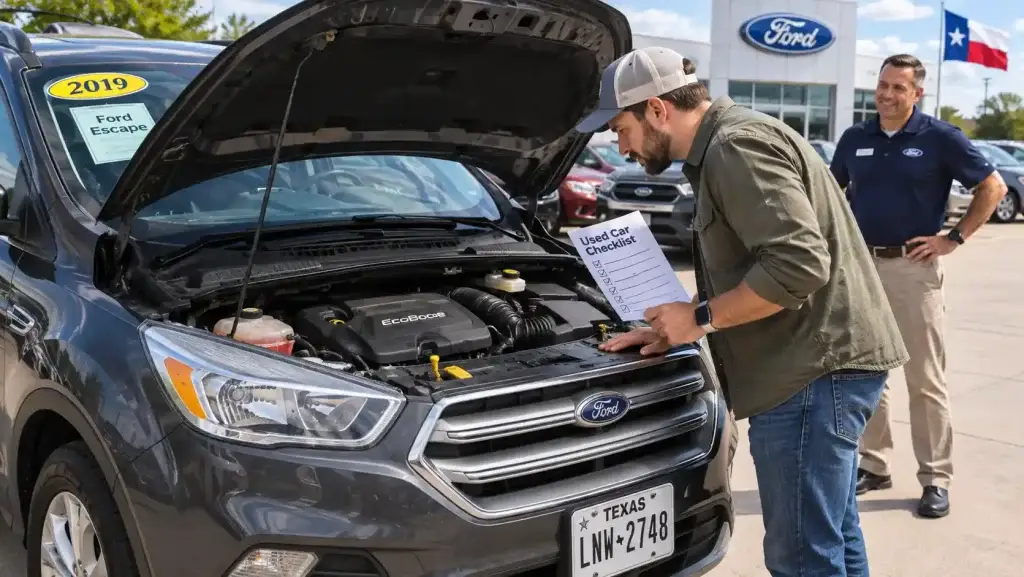
For more pre-purchase advice on other models, see our used Ford buyer’s guides.
Ford Escape Years to Avoid: FAQs
What is a bad year for Ford Escape?
The worst Ford Escape years are 2008, 2009, 2013, 2014, 2017 (with the 1.5L EcoBoost) and 2020. The 2013 and 2014 are the most notorious, with 1.6L EcoBoost fire recalls and 6F35 transmission failures, and the 2017 has the most NHTSA complaints of any year.
Is there a class action lawsuit against Ford Escape?
Yes. Class actions allege that the 1.5L, 1.6L and 2.0L EcoBoost engines in 2013–2019 Escapes let coolant leak into the cylinders. The cases were consolidated in California in 2025. They’re allegations, not findings, and no settlement had been confirmed as of November 2026.
Is the 2015 Ford Escape reliable?
The 2015 Ford Escape is reasonably reliable compared with the 2013–2014, with about half the NHTSA complaints (1,107). Choose the 2.5L or 2.0L engine over the 1.6L, confirm the shifter bushing recall is done and test the transmission carefully, since the 6F35 can still fail at higher mileage.
Is a 2010 Ford Escape a reliable vehicle?
A 2010 Ford Escape can be reliable if the power steering recall (14V-284) was completed and the body is free of serious rust. It uses the durable 2.5L four-cylinder or 3.0L V6 with a six-speed automatic. It has more complaints than the 2011–2012, mostly about steering, so a 2011 or 2012 is the safer second-gen choice.
What is the most reliable Ford Escape year?
The most reliable Ford Escape years are 2023, 2024 and 2025, which have the fewest NHTSA complaints. On a budget, the 2012 and a late-build 2019 are the most reliable older choices.
What does “Engine Fault Service Now” mean on a Ford Escape?
“Engine Fault Service Now” means the engine computer has detected a fault serious enough to flag immediately, sometimes putting the engine into reduced-power mode. Common causes include a weak battery or charging problem, misfires, failing sensors and, on 2013–2019 EcoBoost models, coolant intrusion. Have the trouble codes read before driving far.
Should you avoid the 2021 and 2022 Ford Escape?
Not necessarily. The 2021 (347 complaints) and 2022 (233) have far fewer complaints than the 2020 (1,526). They share the 1.5L injector and hybrid recalls, so buy one only with every recall completed.
What do owners on Reddit say about Ford Escape years to avoid?
On Reddit and the Ford Escape Forum, owners most often warn about 2013–2019 EcoBoost models, especially the 1.5L and 2.0L in 2017–2019, because of coolant intrusion. That matches Ford’s own coolant bulletins for those engines.
Is Ford still making the Escape?
No. Ford ended Escape production at its Louisville, Kentucky, plant in December 2025, and the 2026 model is the last. The plant is being retooled for electric vehicles.